 English
 Español
FTCB 15 Flat Tinned Copper Braided Tape for High-Current Flexible Connections
Modern electrical systems increasingly require conductors that combine high current capacity with mechanical flexibility. Conventional rigid copper bars provide excellent conductivity, but they can transmit vibration, resist movement, and place stress on terminals and connected components. Ordinary round wires are flexible, but they may occupy more installation space, provide a smaller contact area, or require complex routing when used in compact power assemblies. Flat copper braided tape addresses these limitations by combining a wide contact surface, low electrical resistance, flexible movement, and effective vibration absorption.
FTCB 15 is a flat tinned copper braided tape developed for electrical installations, switchgear, electric furnaces, battery systems, energy-storage equipment, electric vehicles, industrial controls, and other high-current applications. Its braided construction is formed from fine annealed copper wires, while the tinned surface improves resistance to oxidation and supports more reliable long-term contact performance. The product is available in multiple cross-sectional areas and can be supplied in continuous 25-meter packaging for efficient installation and production use.
This article examines the construction, performance, manufacturing strengths, application value, technical options, and customization potential of FTCB 15. It also explains why a flat tinned braided conductor can be a more practical alternative to rigid busbars, unplated copper braid, and conventional flexible cable in demanding electrical connection environments.
1. Product Overview
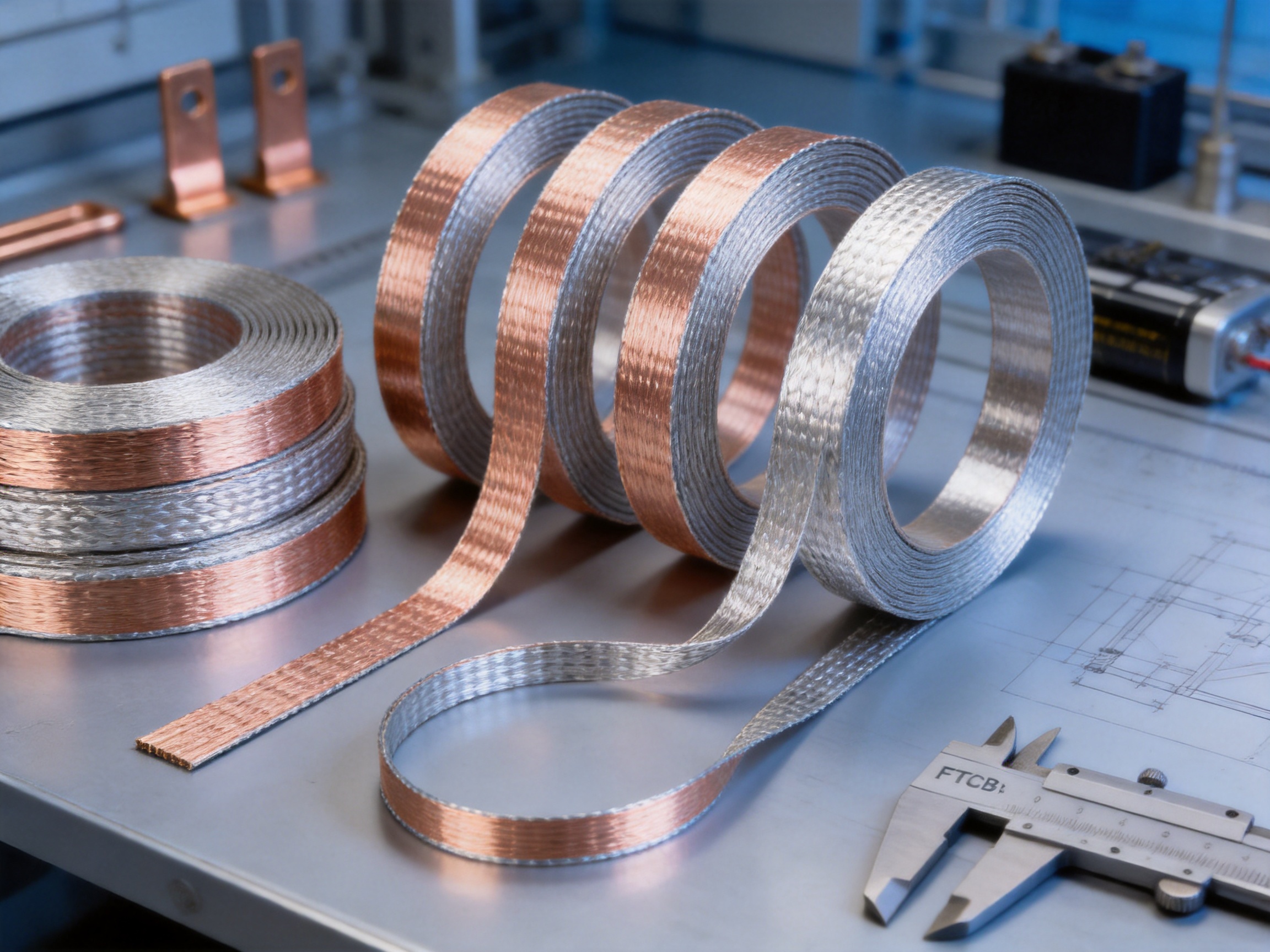
FTCB 15 is a flat flexible conductor made by braiding multiple fine copper wires into a compact, ribbon-like structure. The base material is annealed Cu-ETP copper, commonly associated with C11000 copper, with a copper content of at least 99.95 percent. The fine wires are arranged in carriers and woven according to the requirements of flexible braided conductors. The resulting product has a broad, low-profile shape that can be bent, compressed, and routed through limited spaces.
The standard product is supplied with a tinned copper finish. Tin plating creates a protective surface over the copper wires and helps reduce the effects of oxidation, humidity, salt exposure, and industrial contamination. It also improves solderability where soldered terminations or solder-assisted assembly processes are required. Depending on the application, other finishes, including bare copper, nickel plating, and silver plating, may be available as customized options.
The product family includes sizes from 3 mm² to 100 mm². These sizes support applications ranging from compact grounding links and control-cabinet connections to heavy-current battery and power-distribution assemblies. The tape can be used as a bare conductor or supplied with optional PVC or TPE insulation when additional protection against accidental contact, abrasion, chemicals, or environmental exposure is required.
Unlike a flat stamped copper bar, FTCB 15 is not a rigid component. Its braided structure allows controlled movement in several directions and provides relief from mechanical stress. Unlike a round flexible cable, its flat geometry creates a larger surface area for terminal contact and enables a lower installation height. This combination is particularly valuable in battery packs, switchgear, power converters, and systems where components expand, contract, or vibrate during operation.
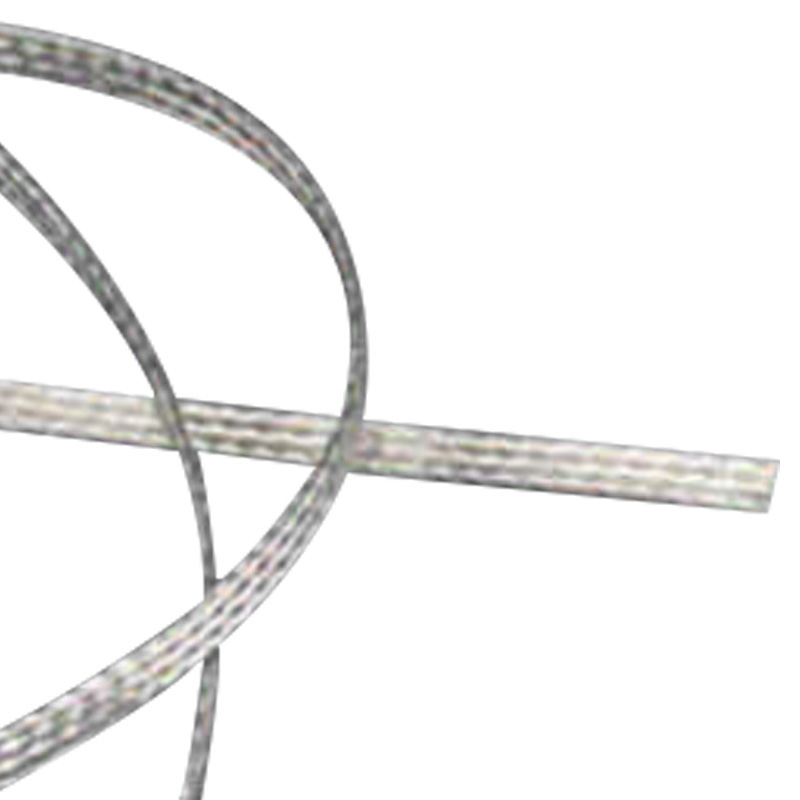
FTCB 15 Flat Tinned Copper Braided Tape
2. Construction and Material Selection
2.1 High-Purity Copper Conductors
The electrical performance of a flexible braid begins with the quality of its copper wire. FTCB 15 uses T2 or Cu-ETP copper, with a stated copper content of at least 99.95 percent. High-purity copper provides low electrical resistance and supports efficient power transmission. Lower resistance helps reduce voltage drop, power loss, and heat generation in high-current circuits.
For battery modules and power-electronic assemblies, conductor resistance is a critical design factor. Even a small increase in resistance can cause additional heat when current flows continuously through the connection. At high current, the relationship between current and resistive loss becomes especially important because power loss increases according to the square of current. Selecting a high-conductivity copper conductor therefore supports improved thermal performance and energy efficiency.
The use of annealed copper wire is also important. Annealing softens the material and improves bendability without changing the fundamental conductivity benefits of copper. Fine annealed wires can move relative to one another within the braid, allowing the complete tape to accommodate bending and vibration more effectively than a solid strip.
2.2 Fine-Wire Braided Structure
The product can be manufactured using single wire diameters such as 0.05 mm, 0.07 mm, 0.10 mm, 0.12 mm, 0.127 mm, 0.15 mm, 0.20 mm, 0.25 mm, and 0.254 mm. The selected wire diameter influences flexibility, mechanical strength, surface texture, and the overall construction of the braid.
Fine wires create many individual bending points. Instead of forcing one large conductor to flex at a single location, the braided tape distributes movement across numerous small copper filaments. This reduces localized stress concentration and helps the conductor tolerate repeated movement. The braid can also absorb a portion of mechanical vibration before that vibration reaches sensitive terminals, battery tabs, semiconductor assemblies, or busbar supports.
Carrier numbers may include 13, 16, 24, 32, 36, 40, 48, 64, and 96, depending on the required construction. In production, carrier selection, wire diameter, braid density, and final cross-sectional area are coordinated to achieve the required electrical and mechanical characteristics. A design that prioritizes maximum flexibility may use a different braid arrangement from one designed for high mechanical strength or maximum current capacity.
2.3 Tinned Surface
The tin-plated finish is one of the principal differences between FTCB 15 and an ordinary bare copper braid. Bare copper offers excellent conductivity, but its surface can gradually oxidize when exposed to air, moisture, salts, chemicals, or industrial pollutants. Oxidation may increase contact resistance and make termination surfaces more difficult to solder or maintain.
Tin plating provides a more stable external surface. It helps protect the copper from direct environmental exposure and supports more consistent contact performance over the service life of the assembly. The coating is especially useful in battery systems, renewable-energy equipment, transportation equipment, and industrial environments where humidity and contamination may be present.
The tin surface also supports solderability. While not every FTCB 15 installation requires soldering, solderable surfaces can simplify certain terminal, tab, electronic, and grounding assembly processes. For customers using crimped, bolted, welded, or soldered terminations, the correct surface finish can be selected according to the complete connection design.
Tin plating is not intended to eliminate the need for proper connection engineering. Terminal pressure, contact area, bolt torque, surface preparation, insulation clearance, and environmental sealing remain important. However, the tinned finish provides a strong foundation for reliable contact design and offers a practical balance between performance, cost, and availability.
3. Flat Geometry and Electrical Performance
The flat profile of FTCB 15 creates a broad contact area compared with a conductor of similar cross-sectional area in a round configuration. This can simplify connections to flat terminals, copper plates, battery tabs, inverter terminals, and equipment grounding points. It can also reduce the height required for a connection, which is valuable in compact battery packs and electrical enclosures.
A wider conductor can distribute current across a larger interface when correctly installed. It can also promote heat transfer to nearby metal surfaces, terminal blocks, or busbar supports. The actual current-carrying capability depends on many factors, including ambient temperature, installation orientation, ventilation, contact resistance, duty cycle, insulation, terminal design, and permissible temperature rise.
The FTCB 15 product range includes nominal current values from approximately 30 A to 360 A for the listed configurations. These values should be treated as reference data rather than universal design limits. The correct rating must be verified for the specific installation, including continuous current, short-duration surge current, temperature, enclosure conditions, and applicable electrical standards.
In battery applications, current may vary significantly during charging, discharging, acceleration, regenerative braking, or fault conditions. A connection designed only for normal operating current may not be sufficient for short-duration peak current. Engineers should evaluate both continuous and transient requirements and confirm the thermal performance of the complete connection, including terminals and fasteners.
Compared with a rigid copper bar, FTCB 15 can maintain electrical continuity while allowing movement. This is useful where the connected components do not remain perfectly aligned during assembly or operation. A flexible braid can accommodate minor tolerance differences, thermal expansion, and vibration without requiring the rigid bar to act as a mechanical support.
4. Mechanical Flexibility and Vibration Resistance
Mechanical reliability is a major reason to use braided tape instead of a solid conductor. Rigid busbars are effective when the connection points remain fixed, but they may experience stress when equipment vibrates or when connected parts expand at different rates. Repeated stress can lead to fatigue near holes, bends, bolts, welds, or terminal interfaces.
FTCB 15 reduces these risks through its multi-wire construction. The braid can bend along its length and accommodate movement in the connected assembly. Each fine wire undergoes relatively small movement, and the overall structure can absorb vibration rather than transferring all mechanical energy directly to the connection points.
This feature is relevant to electric vehicles, rail equipment, industrial machinery, and energy-storage systems. Battery packs may experience vibration from road movement, fans, pumps, compressors, or other rotating equipment. Power converters and switchgear may also generate electromagnetic or mechanical forces during switching and fault events. A flexible connection helps isolate sensitive components from these effects.
Flexibility does not mean the braid should be repeatedly folded sharply or used outside its bend radius. The installation should avoid excessive torsion, unsupported weight, sharp edges, and unnecessary movement at the terminal. Proper clamping and routing are still needed. When correctly installed, the braid can provide better fatigue resistance than a rigid strip or a large solid wire exposed to repeated movement.
The braided construction also helps accommodate thermal expansion and contraction. Copper, aluminum, steel terminals, polymer housings, and battery materials may expand at different rates. A rigid connection can transfer these dimensional changes into mechanical stress. A flexible copper braid provides a degree of compliance, helping preserve contact integrity during thermal cycling.
4.1 Advantages in Dynamic Systems
In an electric vehicle, a flexible braid may connect battery modules, high-voltage distribution components, motor controllers, grounding points, or inverter assemblies. In an energy-storage cabinet, it may connect battery racks, internal busbars, switches, and protective equipment. In industrial machinery, it can serve as a flexible grounding strap or a high-current link between moving or vibrating components.
Compared with a conventional cable, the flat braid can be easier to position against a surface or inside a low-clearance enclosure. Compared with a rigid bar, it offers more movement and simplifies alignment. This makes it suitable for applications in which the electrical path must be strong but the mechanical connection cannot be completely rigid.
5. Corrosion Protection and Environmental Reliability
Electrical connections often fail gradually rather than suddenly. Moisture, oxygen, salt, dust, chemicals, and temperature changes can alter the surface condition of a conductor. As the contact surface degrades, resistance can increase. Increased resistance creates additional heat, which may accelerate further degradation.
The tinned surface of FTCB 15 helps slow this process by shielding the underlying copper from direct exposure. Tin is widely used for electrical contact surfaces because it provides useful corrosion resistance and maintains practical soldering characteristics. The coating is particularly beneficial where copper will be exposed during storage, assembly, or service.
Applications in coastal regions, transportation systems, outdoor renewable-energy equipment, and industrial plants may expose conductors to more demanding conditions than indoor control cabinets. In these situations, a plated conductor can provide greater surface stability than an unplated alternative. Additional enclosure protection, sealing, insulation, or environmental testing may still be required depending on the application.
Optional PVC or TPE insulation can further improve environmental protection. Insulation helps reduce accidental contact, short-circuit risk, abrasion, and exposure to selected chemicals. TPE may be preferred in applications requiring increased flexibility over a wider temperature range, while PVC can provide a practical and economical protective layer for many general-purpose installations. The suitable material should be selected according to temperature, voltage, movement, chemical exposure, and regulatory requirements.
6. Product Advantages Compared with Alternative Conductors
6.1 Compared with Rigid Copper Busbars
Rigid copper busbars are widely used for power distribution because they offer low resistance, high mechanical strength, and a clearly defined shape. However, they require accurate dimensional control and may need bending, drilling, insulating, and supporting during installation. If the equipment layout changes, the rigid bar may need to be redesigned or remanufactured.
FTCB 15 offers a more forgiving connection. It can be cut to length, routed around components, and connected across small alignment differences. Its flexible structure reduces stress caused by vibration and thermal movement. It also avoids some of the tooling and forming operations associated with rigid bars.
A rigid busbar may remain preferable for long straight distribution paths or applications requiring structural support. FTCB 15 is especially advantageous at transition points, moving interfaces, battery-module connections, grounding locations, and areas where a rigid bar would transfer excessive stress to the equipment.
6.2 Compared with Bare Copper Braid
Bare copper braid has the same basic flexibility advantages, but its exposed copper surface is more vulnerable to oxidation and environmental contamination. FTCB 15 adds tin plating to improve surface protection, solderability, and long-term contact stability.
The tinned version is particularly appropriate when the connection may be exposed to humidity, condensation, salt spray, or industrial pollutants. It is also useful where the braid will be integrated into a solderable assembly or where the customer wants a more stable surface finish during storage and installation.
6.3 Compared with Round Flexible Cable
Round cable provides excellent routing flexibility and can be enclosed in insulation. However, it may require more space around bends and may not match flat terminals as naturally as a braided tape. In some high-current connections, multiple cables or larger cable lugs are needed to achieve the required capacity.
FTCB 15 provides a low-profile alternative with a broad surface. It can be placed between flat connection points and may be easier to integrate into compact enclosures. Its open braided structure can also provide useful flexibility without the bulk of a heavily insulated high-current cable.
6.4 Compared with Laminated Flexible Busbars
Laminated busbars provide controlled spacing, insulation, and low-inductance power distribution. They are often ideal for complex inverter and power-electronics assemblies. However, they can involve more complex design, tooling, insulation, and production requirements.
FTCB 15 is a simpler and highly adaptable solution for individual flexible links, grounding straps, battery interconnections, and connections where controlled multi-layer geometry is not necessary. It can complement rather than replace laminated busbars, serving as a flexible interface between rigid components.
7. Technical Range and Configuration Options
The FTCB 15 range is designed to support different current levels and installation dimensions. The listed configurations are summarized below.
| Part Number | Description | Cross-Sectional Area | Approximate Construction | Number of Cores | Nominal Current | Standard Packaging |
| 23000437 | FTCB 15-3 | 3 mm² | 5 × 1 mm | 168 | 30 A | 25 m |
| 23000438 | FTCB 15-5 | 5 mm² | 8 × 1 mm | 288 | 45 A | 25 m |
| 23000439 | FTCB 15-8 | 8 mm² | 8 × 1.5 mm | 456 | 65 A | 25 m |
| 23000440 | FTCB 15-10 | 10 mm² | 10 × 1.5 mm | 576 | 75 A | 25 m |
| 23000441 | FTCB 15-16 | 16 mm² | 15 × 1.5 mm | 896 | 120 A | 25 m |
| 23000442 | FTCB 15-20 | 20 mm² | 20 × 1.5 mm | 1120 | 140 A | 25 m |
| 23000443 | FTCB 15-25 | 25 mm² | 23 × 1.5 mm | 1404 | 150 A | 25 m |
| 23000444 | FTCB 15-30 | 30 mm² | 23 × 2.0 mm | 1692 | 180 A | 25 m |
| 23000445 | FTCB 15-35 | 35 mm² | 23 × 2.5 mm | 1980 | 200 A | 25 m |
| 23000446 | FTCB 15-40 | 40 mm² | 25 × 2.5 mm | 2272 | 220 A | 25 m |
| 23000447 | FTCB 15-50 | 50 mm² | 28 × 3.0 mm | 2848 | 250 A | 25 m |
| 23000448 | FTCB 15-60 | 60 mm² | 30 × 3.0 mm | 3392 | 280 A | 25 m |
| 23000449 | FTCB 15-70 | 70 mm² | 30 × 3.5 mm | 3968 | 290 A | 25 m |
| 23000450 | FTCB 15-75 | 75 mm² | 30 × 4.0 mm | 4256 | 300 A | 25 m |
| 23000451 | FTCB 15-100 | 100 mm² | 40 × 4.0 mm | 5664 | 360 A | 25 m |
The table provides a useful starting point for product selection, but final engineering should confirm the exact dimensions, construction, current rating, plating thickness, insulation requirements, and termination method. The number of cores and construction descriptions may vary according to the production configuration and customer specification.
7.1 Finish Options
Bare copper may be selected where the conductor is installed in a controlled environment and maximum basic conductivity is the primary requirement. Tinned copper is generally more suitable for standard battery, industrial, and outdoor-related applications because it offers improved surface protection and solderability.
Nickel plating may be considered for higher-temperature environments or applications requiring a different surface-performance balance. Silver plating can be selected for specialized electrical or high-performance requirements. Finish selection should be based on operating temperature, environmental exposure, joining process, cost, and required service life.
7.2 Insulation Options
Optional PVC or TPE insulation can be added when the braid requires electrical isolation or improved mechanical protection. Insulation color, thickness, temperature rating, and flexibility can be discussed during the specification process. Insulation is especially useful when several conductors are routed close together or when the braid passes near metal housings and sharp edges.
7.3 Packaging Options
FTCB 15 can be supplied in rolls, on spools, or on wooden drums. Standard packaging is listed as 25-meter lengths for the product configurations shown. Continuous packaging reduces the number of joints in production and helps customers cut the exact length required for each assembly.
Spools can be useful for automated or semi-automated processing, while rolls may be convenient for manual cutting and kitting. Wooden drums may be selected for larger quantities, heavier cross sections, or transportation and storage requirements. Packaging can be coordinated with the customer's production process.
8. Applications in Battery Packs and Energy Storage
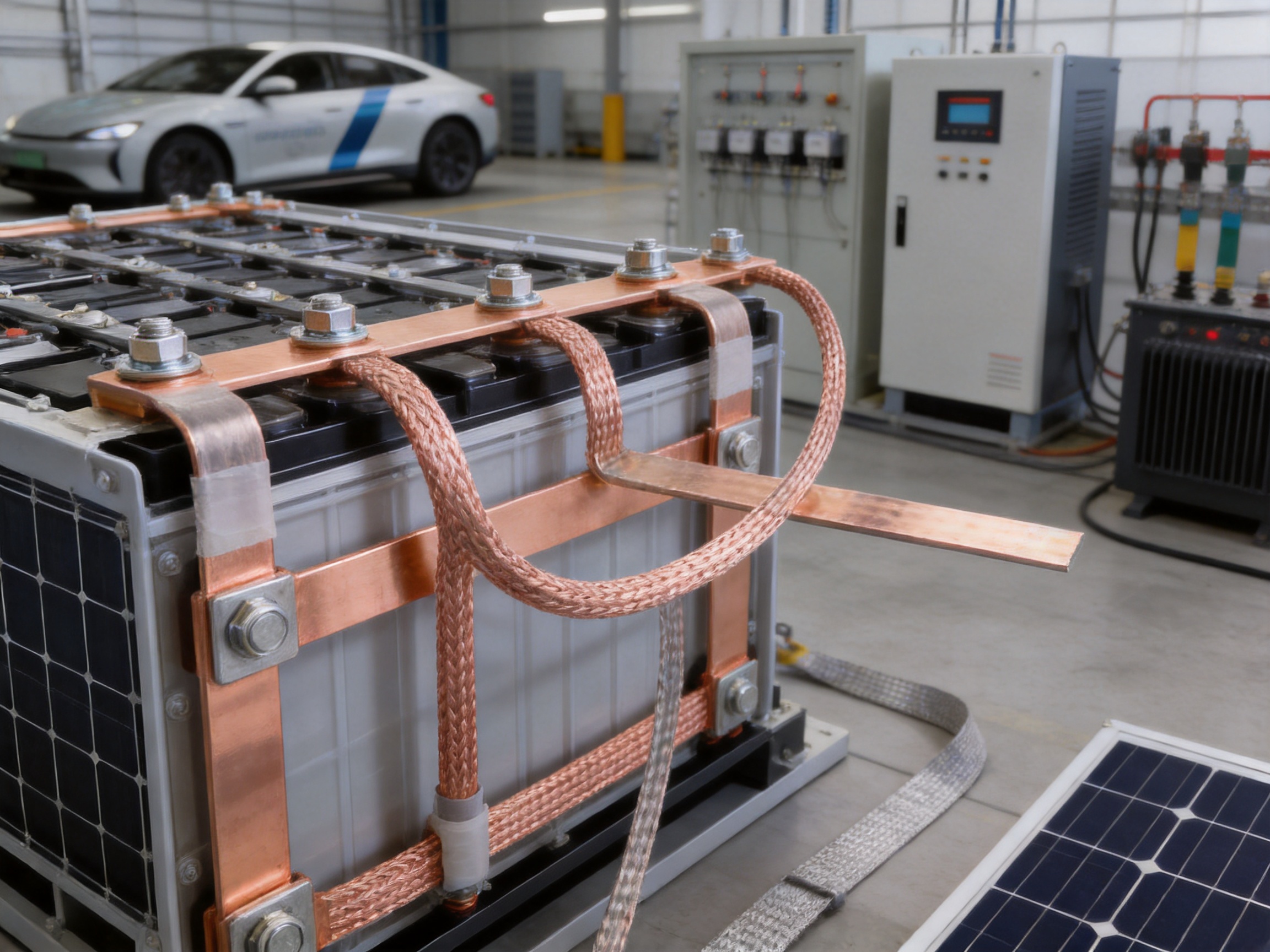
Battery systems place special demands on electrical connectors. Conductors must carry high current, fit within limited spaces, tolerate vibration and thermal cycling, and maintain reliable contact over many operating cycles. FTCB 15 is well suited to battery-pack connections because it provides a flexible path between cells, modules, busbars, terminals, and power-distribution components.
In electric-vehicle battery packs, flexible copper braids may be used for module interconnections, grounding, high-current links, and connections between battery sections and protection equipment. Their low-profile shape can simplify routing around cell housings, cooling components, covers, and structural supports.
In stationary energy-storage systems, the braid can connect battery racks, contactors, fuses, disconnect switches, busbars, and inverter interfaces. The tinned surface is valuable in equipment that may encounter humidity, temperature variation, or long storage periods before commissioning.
Battery systems may also experience expansion and contraction during charging and discharging. Although the amount of movement depends on the cell design and pack structure, flexible conductors can help accommodate small dimensional changes without placing unnecessary stress on cell terminals or rigid busbars.
The product can also be integrated with battery terminal insulator covers, cell contact systems, composite laminated busbars, and other conductive components. For advanced battery assemblies, the conductor may be terminated with lugs, pressed terminals, welded ends, or customized connection pieces. The correct termination depends on current, space, joining equipment, insulation, and service requirements.
9. Applications in Power Distribution and Electrical Equipment
FTCB 15 can be used in switchgear, distribution cabinets, transformer connections, power supplies, UPS systems, and industrial control equipment. In these applications, the braid can serve as a flexible link between a fixed busbar and a movable or removable panel. It can also provide grounding continuity across hinged doors, removable covers, and equipment sections.
Grounding applications benefit from the braid's flexibility and broad surface. A grounding strap must remain electrically continuous while tolerating movement, vibration, and repeated opening or closing. The tinned surface can help maintain a stable connection when properly terminated and protected.
In data centers and communications facilities, flexible braids can support grounding and bonding between cabinets, power-distribution equipment, and sensitive electronic systems. They may also be used in equipment where low mechanical stress is important, such as power supplies, servers, rectifiers, and control cabinets.
Renewable-energy systems provide another important application area. Solar inverters, wind-power converters, battery storage units, and power-conditioning equipment frequently combine high current, switching activity, thermal cycling, and limited installation space. A flexible tinned braid can connect power components while accommodating layout tolerances and reducing mechanical stress.
10. Industrial, Transportation, and Specialized Uses
Industrial furnaces and heating equipment require conductors capable of handling substantial current and operating near equipment that may experience high temperature and vibration. FTCB 15 can be used for suitable flexible links and grounding connections when the selected finish, insulation, and installation arrangement meet the thermal requirements.
Rail transit equipment benefits from vibration-resistant electrical connections. Train traction systems, locomotives, subway equipment, and onboard power supplies are exposed to continuous movement and mechanical shock. Flexible braided conductors can help maintain electrical continuity between components that cannot be joined by a completely rigid connection.
Heavy machinery, mining equipment, marine electrical systems, and construction equipment also require robust connections. In these environments, conductors may experience vibration, dust, moisture, movement, and difficult maintenance conditions. Tinned copper braid, combined with suitable insulation and protected termination points, can provide a durable and serviceable connection option.
Electronics and telecommunications equipment may use flexible braid for grounding, bonding, shielding, or power links. The braid can be positioned around housings, panels, and assemblies where a rigid strip would be inconvenient. In EMI-related applications, the final design must consider braid coverage, frequency range, termination quality, and grounding architecture.
11. Manufacturing Process and Quality Strengths
11.1 Engineering and Material Control
Zhejiang Zhongyan New Energy Co., Ltd. specializes in conductive components for new-energy and power-transmission applications. Its product scope includes copper foil soft connections, special-shaped flexible connections, battery soft connections, and other precision conductive components.
The manufacturing process begins with material selection and design planning. Copper purity, wire diameter, annealing condition, braid arrangement, cross-sectional area, finish, and termination requirements are reviewed according to the target application. This engineering approach is important because a flexible conductor is not defined by cross-sectional area alone. Mechanical movement, terminal geometry, thermal conditions, and insulation must also be considered.
Material control helps ensure that the copper input is consistent with the required conductivity and processing characteristics. Consistent wire diameter is important for braid uniformity, while controlled annealing supports repeatable flexibility. Surface preparation before plating is also essential because the quality of the finished tin layer depends on the condition of the copper substrate.
11.2 Braiding and Dimensional Control
During braiding, multiple carriers work together to form the flat conductor. The braid angle, tension, density, width, and thickness influence the final performance. Excessive tension may reduce flexibility, while insufficient control may produce uneven dimensions or inconsistent contact surfaces.
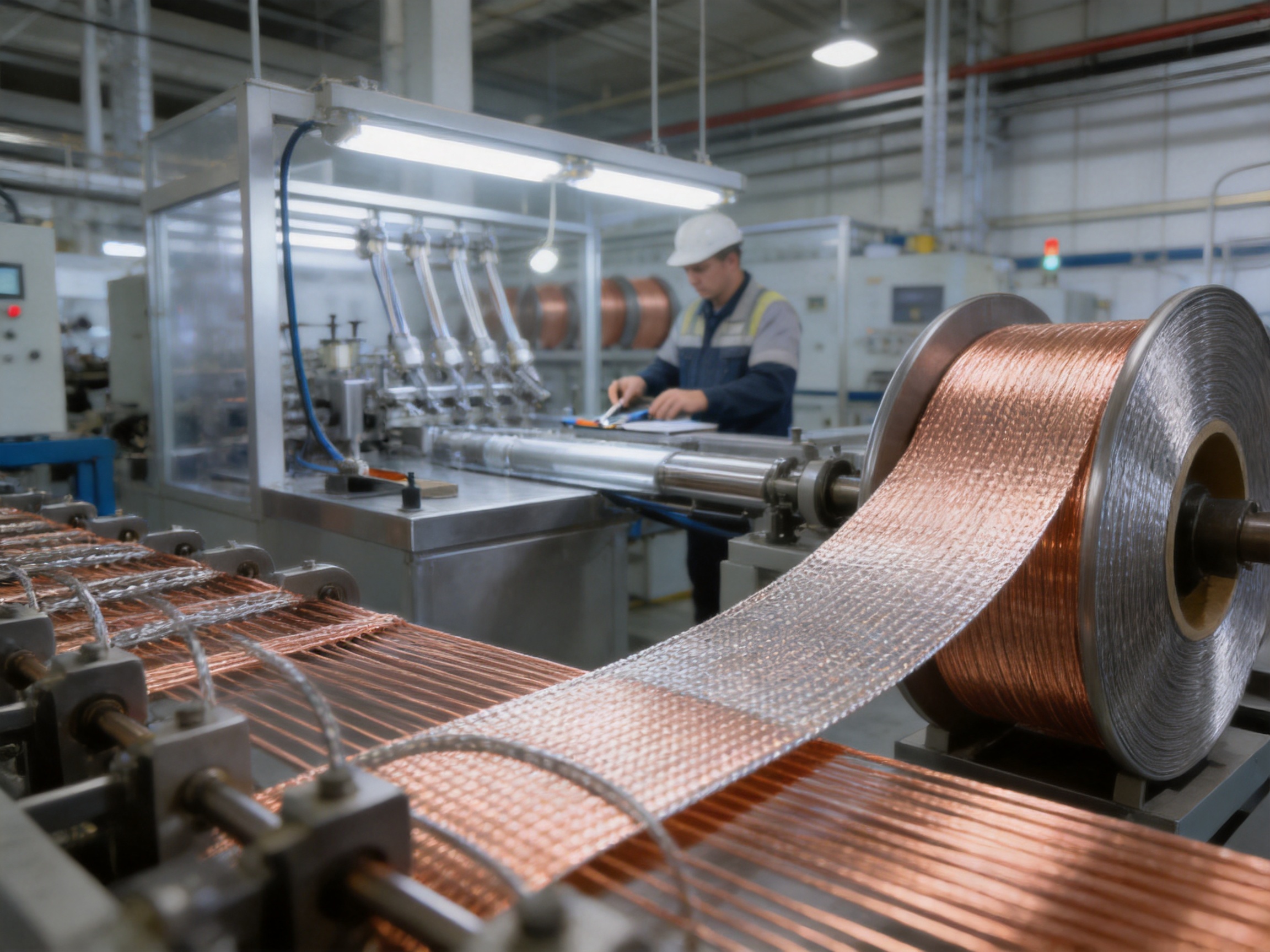
Professional production equipment supports repeatable braiding conditions across different sizes. The process can be adjusted for small flexible links or larger high-current configurations. Quality personnel can inspect the finished braid for dimensional consistency, surface uniformity, broken wires, loose sections, and other visible defects.
Dimensional control is particularly important when the tape must fit into a battery module or a predefined busbar channel. A small difference in width or thickness may affect insulation clearance, terminal alignment, or enclosure fit. Consistent production helps reduce assembly adjustments and supports more predictable customer manufacturing.
11.3 Plating and Surface Treatment
Tinning requires appropriate surface preparation, plating control, and post-process handling. The copper surface must be clean enough to receive the coating uniformly. Plating parameters influence coverage, appearance, solderability, and corrosion resistance.
A controlled surface-treatment process helps reduce variations between production batches. Depending on the customer requirement, inspection may include visual examination, dimensional checks, coating evaluation, solderability assessment, and electrical continuity testing. The specific inspection plan can be adapted to the application and order requirements.
11.4 Polymer Diffusion Welding and Laser Technology
The company has developed capabilities involving polymer diffusion welding and laser technology for new-energy precision components. These technologies are relevant to battery and conductive-component manufacturing because they can support high-reliability connections, controlled heat input, and precise joining of specialized components.
For battery soft connections and customized terminals, advanced joining methods can help create low-resistance interfaces while minimizing unnecessary thermal influence on adjacent materials. Laser processing may be used where concentrated energy, repeatability, and precise positioning are required. Polymer diffusion welding can support specialized bonding or encapsulation structures where polymer components are integrated with conductive assemblies.
The exact process used for a specific FTCB 15 assembly depends on the termination design and customer requirements. The braid itself may be supplied as continuous material, while customized assemblies may include formed ends, lugs, terminal plates, insulation, covers, or other components. The availability of advanced joining and precision-processing capabilities improves the manufacturer's ability to deliver complete connection solutions rather than only standard raw material.
11.5 Research, Development, and Verification
The company maintains a technical team focused on materials, precision machining, testing, and verification. This supports product development from initial concept through sample production and manufacturing validation. For customers developing battery packs or electrical equipment, engineering support can help determine the appropriate braid size, termination method, insulation, and installation geometry.
Testing and verification are essential when a conductor is used in high-current or safety-sensitive equipment. Depending on the product configuration, evaluation may include resistance measurement, temperature-rise testing, tensile or pull testing, bend assessment, dimensional inspection, plating inspection, and environmental evaluation. Customer-specific validation may also include vibration, thermal cycling, salt spray, or endurance testing.
12. Customization and OEM Support
One of the important advantages of working with a specialized manufacturer is the ability to customize the conductor to the equipment rather than forcing the equipment to use a standard component. FTCB 15 can be discussed in terms of cross-sectional area, width, thickness, wire diameter, braid density, surface finish, insulation, length, packaging, and termination style.
Customers may request cut-to-length pieces for manual assembly or continuous rolls for internal processing. Customized end treatments can include crimped lugs, copper terminal plates, drilled connection ends, compressed braid ends, welded interfaces, or other suitable terminal structures. The best option depends on the available assembly process and the required electrical and mechanical performance.
Insulation can be designed around clearance and routing requirements. For example, a battery pack may require a compact protective layer that follows a defined bend path, while an industrial grounding strap may prioritize abrasion resistance and easy visual inspection. PVC and TPE are available as potential insulation materials, subject to the required specifications.
OEM support also includes documentation and production coordination. Customers may require drawings, samples, dimensional records, material declarations, inspection reports, packaging instructions, or batch identification. A structured manufacturing process makes it easier to manage repeat orders and maintain consistency between development samples and mass production.
13. Installation Recommendations
13.1 Selecting the Correct Size
Begin with the electrical requirements. Determine continuous current, peak current, expected duty cycle, ambient temperature, permissible temperature rise, and available cooling. Use the cross-sectional area and reference current values as an initial guide, then verify the complete assembly through engineering calculations or testing.
Mechanical requirements should be evaluated at the same time. The braid must fit within the available width and thickness envelope, and it should have enough length to accommodate movement without being pulled tight. A connection that is too short may transmit stress to the terminals, while excessive unsupported length may create unwanted movement or vibration.
13.2 Termination and Contact Pressure
Reliable termination requires adequate contact area and consistent pressure. Bolted connections should use appropriate washers, fasteners, and torque values. Crimped connections should be produced with tooling suitable for the terminal and conductor construction. Welded or soldered connections require controlled process parameters and proper surface preparation.
The braid should not be clamped in a way that cuts or sharply compresses a large number of wires. If the end is flattened or formed, the process should maintain electrical continuity and mechanical integrity. Termination design should also prevent individual wires from spreading into areas where they could cause short circuits or interfere with insulation.
13.3 Routing and Bend Management
Route the braid away from sharp edges, moving mechanisms, excessive heat sources, and locations where it may be pinched. Use suitable supports or clips when necessary, but avoid over-constraining the conductor. The flexible section should be allowed to move in the intended direction without rubbing against nearby parts.
Where the connection is exposed to vibration, provide strain relief near the terminals and avoid placing the primary bend immediately at the connection interface. A gradual bend distributes stress more effectively than a sharp fold. The recommended bend radius depends on the wire diameter, braid construction, size, and movement frequency, so application-specific guidance should be requested for demanding assemblies.
13.4 Insulation and Safety
When the conductor is used in a high-voltage battery or power system, insulation and clearance must be considered as part of the complete design. Optional PVC or TPE insulation can reduce accidental contact, but it must be compatible with the system voltage, temperature, chemicals, and mechanical environment.
After installation, inspect the braid for exposed strands, damaged plating, cuts, sharp bends, inadequate clearance, and loose terminals. Electrical testing should confirm continuity and resistance. High-voltage systems require appropriate isolation, insulation resistance, and safety procedures determined by the equipment designer.
14. Why the Product Is a Strong Choice for Western Markets
Customers in Europe, North America, and other developed industrial markets often require more than a conductor that meets a nominal cross-sectional area. They look for stable quality, repeatable dimensions, responsive engineering communication, flexible packaging, and support for customized assemblies. FTCB 15 is positioned to address these requirements through its material options, plating choices, insulation possibilities, and broad size range.
The product is suitable for applications where reliability and maintainability are important. Its tinned surface is practical for environments with humidity or contamination, while its flexible construction helps reduce stress-related failures. The flat profile supports compact system design, and the continuous packaging options can improve factory handling.
The manufacturer's focus on new-energy conductive components is also relevant to customers developing electric vehicles, energy-storage systems, battery modules, renewable-energy equipment, and high-voltage distribution products. Experience with soft connections and precision components can help bridge the gap between a standard braid and a finished, application-specific connection.
Established in 2022, Zhejiang Zhongyan New Energy Co., Ltd. combines engineering teams, specialized equipment, product development, manufacturing, and quality-management capabilities. The company has supplied conductive components to major enterprises and is expanding its capabilities across battery cells and connection systems. This integrated direction supports customers that need coordinated development of cells, conductive links, insulation, and battery-pack structures.
15. Selection Guide for Engineers and Purchasing Teams
When requesting FTCB 15, provide the required cross-sectional area and expected current. Also specify whether the current is continuous, intermittent, or pulsed. Include the operating temperature and the maximum acceptable temperature rise if available.
Describe the mechanical movement expected during service. Important details include vibration level, movement frequency, bend direction, thermal cycling, installation space, and required service life. These factors help determine whether a standard braid is appropriate or whether a customized construction is needed.
Specify the surface finish. Tinning is a practical general-purpose option, but bare copper, nickel, or silver plating may be appropriate for specialized environments. If soldering, welding, crimping, or bolting will be used, communicate the joining method before production.
Specify the insulation requirement, if any. Include material preference, color, thickness, voltage level, temperature range, chemical exposure, and abrasion conditions. If the product will be installed inside a battery pack or sealed cabinet, provide information about coolant, electrolyte exposure, condensation, and enclosure materials.
Finally, provide drawings or samples showing the available space and connection points. A manufacturer can often recommend a more effective geometry when it understands the complete assembly rather than only the conductor's electrical rating.
16. Frequently Asked Questions
Q1: What is FTCB 15?
FTCB 15 is a flat tinned copper braided tape made from fine annealed copper wires. It is designed for flexible electrical conductivity, grounding, high-current links, battery connections, and applications exposed to vibration or thermal movement.
Q2: What copper material is used?
The product uses annealed Cu-ETP or C11000-type copper with a stated copper content of at least 99.95 percent. This material provides high electrical conductivity and good flexibility after annealing.
Q3: Why is the conductor tin plated?
Tin plating helps protect the copper surface from oxidation and corrosion. It also improves solderability and can support more stable contact performance in humid, polluted, or variable environments.
Q4: Can FTCB 15 replace a rigid copper busbar?
It can replace a rigid busbar in suitable flexible-link applications, especially where vibration, thermal expansion, alignment differences, or compact routing are concerns. A rigid bar may remain preferable for long, fixed, structurally supported distribution paths. The choice should be based on current, geometry, mechanical movement, temperature, and applicable standards.
Q5: What current ratings are available?
The listed FTCB 15 configurations range from approximately 30 A for the 3 mm² version to approximately 360 A for the 100 mm² version. These are reference values. Actual permissible current must be confirmed for the installation conditions and complete termination system.
Q6: Can the braid be insulated?
Yes. Optional PVC or TPE insulation can be added for electrical safety, abrasion resistance, chemical protection, and reduced short-circuit risk. The insulation selection should match the voltage, temperature, flexibility, and environmental requirements.
Q7: Can the product be cut to custom lengths?
Yes. The material can be supplied in rolls, on spools, or on wooden drums and can be cut to the required length. Customized assemblies with formed or terminated ends can also be discussed.
Q8: Which termination methods can be used?
Depending on the design, FTCB 15 can be connected by bolting, crimping, soldering, welding, or customized terminal structures. The termination method should be selected according to current, mechanical load, production equipment, and service conditions.
Q9: Is FTCB 15 suitable for electric vehicles?
It is suitable for appropriate electric-vehicle applications such as battery-module links, grounding, high-current flexible connections, and power-electronic interfaces. The final design must be validated for vehicle vibration, thermal cycling, voltage, insulation, short-circuit current, and applicable automotive requirements.
Q10: Is the braid suitable for energy-storage systems?
Yes. It can be used in battery racks, energy-storage cabinets, inverter connections, grounding systems, disconnect equipment, and flexible power links. The selected size, insulation, termination, and environmental protection should be verified for the complete energy-storage design.
Q11: What makes the product different from ordinary copper braid?
The principal differences are the flat profile, tin-plated surface, broad selection of cross-sectional areas, optional insulation, and customization support. These features can improve environmental resistance, installation flexibility, contact integration, and production efficiency compared with a basic bare round braid.
Q12: Can the manufacturer support OEM development?
Yes. The manufacturer provides customized manufacturing support for conductive components and soft connections. Customers can discuss dimensions, finishes, insulation, lengths, terminal structures, packaging, prototypes, drawings, and production requirements.
17. Conclusion
FTCB 15 flat tinned copper braided tape provides a practical connection solution for electrical systems that require conductivity, flexibility, vibration resistance, and environmental durability. Its high-purity annealed copper core minimizes electrical resistance, while the braided structure distributes mechanical movement across many fine wires. The flat profile supports compact routing and broad terminal contact, and the tin-plated surface improves oxidation resistance and solderability.
The product range from 3 mm² to 100 mm² allows the same basic design concept to serve compact grounding links, industrial control equipment, battery modules, energy-storage systems, renewable-energy converters, rail equipment, and high-current power-distribution assemblies. Optional PVC or TPE insulation, multiple surface finishes, continuous packaging, and customized termination provide additional flexibility for OEM applications.
Behind the product is a manufacturer focused on new-energy conductive components, battery soft connections, precision processing, laser technology, polymer diffusion welding, testing, and customized engineering. This combination of product flexibility and manufacturing capability helps customers develop reliable electrical connections that are easier to install, better able to tolerate movement, and more suitable for the compact designs used in modern energy systems.
For the best result, engineers should evaluate the conductor as part of the complete electrical and mechanical assembly. Current, temperature, bend movement, terminal pressure, insulation, environmental exposure, and validation testing should all be considered. When properly selected and installed, FTCB 15 can provide a dependable bridge between the low resistance of a copper busbar and the mechanical adaptability required by advanced electrical equipment.
References
1. JB/T 6313.2-2011, Flexible Copper and Aluminum Conductors for Electrical Applications, relevant industry requirements.
2. ASTM B170, Standard Specification for Oxygen-Free Electrolytic Copper—Refinery Shapes.
3. ASTM B545, Standard Specification for Electrodeposited Coatings of Tin.
4. IEC 61439, Low-Voltage Switchgear and Controlgear Assemblies, general principles for assembly design and verification.
5. IEC 60228, Conductors of Insulated Cables, conductor classes and electrical characteristics.
6. IEC 62619, Secondary Cells and Batteries Containing Alkaline or Other Non-Acid Electrolytes—Safety Requirements for Industrial Applications.
7. Manufacturer-provided FTCB 15 technical data, product construction information, packaging information, and application notes.
8. Manufacturer-provided information concerning copper soft connections, battery connection systems, precision processing, laser technology, and quality-management capabilities.
Product: FTCB 15 Flat Tinned Copper Braided Tape
Driven by the development of new energy and aiming for "zero carbon".
Copyright © Zhejiang Zhongyan New Energy Co., Ltd. All Rights Reserved.
