 English
 Español

High-Voltage Bolt Connectors for Energy Storage and Battery Power Systems
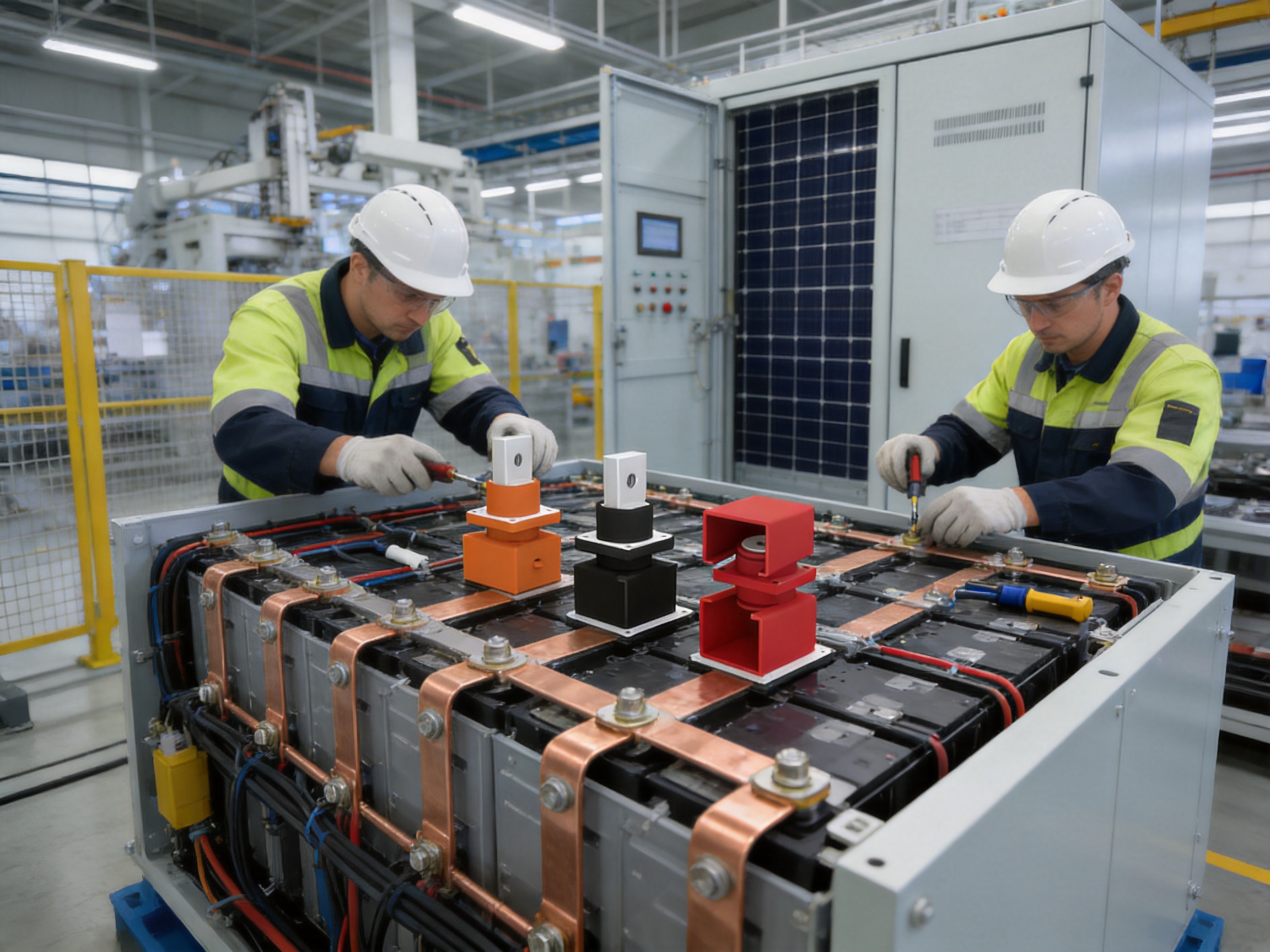
High-voltage battery systems require connection components that can carry substantial electrical current while maintaining insulation, mechanical stability, and dependable service performance. The bolt connector is a dedicated through-wall wiring solution developed for high-voltage batteries, energy storage equipment, industrial power systems, and new energy vehicle applications. Its square wall-through structure, screw-based connection method, and insulated housing make it suitable for applications where safety, compact installation, and reliable power transmission are essential.
Unlike ordinary cable terminals or general-purpose electrical connectors, a high-voltage bolt connector is designed to function as a secure interface between internal and external circuits. It can be mounted through the wall of a battery enclosure, high-voltage box, or energy storage cabinet, creating a controlled and insulated passage for power conductors. The connector supports high-current transmission while helping reduce the risk of accidental contact, loose wiring, polarity confusion, and insulation failure.
Manufactured by Zhejiang Zhongyan New Energy Co., Ltd., the bolt connector forms part of a broader product portfolio covering insulated flexible busbars, rigid busbars, aluminum busbars, coated busbars, copper braided tape, stranded copper wires, laminated busbars, cell contact systems, battery terminals, and energy storage connectors. This manufacturing background gives the product a strong foundation in conductive materials, battery connection technology, precision fabrication, and new energy electrical systems.
What Is a High-Voltage Bolt Connector?
A high-voltage bolt connector is a mechanical and electrical connection device used to join high-current conductors through the wall of an electrical enclosure. The connector normally consists of an insulated housing, a conductive terminal, threaded fastening components, and mounting hardware. The terminal receives the cable, busbar, or power conductor, while the insulated body separates the energized conductor from the enclosure and surrounding components.
The product described here uses a wall-through square structure. This configuration is especially useful for battery packs, high-voltage distribution boxes, energy storage cabinets, and other equipment that requires a fixed electrical interface across an enclosure wall. Once mounted, the connector provides a stable transition point between the internal power circuit and the external wiring harness or busbar system.
The bolt connection is a key feature. Instead of relying only on spring pressure, plug friction, or a small contact clip, the conductor is secured through a threaded mechanical connection. This allows the installer to apply controlled fastening force and create a firm contact interface. A properly tightened bolt connection can reduce the possibility of conductor movement, contact loosening, and localized resistance caused by vibration or thermal cycling.
The connector is designed for high-voltage direct-current applications. Depending on the selected version, the available electrical ratings cover lower-current battery connections as well as high-current energy storage and industrial power connections. The product information includes versions rated from 100 A and 120 A through 150 A, 200 A, 300 A, 350 A, and 400 A, with rated voltage options reaching 1,500 V DC.
Why Bolt-Based Through-Wall Connections Matter
Battery and energy storage equipment often operates under demanding conditions. High currents generate heat at every electrical interface, while vibration, expansion, contraction, and repeated loading can affect the reliability of a connection. An electrical connector must therefore do more than simply complete a circuit. It must maintain low resistance, support mechanical loads, provide insulation, and remain stable throughout the expected operating life of the equipment.
A through-wall bolt connector addresses several of these requirements at the same time. The housing creates a defined insulated passage through the enclosure. The conductive terminal provides a robust current path. The threaded connection secures the conductor, and the mounting screws hold the connector body in a fixed position. This integrated arrangement is more organized and easier to inspect than improvised cable-routing methods.
For battery packs and energy storage cabinets, enclosure integrity is also important. Cables routed through an opening without a dedicated connector may be exposed to abrasion, movement, sharp edges, or accidental contact with the metal enclosure. A purpose-designed wall-mounted connector provides a more professional interface and helps separate the electrical connection from the mechanical structure of the equipment.
The square through-wall design can also support simplified panel installation. It provides a clear mounting footprint and helps prevent unwanted rotation of the connector body. In applications where external cables are frequently connected, serviced, or replaced, this stability can improve installation consistency and reduce strain on the internal battery wiring.
Core Product Advantages
High-Current Transmission Capability
The bolt connector is designed for high-current applications rather than ordinary low-power signal wiring. Its conductive terminal uses H59 brass with nickel plating, combining the mechanical strength of brass with a conductive surface intended to support stable electrical contact. The available product range includes versions for 100 A, 120 A, 150 A, 200 A, 300 A, 350 A, and 400 A applications, subject to the selected model and system design.
High-current capacity depends on the complete installation, including conductor size, contact surface, tightening torque, ambient temperature, ventilation, enclosure design, and duty cycle. Nevertheless, offering multiple current classes enables equipment designers to select a connector that matches the load requirements of a specific battery pack, high-voltage box, or energy storage cabinet.
High-Voltage Insulation
The connector uses PA66 insulation material, with the housing specified as flame-retardant UL94 V-0 grade plastic. PA66 is widely used in electrical and structural components because it offers a useful balance of mechanical strength, dimensional stability, and electrical insulation. The V-0 flame-retardant classification indicates that the material is designed to limit flame propagation under the applicable test conditions.
Depending on the product variant, rated voltage specifications include 600 V DC, 1,000 V DC, and 1,500 V DC. Dielectric strength values listed for the range include 3,000 V AC and 4,000 V AC. These specifications indicate that the connector is intended for demanding insulation environments, but the final application must always be evaluated as a complete system. Clearance, creepage, enclosure design, contamination, humidity, and installation quality all influence high-voltage safety.
Secure Mechanical Fixing
A high-current connection must remain mechanically stable as well as electrically conductive. The bolt connection helps maintain pressure between the conductor and terminal, while the M4 mounting screws secure the connector to the enclosure wall. Depending on the model, the main terminal screw options include M6, M8, and M10.
The different screw sizes allow the connector to accommodate different current classes and conductor arrangements. Lower-current models can use smaller terminal hardware, while higher-current versions can use larger M8 or M10 terminal screws. This provides a practical way to match the mechanical interface with the required conductor size and current capacity.
Positive and Negative Polarity Recognition
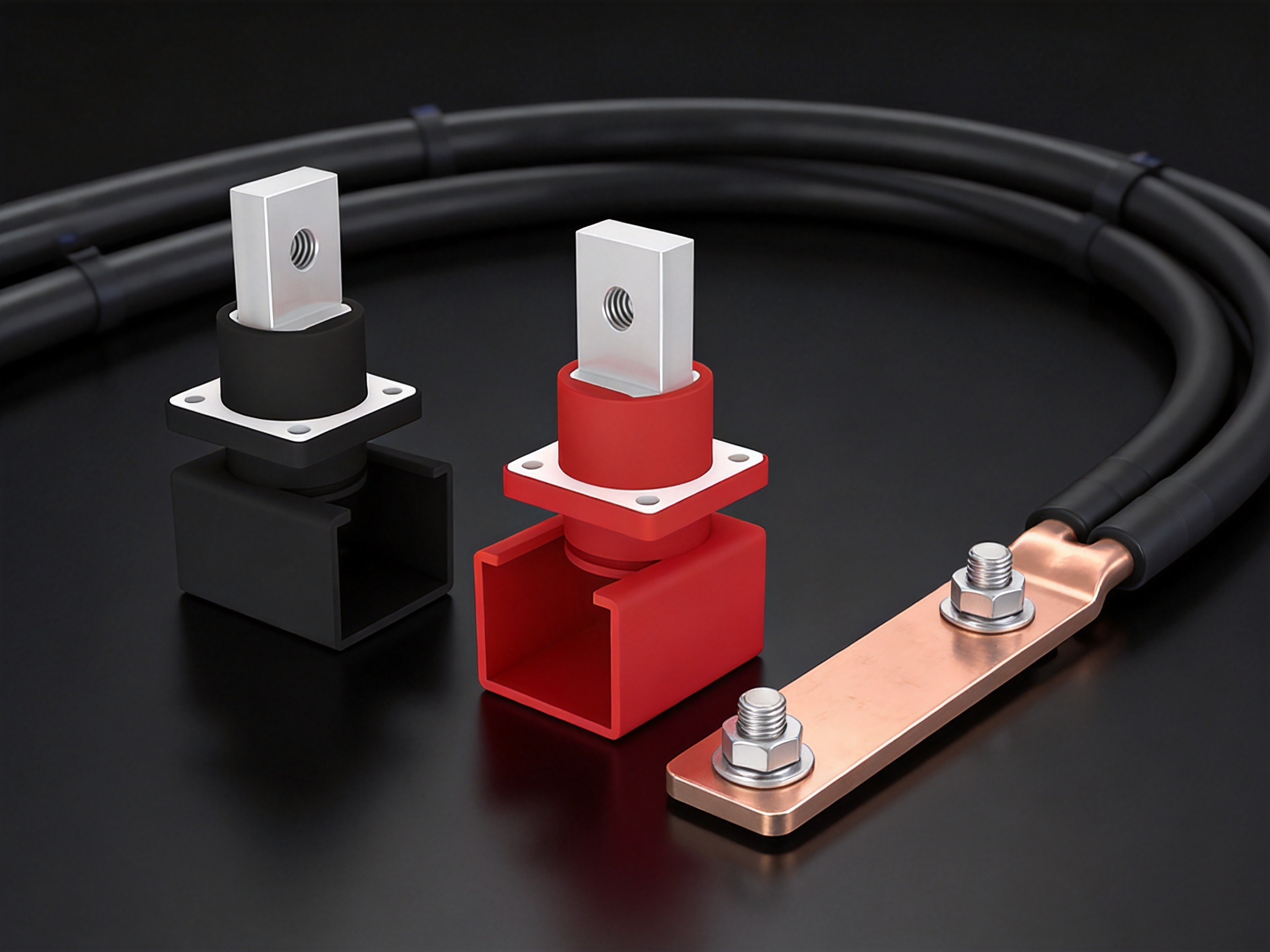
Battery systems depend on correct polarity. A reversed connection can result in equipment damage, protection-system activation, short circuits, or hazardous operating conditions. The product range supports positive and negative pole color recognition, helping installers distinguish the two electrical paths during assembly and maintenance.
Color recognition does not replace electrical testing or documented wiring procedures, but it adds a useful visual control. In production environments, it can help reduce assembly mistakes. In field-service situations, it can make inspection faster, particularly when multiple high-voltage connectors are installed on the same battery cabinet or distribution box.
Flexible Wiring Orientation
The product information indicates that wiring can be performed at any angle through a 360-degree orientation. This flexibility can be valuable when cable routing is restricted by enclosure dimensions, cooling components, busbars, contactors, fuses, battery modules, or other high-voltage equipment.
Flexible orientation may also reduce the need for sharp cable bends. Maintaining an appropriate cable bend radius is important because excessive bending can damage insulation, stress terminal crimp areas, or transfer mechanical force into the connector body. A connector that supports convenient directional positioning can contribute to a cleaner and more reliable wiring layout.
Compact Through-Wall Integration
Battery equipment is often designed around limited space. The wall-mounted structure integrates the electrical interface into the enclosure instead of requiring a separate external terminal assembly. This can help improve the organization of the high-voltage wiring and make the final equipment package more compact.
A fixed through-wall connection also creates a clear separation between internal and external wiring. Internal conductors can be routed to the connector terminal, while the external harness or power cable can be connected from outside the enclosure. This arrangement is beneficial for modular battery packs, cabinet-based energy storage systems, and serviceable high-voltage distribution units.
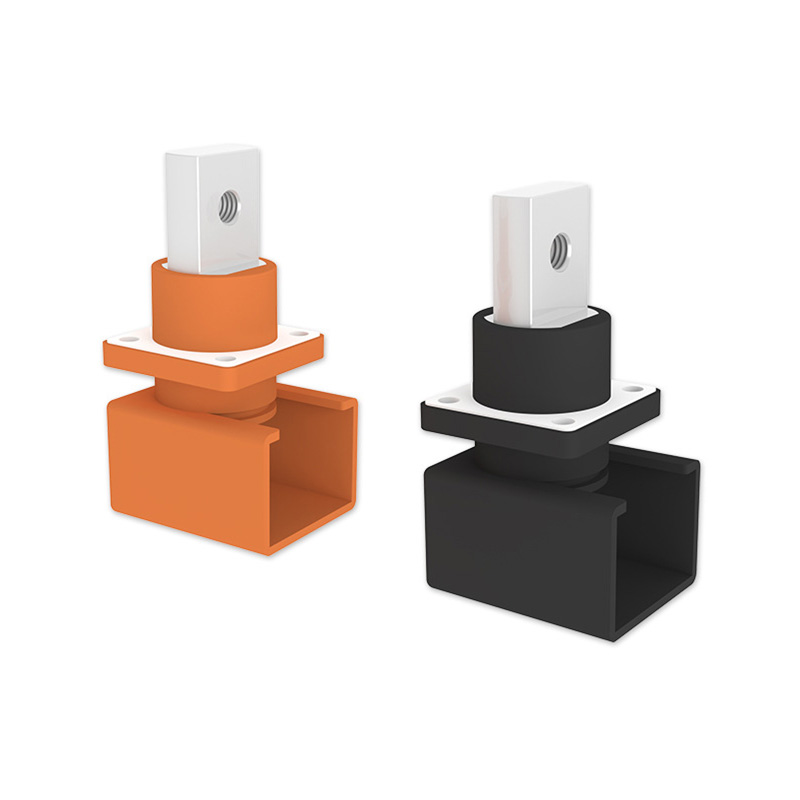
Bolt Connector
Technical Specifications
The bolt connector is available in several performance classes. The following table consolidates the principal technical information provided for the product range. Exact ratings should be confirmed against the selected model, drawing, and application conditions before mass production or field installation.
| Item | Available specification | Application significance |
| Insulation material | PA66 flame-retardant plastic, UL94 V-0 | Provides electrical insulation and supports flame-retardant enclosure design |
| Conductor material | H59 brass with nickel plating | Supports conductive performance, mechanical strength, and surface durability |
| Rated current range | 100 A, 120 A, 150 A, 200 A, 300 A, 350 A, and 400 A | Allows selection according to battery and power-distribution requirements |
| Rated voltage range | 600 V DC, 1,000 V DC, and up to 1,500 V DC | Suitable for different high-voltage battery and energy storage platforms |
| Dielectric strength | 3,000 V AC or 4,000 V AC, depending on model | Supports insulation verification during product testing |
| Main terminal screw | M6, M8, or M10 | Provides mechanical fastening for different conductor and current classes |
| Mounting screw | M4 | Secures the connector body to the enclosure wall |
| Structure | Wall-mounted square through-wall design | Creates a stable interface between internal and external high-voltage circuits |
| Polarity identification | Positive and negative color recognition | Helps reduce wiring errors during assembly and maintenance |
The specifications show that the product line is not limited to one type of battery application. Lower-current versions may be used in compact battery assemblies, auxiliary high-voltage circuits, or smaller energy storage units. Higher-current versions are designed for more demanding battery packs, cabinet power paths, high-voltage distribution systems, and industrial equipment.
Material and Construction Benefits
PA66 Insulated Housing
The insulated housing is a primary safety component. It separates the conductive terminal from the mounting panel and nearby components, helping prevent unintended electrical contact. PA66 is suitable for applications where the connector must withstand mechanical handling, installation pressure, and long-term exposure to electrical operating conditions.
The use of flame-retardant material is particularly relevant in battery and energy storage equipment. Electrical systems must be designed to manage abnormal conditions, including overheating, insulation damage, and localized faults. A flame-retardant housing can support the overall fire-safety strategy of the equipment, although it cannot replace proper overcurrent protection, thermal monitoring, enclosure design, or battery management controls.
Nickel-Plated H59 Brass Conductor
H59 brass is used for the conductive terminal. Brass offers useful mechanical strength for threaded components and repeated fastening. Nickel plating provides a protective surface layer that can improve resistance to oxidation and surface deterioration compared with an unprotected base material.
A stable plated surface is important because electrical contact resistance can increase when surfaces become contaminated, oxidized, or mechanically damaged. Nickel plating can help maintain a consistent interface when the connector is used in industrial environments, battery cabinets, or equipment exposed to temperature changes and humidity. Correct cable preparation and tightening remain essential for achieving the intended performance.
Threaded Connection Architecture
The threaded terminal architecture is well suited to high-current conductors because it allows a direct and robust mechanical interface. When the conductor is correctly prepared and fastened, the connection can maintain strong contact pressure and reduce movement caused by vibration.
For production assembly, the fastening process can be standardized through torque specifications, inspection procedures, and tool control. This is an important advantage over connection methods that depend heavily on manual insertion depth or subjective retention checks. A controlled bolt process can be documented and incorporated into a quality management system.
Advantages Compared with General-Purpose Alternatives
Compared with Ordinary Cable Glands
A standard cable gland primarily provides cable retention and sealing at an enclosure wall. It is not necessarily intended to function as a high-current electrical terminal. The cable must normally continue through the wall to another terminal, which increases the number of components and may make internal wiring less organized.
A dedicated bolt connector combines the wall passage and electrical terminal in one component. It provides a defined conductive path, an insulated structure, and a fixed mounting arrangement. This can simplify high-voltage cabinet design and reduce the need for additional terminal hardware inside the enclosure.
Compared with Small Plug Connectors
Plug-style connectors are useful where rapid disconnection is a priority, but their suitability depends on current, voltage, environmental conditions, and the required locking system. For large battery currents, a bolt connection can provide a more substantial mechanical interface and a direct fastening method.
The bolt connector is particularly appropriate where the wiring is intended to remain securely installed rather than frequently disconnected. The threaded terminal provides a clear installation procedure and allows the connection to be inspected for proper fastening during production or service.
Compared with Improvised Lug and Panel Arrangements
Some equipment designs use a cable lug attached to a stud and then add separate insulating covers, spacers, and panel hardware. Although this can work in certain applications, it may require more assembly steps and create more opportunities for incorrect spacing, exposed metal, or mechanical movement.
The integrated connector approach organizes the terminal, insulating body, and panel mounting function into one purpose-designed component. This can improve assembly consistency and make the finished high-voltage interface easier to understand and maintain.
Compared with Fixed Internal Wiring
Permanent internal wiring without a through-wall connector may reduce component count in a simple enclosure, but it can make servicing and modular replacement more difficult. A wall-mounted connector creates a defined boundary between the battery or high-voltage equipment and the external harness.
This boundary is useful for modular systems. Battery modules, high-voltage boxes, and energy storage cabinets can be designed with standardized connection locations. Such standardization can support production efficiency, replacement procedures, and system-level integration.
Applications in Battery and Energy Storage Equipment
High-Voltage Battery Packs
High-voltage battery packs for electric vehicles, industrial vehicles, specialty vehicles, and mobile equipment need reliable power interfaces. The bolt connector can be installed on the battery enclosure to connect internal cell modules, busbars, contactors, fuses, and monitoring components to an external high-voltage harness.
In this application, the connector must be selected according to the maximum continuous current, peak current, operating voltage, temperature, enclosure layout, and cable dimensions. The high-current models are suitable for systems in which substantial energy must be transferred between the battery and an inverter, motor controller, charger, or high-voltage distribution unit.
Energy Storage Systems
Stationary energy storage systems use battery racks, cabinets, containers, and power conversion equipment to store and release electrical energy. Their high-voltage interfaces must support repeated charge and discharge cycles, continuous current transmission, and service access.
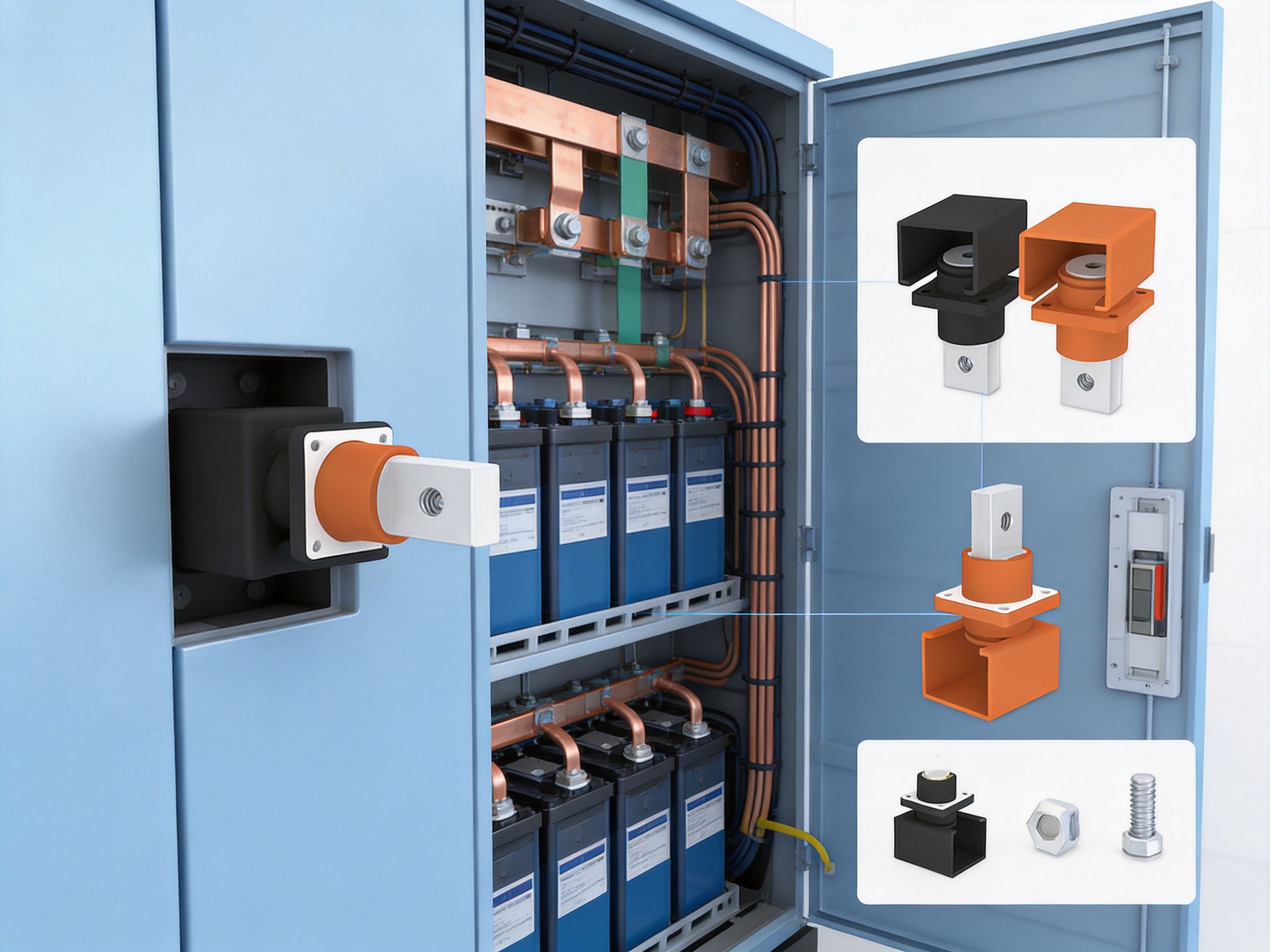
The through-wall bolt connector can serve as a hub for high-current and high-voltage wiring in industrial and commercial energy storage cabinets. It can connect battery strings to a cabinet busbar, power distribution assembly, contactor box, or external power conversion system. Its fixed mounting structure helps keep the wiring organized within the cabinet.
High-Voltage Boxes
A high-voltage box typically combines contactors, fuses, pre-charge circuits, current sensors, busbars, and other protection or distribution components. The box requires reliable external interfaces for positive and negative power paths.
The bolt connector can provide these interfaces while maintaining insulation between the terminals and the metal enclosure. Color-based polarity recognition can help simplify assembly, especially when several high-voltage paths are installed close together.
Industrial and Commercial Energy Storage Cabinets
Industrial and commercial cabinets often combine high battery capacity with compact installation space. They may be installed in factories, commercial buildings, data facilities, renewable energy projects, and microgrid systems. A reliable high-current connection is necessary for linking battery modules, power conversion systems, and distribution equipment.
Because cabinet systems are frequently assembled in production and serviced in the field, the connector should support repeatable installation. The bolt design, M4 mounting hardware, selectable terminal screw sizes, and clear polarity identification are all useful in these environments.
New Energy Vehicle Wiring Harnesses
Electric and hybrid vehicles place strict demands on high-voltage wiring. The connectors must remain secure under vibration, thermal cycling, and dynamic vehicle operation. They must also support compact packaging around battery packs, inverters, onboard chargers, and distribution boxes.
The product can be used as part of high-voltage wiring harness assemblies and battery connection systems. Final vehicle use requires confirmation of all applicable automotive, environmental, sealing, vibration, and validation requirements. The connector should be integrated with an appropriate cable, terminal preparation method, protective routing design, and vehicle-level safety system.
Manufacturing Strengths of the Supplier
Zhejiang Zhongyan New Energy Co., Ltd. is a high-tech enterprise focused on conductive components and new energy electrical connection solutions. Its product range includes high-voltage electrical copper foil soft connections, special-shaped flexible connections, battery soft connections, busbars, battery terminals, and energy storage connectors.
This product breadth is significant because bolt connectors do not operate independently. They are normally installed alongside busbars, flexible copper connections, battery terminals, cell contact systems, cables, and high-voltage distribution components. A supplier with experience across these product categories can better understand the electrical and mechanical relationships within a complete battery connection system.
Engineering and Product Development
The company brings together experienced engineers and technical personnel working in product design, research and development, manufacturing, testing, and solution development. This combination supports the development of components that must satisfy multiple requirements at the same time, including low resistance, insulation, dimensional accuracy, mechanical reliability, and compatibility with automated or semi-automated assembly.
For customized connector projects, engineering capability is especially important. Customers may require different terminal screw sizes, mounting dimensions, housing shapes, polarity markings, conductor interfaces, or cable-routing orientations. A capable development team can evaluate the electrical and mechanical requirements and convert them into drawings, samples, process specifications, and production controls.
Advanced Connection Technologies
The company has developed polymer diffusion welding and laser technology patents for new energy precision components. These technologies are particularly relevant to battery soft connections and copper conductive assemblies, where a low-resistance and highly reliable joint is required.
Although the bolt connector itself relies on mechanical fastening, the wider technology base supports the manufacturing of related busbars, flexible connections, and battery components. This can help customers source multiple connected parts from one experienced supplier, simplifying technical communication and supply-chain coordination.
Modern Production and Quality Management
Consistent connector performance depends on controlled production. Important process factors include plastic molding quality, conductor machining, plating consistency, thread accuracy, dimensional control, assembly alignment, and electrical testing. Modern production and quality-management systems help convert engineering specifications into repeatable products.
For high-voltage connectors, inspection should cover both individual components and finished assemblies. Typical controls may include visual inspection, dimensional verification, thread checks, terminal surface inspection, insulation testing, dielectric withstand testing, and current-carrying or temperature-rise evaluation where required by the application.
The company’s experience in precision conductive components and battery connection systems provides a foundation for these controls. Customers can also define additional inspection plans based on their own drawings, certification requirements, and production validation procedures.
Experience in New Energy Markets
Established in 2022, the company focuses on precision components for batteries and new energy applications. Its stated customer experience includes cooperation with leading enterprises such as BYD, CATL, and Jaguar. This background indicates exposure to demanding requirements for consistency, delivery, engineering response, and high-volume production.
Customer references alone do not determine whether a product is suitable for every application. However, experience with major battery and vehicle manufacturers can help a supplier understand the importance of traceability, process control, sample approval, engineering change management, and stable mass production.
Quality Considerations for High-Voltage Bolt Connectors
High-voltage connectors should be evaluated as part of a complete electrical and mechanical system. The rated current printed in a product specification is not the only factor that determines safe operation. The conductor cross-section, contact resistance, ambient temperature, enclosure ventilation, duty cycle, installation torque, and thermal management all influence performance.
Before final selection, engineers should verify the connector’s rated voltage against the maximum system voltage, including possible transient conditions. The insulation system should also be evaluated for the required creepage and clearance distances, environmental contamination, humidity, altitude, and enclosure configuration.
Mechanical validation is equally important. The connector should be checked for resistance to vibration, cable pull, twisting, mounting stress, and repeated thermal expansion. The mounting panel should have the correct thickness, flatness, hole pattern, and edge treatment. The cable should be supported so that its weight and movement do not place excessive load on the connector terminal.
Installation quality has a direct effect on connection reliability. Conductors must be stripped, crimped, or prepared according to the applicable design. Contact surfaces should be clean and free from contamination. Terminal screws should be tightened using controlled tools and the specified torque. After assembly, the connection should be inspected and electrically tested before the system is energized.
Recommended Installation Practices
Confirm the Correct Model
Select the connector according to current, voltage, terminal screw size, mounting arrangement, cable size, and polarity requirements. Do not select a model only by physical appearance. A connector that fits the panel may not have the required electrical rating or terminal capacity.
Prepare the Mounting Panel
The mounting panel should be manufactured according to the connector drawing. Burrs, sharp edges, paint buildup, or distortion around the mounting opening can affect installation quality. The panel should provide adequate support for the connector and should not place bending stress on the insulated housing.
Route and Support Cables Correctly
Cables should be routed with adequate clearance from sharp edges, hot components, moving parts, and other energized conductors. Cable clamps or support brackets should be used where necessary. The connector should not be used as the sole support for a heavy cable assembly.
Apply Controlled Tightening
The main terminal screw and mounting screws should be tightened using the appropriate tools and procedures. Under-tightening can cause high contact resistance and heating. Over-tightening can damage threads, deform the housing, or place excessive stress on the conductor and terminal.
Verify Polarity and Insulation
Positive and negative markings should be checked before connection. The complete assembly should undergo continuity, insulation resistance, and dielectric withstand testing as required by the system specification. High-voltage testing must be performed by qualified personnel using appropriate safety procedures.
Inspect Before Energization
Before the battery or energy storage system is energized, verify that all terminal screws are secure, no conductive parts are exposed unintentionally, the housing is correctly mounted, the cable routing is protected, and the polarity matches the wiring diagram. A documented inspection checklist can reduce commissioning errors.
Customization and OEM Support
Battery and energy storage equipment often requires customized components. Panel dimensions, cable directions, terminal sizes, current ratings, polarity markings, and insulation requirements can vary between projects. A connector supplier should therefore be able to support both standard products and engineering modifications.
OEM support may include drawing review, electrical rating confirmation, sample production, mounting evaluation, cable compatibility checks, packaging design, inspection planning, and production scheduling. For large projects, customers may also require product identification, lot traceability, incoming inspection documents, and change-control procedures.
Zhejiang Zhongyan New Energy Co., Ltd. provides customized manufacturing support across its conductive component product range. Its experience in flexible connections, busbars, battery terminals, and energy storage components can help customers develop coordinated connection solutions instead of treating each part as an isolated purchase.
When requesting a customized bolt connector, customers should provide the following information:
1. Continuous and peak current requirements.
2. Maximum operating voltage and expected transient voltage.
3. Cable type, conductor cross-section, and terminal interface.
4. Mounting panel material and thickness.
5. Required mounting hole pattern and connector orientation.
6. Environmental conditions, including temperature, humidity, vibration, and contamination.
7. Polarity marking and color requirements.
8. Required insulation, dielectric, flame-retardant, or compliance tests.
9. Annual volume, sampling requirements, and delivery schedule.
10. Any specific vehicle, battery, energy storage, or industrial standard that applies.
System-Level Value of the Product
The primary value of a bolt connector is not limited to the connector itself. It contributes to the design of a complete high-voltage power path. By combining a conductive terminal, insulating housing, wall mounting, and mechanical fastening, the connector can reduce the complexity of the enclosure interface.
It can also support modular design. Battery packs, high-voltage boxes, and energy storage cabinets can be manufactured with standardized connection locations. This may improve production flow, simplify inspection, and make replacement of external harnesses more convenient.
In addition, the connector can support a cleaner internal layout. When the power interface is fixed at a defined position, busbars and flexible copper connections can be designed around it. The resulting system may have shorter current paths, improved cable organization, and fewer unsupported conductor sections.
For equipment manufacturers, these advantages can contribute to reduced assembly variation and improved serviceability. For system integrators, they can simplify the transition between battery modules, distribution units, and external power conversion equipment.
Frequently Asked Questions
What is the main purpose of the bolt connector?
The main purpose is to provide a secure, insulated, high-current electrical connection through the wall of a battery enclosure, high-voltage box, or energy storage cabinet. It creates a defined interface between internal conductors and an external cable or busbar system.
What current ratings are available?
The stated product range includes 100 A, 120 A, 150 A, 200 A, 300 A, 350 A, and 400 A versions. The applicable rating depends on the specific model and the operating conditions of the complete system.
What voltage can the connector support?
Available specifications include 600 V DC, 1,000 V DC, and up to 1,500 V DC. Customers should confirm the exact model rating and ensure that the complete insulation system is suitable for the intended application.
What materials are used?
The insulated housing uses PA66, specified as flame-retardant UL94 V-0 plastic. The conductive terminal uses H59 brass with nickel plating. Main terminal screws may be M6, M8, or M10, depending on the model.
Can the connector be used for both positive and negative battery poles?
Yes. The product range supports positive and negative pole color recognition, helping distinguish the two connection paths. Electrical testing and wiring verification are still required before energization.
What does the 360-degree wiring feature mean?
It indicates that the wiring direction can be arranged around the connector according to the installation layout. This can help accommodate different cable-routing requirements and reduce unnecessary bending or mechanical stress.
Is the bolt connector suitable for electric vehicles?
It can be used in high-voltage wiring harnesses and battery connection systems for new energy vehicles, subject to application validation. Vehicle projects must verify vibration, temperature, sealing, insulation, current, safety, and applicable industry requirements.
Can the product be customized?
Customization may be available for electrical ratings, terminal sizes, mounting dimensions, markings, cable interfaces, and other project-specific requirements. Customers should provide complete technical information for engineering review.
What should be checked during installation?
Installers should check model selection, mounting dimensions, conductor preparation, terminal cleanliness, tightening torque, cable support, polarity, insulation, and dielectric performance. The complete high-voltage system should be inspected and tested before operation.
Why is nickel plating used on the brass terminal?
Nickel plating provides a protective conductive surface that can improve resistance to oxidation and surface deterioration. It also supports more consistent contact performance when the connector is used in demanding electrical environments.
Can the connector replace a fuse or contactor?
No. The bolt connector is a passive electrical connection component. It does not provide overcurrent protection, switching, pre-charge control, or battery management functions. It must be integrated with appropriate fuses, contactors, monitoring devices, and safety systems.
What company manufactures the product?
The product is manufactured by Zhejiang Zhongyan New Energy Co., Ltd., a supplier specializing in new energy conductive components, battery connection systems, busbars, flexible connections, and energy storage electrical solutions.
Conclusion
The high-voltage bolt connector is a practical solution for battery packs, energy storage systems, high-voltage boxes, industrial cabinets, and new energy vehicle wiring applications. Its main strengths include a wall-mounted square structure, bolt-based fastening, PA66 flame-retardant insulation, nickel-plated H59 brass conductivity, multiple current and voltage classes, polarity recognition, and flexible wiring orientation.
Compared with general-purpose cable glands, loose terminal assemblies, or small plug connectors, the product provides a more integrated interface for high-current through-wall power transmission. It combines electrical, mechanical, and insulation functions in one organized component, helping equipment designers create safer and more serviceable high-voltage assemblies.
The manufacturer’s broader capabilities in busbars, copper flexible connections, battery terminals, cell contact systems, and precision conductive components further strengthen its ability to support complete new energy connection projects. Its engineering resources, modern production systems, polymer diffusion welding and laser technologies, and experience with battery and vehicle customers provide a foundation for customized OEM manufacturing.
For the best results, the connector should be selected and installed as part of a complete system design. Current, voltage, temperature, cable construction, mounting, torque, insulation, vibration, and service conditions must all be evaluated. With correct model selection and controlled assembly, the bolt connector can provide a stable and efficient interface for modern high-voltage battery and energy storage equipment.
References
1. Product technical information for the high-voltage wall-mounted bolt connector series, including material, current, voltage, dielectric strength, terminal screw, and mounting specifications.
2. PA66 engineering plastic and UL94 flame-retardant material classification information for electrical insulation applications.
3. General design practices for high-voltage battery packs, energy storage cabinets, and electrical power-distribution enclosures.
4. General engineering principles for brass electrical terminals, nickel-plated conductive surfaces, and bolted high-current connections.
5. Manufacturer information concerning new energy conductive components, battery soft connections, flexible copper connections, busbars, and energy storage connectors.
6. General installation and inspection practices for high-voltage cable routing, terminal fastening, insulation testing, and dielectric withstand testing.
Product: Bolt Connector

Driven by the development of new energy and aiming for "zero carbon".
Copyright © Zhejiang Zhongyan New Energy Co., Ltd. All Rights Reserved.
