 English
 Español

FSSB 25 316L Stainless Steel Flat Braided Tape: A Reliable Flexible Connection for Demanding Electrical Applications
Flexible electrical connections are essential wherever equipment must carry current while accommodating movement, vibration, thermal expansion, installation tolerances, or repeated service operations. Traditional rigid conductors are effective for fixed connections, but they can introduce mechanical stress when two connected components move relative to one another. A flat braided tape provides a practical alternative by combining a conductive metallic structure with mechanical flexibility, a broad contact profile, and a compact installation form.
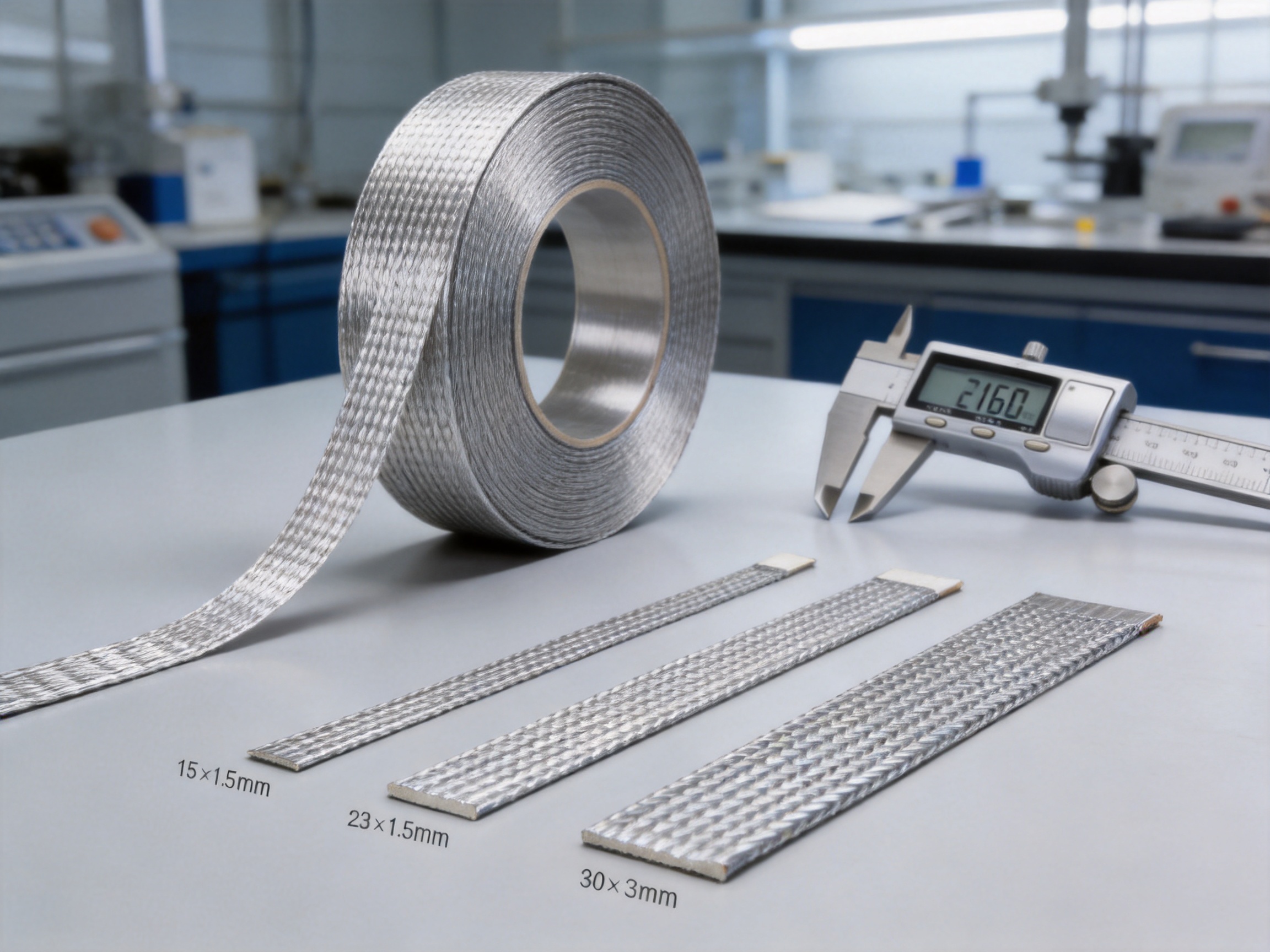
The FSSB 25 316L Stainless Steel Flat Braided Tape is designed for applications that require a flat, flexible, and mechanically durable conductive connection. It is manufactured from 316L stainless steel using wires with a standard diameter of 0.25 mm. The product is available in three cross-sectional options—16 mm², 25 mm², and 50 mm²—with corresponding flat dimensions of 15 × 1.5 mm, 23 × 1.5 mm, and 30 × 3 mm. Each product variation is supplied in a 25-meter package.
Unlike ordinary solid strips, the braided construction allows the tape to flex, conform to uneven surfaces, and absorb some of the mechanical strain that would otherwise be transferred to terminals, fasteners, housings, or connected equipment. The use of 316L stainless steel further supports applications where corrosion resistance, structural durability, and stable performance in challenging environments are important design considerations.
This article examines the product’s construction, specifications, application value, manufacturing strengths, quality considerations, customization potential, and selection criteria. It also explains how Zhejiang Zhongyan New Energy Co., Ltd. supports the production of precision conductive components for power transmission, energy storage, electric vehicles, industrial equipment, and other demanding electrical systems.

FSSB 25 316L Stainless Steel Flat Braided Tape
Content
- Product Overview
- Technical Specifications
- Why a Flat Braided Structure Matters
- Advantages Compared with Conventional Alternatives
- Material Selection: 316L Stainless Steel
- Manufacturing Process and Quality Strengths
- Applications
- Installation Recommendations
- Electrical and Thermal Design Considerations
- Environmental and Mechanical Reliability
- OEM and Customized Manufacturing Services
- How to Select the Correct FSSB 25 Version
- Quality Assurance and Validation
- Frequently Asked Questions
- What is the FSSB 25 316L Stainless Steel Flat Braided Tape?
- Is this product made from copper?
- What dimensions are available?
- How long is each package?
- What are the main advantages of the flat braided construction?
- Is the product suitable for high-current applications?
- Can the tape be used outdoors?
- Can the product be customized?
- Can it be used in battery systems?
- How should the braid be installed?
- What information should be provided for an OEM quotation?
- How can product performance be verified?
- Conclusion
- References
- Product: FSSB 25 316L Stainless Steel Flat Braided Tape
Product Overview
The FSSB 25 series is a flat braided tape made from 316L stainless steel wire. Each individual wire has a standard diameter of 0.25 mm. These fine wires are braided into a flat conductive structure that can be handled, routed, compressed, and installed more easily than many rigid electrical conductors.
The product is supplied in long continuous lengths, with standard packaging of 25 meters. Long-length packaging is useful for manufacturers and installers because it reduces the number of joints required in production and allows the tape to be cut according to the specific connection length. It is suitable for both prototype development and volume manufacturing, subject to the customer’s required cutting, termination, and assembly process.
The flat form is particularly valuable in applications where installation space is limited. A flat braid can be positioned along a panel, around an edge, across a joint, or between two conductive surfaces. Compared with a round cable, it may offer a lower-profile route and a broader contact area when secured under a clamp, terminal, busbar, or fastening system.
The product should be understood as a stainless steel braided tape rather than a conventional copper braid. Stainless steel and copper have different electrical, mechanical, thermal, and corrosion characteristics. The correct material selection depends on the required current, resistance, temperature, mechanical loading, environmental exposure, and connection design. The FSSB 25 is intended for customers who value the specific balance provided by 316L stainless steel and a flexible braided construction.
Key Product Characteristics
The primary product characteristics include 316L stainless steel construction, 0.25 mm standard wire diameter, flat braided geometry, flexible handling, long-length packaging, and three available cross-sectional options. These characteristics make the product adaptable to electrical assemblies that need a combination of conductivity, flexibility, compactness, and environmental durability.
The 316L designation identifies a low-carbon austenitic stainless steel grade commonly selected for improved corrosion resistance compared with many general-purpose stainless steel grades. The molybdenum-bearing composition associated with 316L can be beneficial in environments exposed to moisture, salts, and certain corrosive contaminants. Actual performance depends on the surrounding environment, surface condition, connection hardware, temperature, and installation practices.
The fine 0.25 mm wires contribute to the braid’s flexibility. Rather than relying on one thick metal strip, the structure distributes bending across many small wires. This can help the tape conform to the movement of connected components and reduce localized bending stress. The resulting product can be easier to route through compact assemblies than a rigid metal bar.
Technical Specifications
The available product versions are summarized in the following table. The dimensions and packaging information are based on the supplied product data.
| Part Number | Description | Nominal Cross Section | Flat Dimensions | Packaging | Listed Weight |
|---|---|---|---|---|---|
| 23000479 | FSSB 25-16² | 16 mm² | 15 × 1.5 mm | 25 m | 0.14 kg |
| 23000480 | FSSB 25-25² | 25 mm² | 23 × 1.5 mm | 25 m | 0.22 kg |
| 23000481 | FSSB 25-50² | 50 mm² | 30 × 3 mm | 25 m | 0.44 kg |
The stated dimensions should be used as reference values during preliminary design. Braided products can experience small dimensional changes depending on braid tension, flattening, handling, compression, and the method used to measure width and thickness. For a final engineering specification, customers should confirm tolerances, termination details, electrical performance, and environmental requirements with the manufacturer.
The listed packaging length of 25 meters gives users flexibility in production planning. It can reduce material waste when several assemblies are cut from one continuous package, while also allowing the same product family to be used in different equipment designs. If a particular project requires pre-cut lengths, drilled ends, crimped terminals, plated contact areas, insulation, or additional assembly operations, these requirements can be discussed as part of an OEM manufacturing program.
Why a Flat Braided Structure Matters
A braided tape differs from a rigid busbar, solid strip, or ordinary round conductor because its electrical path is formed by multiple interwoven wires. This structure creates a flexible connection that can move in several directions. The tape can bend, twist slightly, and adapt to installation conditions without requiring the entire connection to behave like a solid member.
In electrical equipment, movement can result from thermal expansion, vibration, door or cover operation, equipment assembly tolerances, transportation, or the relative motion of battery modules and enclosures. A rigid conductor may transfer these forces directly into the connection points. Over time, this can contribute to fatigue, loosening, cracking, or deformation. A properly designed braid can act as a flexible link that helps accommodate such movement.
The flat profile also supports compact routing. In a cabinet, battery pack, distribution assembly, or industrial machine, available space may be restricted by insulation, cooling channels, fasteners, protective covers, and neighboring conductors. A flat tape can be installed in a controlled plane and may occupy less routing volume than an equivalent round conductor in certain layouts.
Another benefit is the broad geometry of the contact area. When the tape is terminated correctly, the flat end can be integrated with a terminal plate, busbar, grounding point, or conductive joint. The final contact performance depends on the termination method, surface preparation, contact pressure, hardware, and applicable electrical design standards. The braid itself is only one part of the complete connection system.
Flexibility and Mechanical Relief
One of the main advantages of the FSSB 25 is its ability to provide mechanical relief between connected components. A flexible connection can help prevent the conductor from becoming a structural bridge between two parts that expand, vibrate, or shift independently.
The many-wire construction distributes bending across the braid rather than concentrating it in one narrow bend line. This is especially useful in assemblies that are opened, closed, serviced, or connected across a moving joint. Examples may include equipment doors, removable panels, battery covers, power modules, and links between adjacent conductive components.
Flexibility should not be confused with unlimited fatigue resistance. The minimum bend radius, bend direction, motion frequency, clamping method, and protection against abrasion all influence service life. Engineers should avoid sharp creases, repeated bending at the same point, excessive twisting, and unsupported vibration. Where the product is used in a dynamic application, a motion and fatigue evaluation is recommended.
Compact Installation
The flat form can help simplify the design of compact electrical assemblies. A 15 mm, 23 mm, or 30 mm wide tape can be placed in a defined path and secured against a conductive or insulating surface. The low-profile arrangement may be useful when enclosure depth is limited or when the connection must pass beneath a cover.
Flat geometry can also make visual inspection easier. Installers can check the braid’s position, contact overlap, fastener alignment, and potential interference with nearby parts. In automated production, a defined width and continuous length may support repeatable cutting, forming, and termination operations.
Resistance to Corrosive Conditions
316L stainless steel is commonly chosen for environments where corrosion resistance is a significant requirement. The grade is widely used in marine-adjacent equipment, chemical-processing environments, food-processing machinery, outdoor electrical systems, and industrial assemblies exposed to moisture or contaminants.
The use of 316L does not make the complete assembly immune to corrosion. Galvanic interaction can occur when stainless steel is joined with copper, aluminum, zinc-plated steel, or other dissimilar metals in the presence of an electrolyte. The joint design should therefore consider terminal materials, plating, washers, sealants, contact compounds, and environmental exposure.
For outdoor, high-humidity, salt-spray, or chemically exposed applications, the complete system should be tested rather than evaluated only by the braid material. Proper enclosure design, drainage, sealing, cleaning, and fastener selection are all important to long-term reliability.
Advantages Compared with Conventional Alternatives
Customers often compare braided tape with solid busbars, flexible copper braids, stranded cables, and prefabricated flexible connectors. Each alternative has an appropriate application range. The FSSB 25 offers a distinctive combination of stainless steel material, flat geometry, continuous length, and flexible mechanical behavior.
Compared with Rigid Busbars
Rigid busbars are efficient for fixed, accurately aligned connections. They can provide a defined shape and high mechanical stability, but they generally require precise installation alignment. If connected components move or expand at different rates, a rigid busbar may need additional expansion joints, bends, supports, or flexible sections.
The FSSB 25 can reduce the need for complex formed sections in applications where moderate flexibility is required. It can be routed after the surrounding components have been positioned, helping compensate for assembly tolerances. This may simplify installation and reduce the mechanical load transferred to terminals.
A rigid busbar can still be the better choice for applications requiring a fixed structural conductor, precise clearances, high short-circuit withstand, or a defined three-dimensional geometry. The selection should be based on the full electrical and mechanical specification rather than flexibility alone.
Compared with Round Stranded Cables
Round stranded cables are widely used and can offer excellent flexibility. However, they may require more routing space and specialized lugs or terminals. Their circular profile can make it difficult to maintain a low-profile connection in shallow enclosures.
A flat braid can offer a more controlled installation footprint. Its width can be aligned with a flat terminal or busbar surface, and its profile may be advantageous where height is restricted. The tape may also be easier to place across a short gap or around a panel edge without creating a large loop.
Round cables remain valuable when long-distance routing, insulation, high bend frequency, or standardized cable accessories are required. The FSSB 25 is most beneficial when a short or moderate-length flexible link with a flat form is preferred.
Compared with Copper Braided Tape
Copper braided tape generally provides higher electrical conductivity than stainless steel and is often selected for high-current flexible connections. However, copper may require additional surface treatment, plating, insulation, or environmental protection depending on the operating conditions.
The FSSB 25 is not intended to replace copper in every current-carrying application. Its value lies in the properties of 316L stainless steel, including mechanical durability and corrosion resistance. In some applications, the required current is moderate while the environmental or mechanical requirements make stainless steel attractive.
Engineers should compare electrical resistance, allowable temperature rise, current density, contact resistance, corrosion behavior, mechanical fatigue, and cost. The choice between copper and stainless steel should be made using measured or verified data for the complete assembly.
Compared with Solid Stainless Steel Strips
A solid stainless steel strip can provide corrosion resistance and mechanical strength but lacks the inherent flexibility of a braid. It may need to be formed with bends or loops to accommodate movement. Those formed sections can increase the required installation space and may create stress concentration points.
The braided FSSB 25 provides flexibility without requiring the entire strip to be permanently formed. This can improve installation adaptability and make replacement or service work more convenient. The braid can be positioned to follow the equipment layout while maintaining a relatively flat profile.
Material Selection: 316L Stainless Steel
Material selection is central to product performance. Stainless steel 316L is recognized for its combination of corrosion resistance, strength, formability, and durability. The low-carbon version is commonly preferred for welded or thermally affected components because it reduces the risk of certain sensitization-related corrosion issues associated with higher-carbon variants.
In a braided tape, the material must withstand repeated handling during manufacturing, cutting, forming, and installation. The wire must be sufficiently consistent to support stable braiding. Variations in wire diameter, surface condition, tensile behavior, or hardness can influence braid uniformity and flexibility.
The 0.25 mm wire diameter represents a balance between fine-wire flexibility and the need to create a stable conductive structure. Smaller wires can generally support smoother bending, while larger wires may increase stiffness and resistance to deformation. The selected diameter is therefore an important part of the product’s mechanical behavior.
Stainless steel electrical conductivity is lower than that of copper and aluminum. For this reason, designers must not select the product solely by nominal cross-sectional area. The required current, allowable voltage drop, thermal conditions, connection length, and duty cycle must be reviewed. The nominal cross-section identifies the product size, but the complete electrical performance must be confirmed for the intended use.
Surface Condition and Contact Quality
The braid’s surface condition affects contact performance and environmental durability. A clean, consistent wire surface supports reliable handling and termination. Contamination, oil, embedded particles, or excessive oxidation can increase contact resistance or interfere with assembly.
When the braid is connected to another conductor, the joint should be designed to provide stable contact pressure across the intended area. Fasteners should be tightened according to the assembly specification. If the joint is exposed to vibration or thermal cycling, locking features and suitable hardware may be required.
Where stainless steel is joined to copper or aluminum, the designer should consider galvanic compatibility. Appropriate plating, transition components, washers, joint compounds, or environmental seals may be needed. These decisions should be validated through corrosion testing and electrical resistance measurements when the application is safety-critical.
Manufacturing Process and Quality Strengths
Zhejiang Zhongyan New Energy Co., Ltd. specializes in new energy conductive components and precision flexible connection products. The company’s capabilities include product design, research and development, manufacturing, testing, and solution support. This integrated approach is valuable because a braided tape is not simply a commodity wire product; its performance depends on material control, braid consistency, dimensional stability, and correct integration into the customer’s assembly.
The manufacturing process begins with material preparation. Stainless steel wire is selected and inspected according to the required grade and diameter. Consistent wire supply is essential because changes in diameter or mechanical properties can affect the finished tape’s width, thickness, flexibility, and cross-sectional distribution.
During braiding, multiple wires are interwoven under controlled tension. Braid tension influences the compactness and geometry of the finished tape. Excessive tension can make the tape too tight or stiff, while insufficient control can produce an uneven structure. A stable process helps maintain consistent width and supports repeatable cutting and termination.
After braiding, the tape may undergo flattening, sizing, inspection, and packaging operations. The target dimensions for the FSSB 25 family include the specified widths and thicknesses for the 16 mm², 25 mm², and 50 mm² versions. Process monitoring helps identify irregular edges, broken wires, loose sections, excessive deformation, and packaging defects.
Quality control should cover incoming material, in-process braid appearance, dimensional conformity, length, packaging, and final product condition. Depending on the customer’s requirements, additional checks may include electrical resistance, tensile performance, bend behavior, surface cleanliness, corrosion exposure, and termination pull strength.
The company’s experience with high-voltage electrical copper foil soft connections, battery soft connections, special-shaped flexible connections, and other precision components contributes to its understanding of flexible current paths. This experience supports the development of products that must combine electrical function with mechanical reliability and process consistency.
Advanced Joining and Connection Expertise
The company reports capabilities in polymer diffusion welding and laser technology for the production of low-resistance, high-reliability conductive components. These technologies are particularly relevant to battery connection systems and precision electrical assemblies. Although the FSSB 25 is a braided stainless steel tape, the broader manufacturing expertise can support related termination, joining, and custom connector projects.
Laser processing can provide precise, localized energy for cutting, welding, marking, and shaping. When properly controlled, it can help reduce heat-affected areas and support repeatable component geometry. Diffusion-based joining can create stable interfaces between suitable materials under controlled pressure and temperature conditions.
Such technologies are valuable for customers seeking more than bulk material. They can support the development of complete flexible connection assemblies, including cut-to-length pieces, formed sections, terminals, protective components, and integrated battery or busbar interfaces.
Engineering and Customization Support
Different applications require different braid lengths, widths, terminal configurations, mounting holes, bend directions, insulation systems, and environmental protections. A manufacturer with design and development capabilities can help convert an electrical requirement into a manufacturable component.
Customization may include non-standard lengths, pre-cut pieces, terminal integration, hole punching, end flattening, crimping, welding, plating, protective sleeving, labeling, and packaging. The feasibility of each option depends on the material, cross section, production volume, electrical rating, and customer assembly process.
Design support should begin with a clear application specification. Important information includes operating current, voltage, frequency, maximum temperature, expected movement, installation space, terminal material, environmental exposure, vibration level, service life, and applicable standards. With this information, the product can be evaluated as part of a complete connection rather than as an isolated strip.

Applications
The FSSB 25 316L stainless steel flat braided tape can be considered for a wide range of flexible conductive applications. Final suitability must be verified by the equipment designer, particularly where the connection is part of a high-current, high-voltage, safety-critical, or high-temperature system.
Power Distribution Equipment
Power distribution cabinets and electrical panels often contain doors, removable covers, hinged sections, and equipment modules that require bonding or flexible connection. A flat braid can provide a compact link between a moving panel and the fixed grounding or conductive structure.
It may also be used between adjacent assemblies where minor movement or installation tolerance exists. The product can be cut to a suitable length and terminated using a design appropriate to the equipment’s electrical and mechanical requirements.
Industrial Machinery
Industrial machines are exposed to vibration, repeated operation, maintenance activity, and thermal changes. Flexible conductive links may be used between motor assemblies, control panels, machine frames, moving guards, and power modules.
The stainless steel construction can be advantageous in workshops or production environments where moisture, cleaning chemicals, dust, or airborne contaminants are present. Protection from abrasion and contact with sharp edges should still be provided.
Battery and Energy Storage Systems
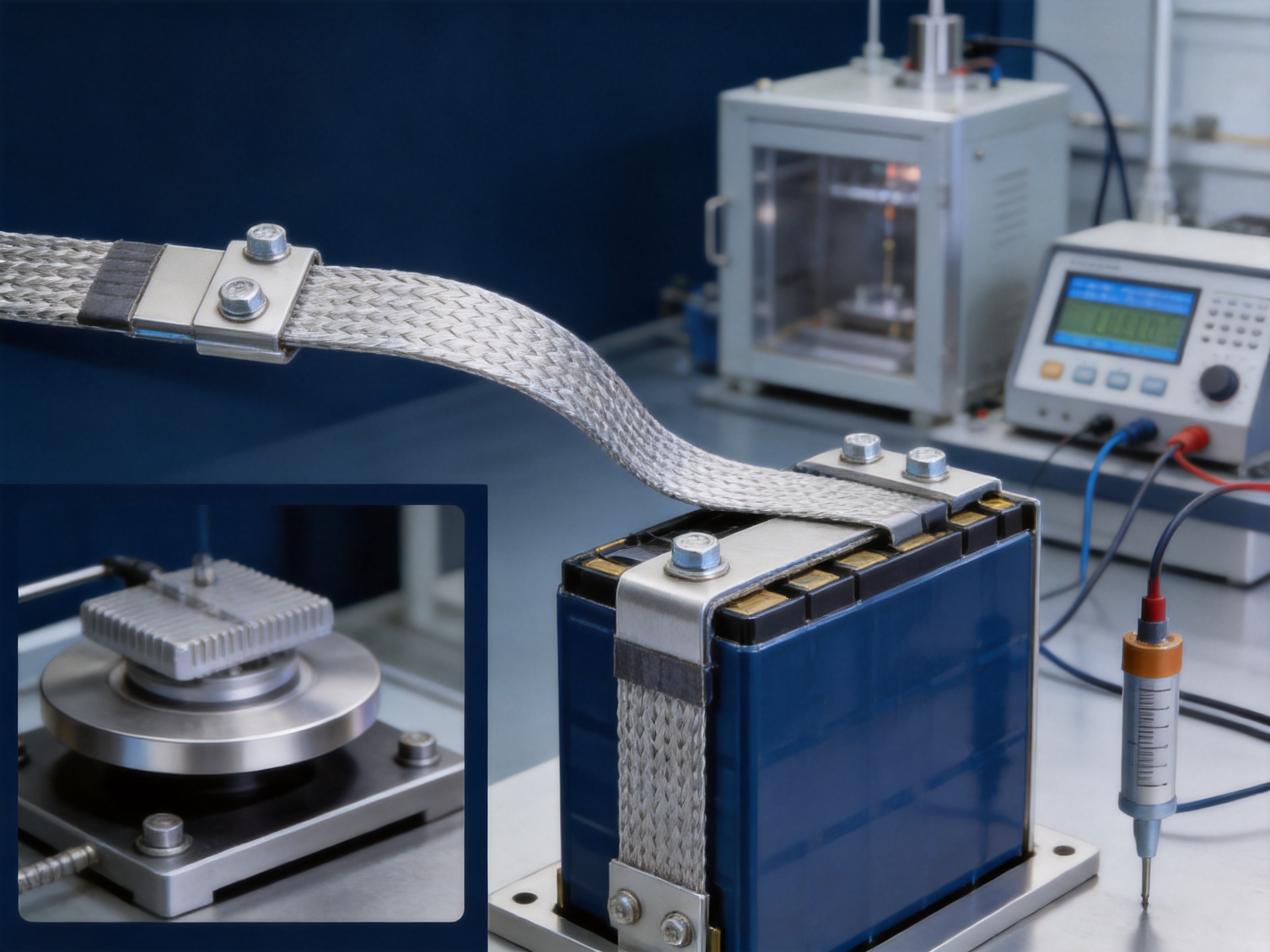
Energy storage systems require reliable current paths between cells, modules, busbars, contactors, enclosures, monitoring equipment, and protection devices. Flexible connections can help accommodate module assembly tolerances and reduce mechanical loads on terminals.
The FSSB 25 can be evaluated for selected battery-system bonding, grounding, auxiliary conductive, or flexible interconnection functions. The current rating and thermal behavior must be determined for the specific system. Battery applications also require careful attention to insulation coordination, creepage and clearance, fault current, vibration, fire safety, and service procedures.
Zhejiang Zhongyan New Energy Co., Ltd. develops products for battery soft connections, cell connection systems, battery storage connectors, and other new energy components. This industry focus provides a useful foundation for customers developing integrated battery connection solutions.
Rail Transit and Transportation Equipment
Rail transit and transportation systems commonly require conductive connections that can tolerate vibration, movement, and environmental exposure. Flat flexible links may be used in equipment cabinets, grounding assemblies, power modules, and enclosure bonding systems.
Transportation applications generally require extensive validation, including vibration, shock, temperature cycling, humidity, salt exposure, fire behavior, and electrical endurance. The product must be evaluated according to the applicable transportation and system-level standards.
Communication and Power Electronics
Communication equipment, rectifiers, inverter systems, and power electronics assemblies may contain compact conductive paths between heat sinks, chassis sections, distribution plates, and removable modules. A low-profile braid can help preserve space for cooling and insulation while accommodating service access.
In high-frequency or sensitive electronic systems, the connection’s inductance, loop area, grounding arrangement, and electromagnetic compatibility should be considered. The product’s suitability depends not only on its direct-current resistance but also on the electrical behavior of the complete layout.
Installation Recommendations
Correct installation is essential for achieving the expected performance of any braided conductor. The tape should be routed without sharp kinks or unnecessary twisting. Bends should be gradual, and the braid should not be forced into a position that places excessive stress on the terminals.
The connection should be supported so that its weight and vibration are not carried entirely by the termination points. Where the braid crosses a metal edge, an insulating or protective barrier may be required. The tape should not be scraped, crushed, pierced, or exposed to repeated rubbing during operation.
Terminations should provide adequate contact area and stable pressure. If the braid is clamped between flat conductive surfaces, the surfaces should be clean, aligned, and free from burrs. The use of washers, spring elements, locking nuts, or other retention features should be considered where vibration is present.
Installers should avoid clamping directly over an area that must flex during service. The flexible section should have enough free length to accommodate the expected movement without reaching its maximum extension or creating a sharp bend at the clamp.
After installation, the assembly should be inspected for loose wires, uneven compression, insufficient overlap, interference with nearby parts, and inadequate insulation. Electrical resistance and continuity should be checked where appropriate. For production equipment, the inspection method should be documented and repeatable.
Termination Options
The appropriate termination depends on the mating components and required electrical rating. Possible approaches include bolted flat terminals, crimped lugs, welded end pieces, formed ends, plated contact tabs, or custom connector assemblies. The product may be supplied as continuous tape for customer-side processing or developed as a finished component with integrated ends.
Bolted joints should be designed around the required contact pressure, fastener size, hole diameter, edge distance, and available clamping area. Crimped joints require controlled tooling and a verified crimp profile. Welded terminations require material compatibility, process qualification, and inspection of the joint.
It is important to distinguish the nominal braid cross section from the effective contact area at the termination. A connection that is too narrow, poorly compressed, or damaged during preparation may create a localized hot spot even when the braid itself is correctly sized.
Electrical and Thermal Design Considerations
The FSSB 25 should be selected using the electrical requirements of the complete circuit. The nominal cross-sectional options are 16 mm², 25 mm², and 50 mm², but allowable current depends on material resistivity, length, ambient temperature, cooling, installation arrangement, duty cycle, contact resistance, and permissible temperature rise.
Stainless steel has a higher electrical resistance than copper. This means that a stainless steel braid may require a larger cross section, shorter length, lower current, or enhanced cooling compared with a copper braid for the same voltage-drop and temperature-rise target. This is not a disadvantage in every application; it is a design characteristic that must be included in the calculation.
Temperature affects electrical resistance and mechanical behavior. The braid should be evaluated at the maximum expected operating temperature, including heat from adjacent components. If the product is installed inside a sealed enclosure, natural convection may be limited. If it is routed near batteries, resistors, power semiconductors, or busbars, thermal coupling should be assessed.
Short-circuit conditions require separate consideration. Peak fault current can create electromagnetic forces and rapid heating that differ substantially from normal operating conditions. A flexible braid used in a protective or power-distribution system should be assessed for short-time withstand, mechanical restraint, and termination integrity.
Where the tape forms part of a high-voltage assembly, electrical insulation and clearance must be designed around the complete product. An uninsulated braid may require sleeving, molded insulation, barriers, or enclosure protection. The braid’s flat shape can influence creepage distance and electric-field distribution, so the layout should be reviewed carefully.
Environmental and Mechanical Reliability
Reliability depends on the interaction between material, braid structure, termination, environment, and installation. A high-quality braid can still fail if it is over-bent, under-supported, exposed to incompatible chemicals, or connected with insufficient contact pressure.
For vibration applications, the braid should be tested in its final installed configuration. The length between supports, terminal stiffness, bend location, and fastener design all influence fatigue behavior. Testing only the loose tape may not represent the stresses experienced in the finished equipment.
For humid or corrosive environments, the complete assembly should be assessed for surface corrosion, galvanic effects, contact resistance growth, and mechanical degradation. A stainless steel braid may perform well while an incompatible terminal or fastener becomes the limiting component.
For outdoor applications, water collection and drainage should be prevented. The braid should not be installed in a location where water, salt, or chemical residue can remain trapped at the termination. Protective covers, suitable coatings, and sealed enclosures may be required.
For repeated motion, the bend radius and movement path should be controlled. The braid should flex over a broad area rather than at one sharp point. Cable supports, strain reliefs, flexible insulation, and protective sleeves can improve service life when correctly applied.
OEM and Customized Manufacturing Services
Many customers need a finished flexible connection rather than a roll of raw braid. An OEM manufacturer can support the transition from concept to production by reviewing the electrical drawing, mechanical envelope, terminal requirements, materials, and test criteria.
Customized versions may include a specified overall length, different end treatments, punched mounting holes, terminal plates, special bends, protective insulation, color identification, labels, or customer-specific packaging. The braid can also be incorporated into a larger flexible busbar or battery connection assembly.
For new projects, the recommended process is to begin with prototype samples. Prototype evaluation can confirm fit, bend behavior, terminal assembly, resistance, temperature rise, and compatibility with neighboring parts. Once the design is approved, production documentation can define the material, dimensions, tolerances, inspection points, packaging, and change-control requirements.
Zhejiang Zhongyan New Energy Co., Ltd. offers product development and manufacturing support for conductive components used in power distribution, electric vehicles, rail transit, communications, and energy storage. Its technical team and specialized equipment support the production of precision flexible connections and related new energy components.
The company was established in 2022 and has focused on precision components such as battery soft connections. It has developed capabilities involving materials science, precision machining, testing, verification, diffusion welding, and laser processing. This combination allows the company to support customers that require both a standard product and a customized connection solution.
The company also reports cooperation with major enterprises, including BYD, CATL, and Jaguar. Such experience indicates exposure to demanding supply-chain, quality, and consistency requirements. Customers should still confirm the specific quality system, certifications, process approvals, and testing documentation required for their own project.
How to Select the Correct FSSB 25 Version
The first selection factor is the required electrical performance. Customers should identify normal current, peak current, voltage drop, operating duration, ambient temperature, and allowable temperature rise. The 16 mm², 25 mm², and 50 mm² products should be compared using verified electrical data rather than cross-sectional area alone.
The second factor is mechanical movement. Determine whether the braid will remain stationary, vibrate continuously, flex occasionally, or move repeatedly throughout the equipment’s life. Record the movement direction, amplitude, frequency, and expected number of cycles.
The third factor is available space. The nominal widths are 15 mm, 23 mm, and 30 mm, while the listed thicknesses are 1.5 mm, 1.5 mm, and 3 mm. These dimensions should be compared with nearby insulation, covers, fasteners, and access requirements.
The fourth factor is the termination. Identify the terminal material, bolt size, hole pattern, contact area, plating, required crimp, and assembly tool. A braid that fits electrically may still be unsuitable if it cannot be terminated consistently.
The fifth factor is environmental exposure. Consider humidity, condensation, salt spray, cleaning chemicals, oil, dust, temperature extremes, ultraviolet exposure, and corrosive gases. The braid, terminals, insulation, and enclosure should be evaluated as one system.
The final factor is production volume and supply format. A 25-meter package may be ideal for a customer that performs in-house cutting and termination. Customers requiring controlled lengths or finished assemblies may benefit from an OEM quotation covering processing, inspection, and packaging.
Quality Assurance and Validation
A professional validation plan should include dimensional, material, electrical, mechanical, and environmental checks. Dimensional inspection can confirm width, thickness, length, and termination geometry. Visual inspection can identify broken wires, loose braiding, damaged edges, contamination, and irregular flattening.
Electrical testing may include continuity, resistance, contact resistance, insulation resistance when insulation is added, and temperature-rise testing under the intended installation conditions. The test current, duration, ambient temperature, support arrangement, and termination method should be documented.
Mechanical testing may include tensile strength, pull-out resistance, bend testing, vibration, shock, and repeated flexing. The appropriate test depends on whether the product functions as a static flexible link, a grounding connection, a battery interconnect, or a continuously moving conductor.
Environmental validation may include humidity, thermal cycling, salt spray, chemical exposure, and corrosion evaluation. Galvanic compatibility testing is particularly relevant when 316L stainless steel is joined to copper or aluminum components.
Production quality should be supported by traceability. Material batches, process parameters, inspection records, and nonconformance handling should be controlled. For high-volume or safety-relevant programs, customers may request control plans, process flow diagrams, failure mode analysis, first-article inspection, and statistical process monitoring.
Frequently Asked Questions
What is the FSSB 25 316L Stainless Steel Flat Braided Tape?
It is a flexible flat conductive tape made from 316L stainless steel wire. The standard wire diameter is 0.25 mm. The tape is available in nominal cross sections of 16 mm², 25 mm², and 50 mm².
Is this product made from copper?
No. The FSSB 25 product described here is made from 316L stainless steel. It belongs to the flexible braided tape product category, but it should not be confused with a copper braided tape. Stainless steel and copper have different electrical and mechanical properties.
What dimensions are available?
The 16 mm² version is listed as 15 × 1.5 mm, the 25 mm² version is listed as 23 × 1.5 mm, and the 50 mm² version is listed as 30 × 3 mm. Customers should confirm manufacturing tolerances before final design approval.
How long is each package?
Each listed version is supplied in a 25-meter package. The continuous length can be cut into individual pieces for assembly or used in a production process that performs in-house termination.
What are the main advantages of the flat braided construction?
The structure provides flexibility, a low-profile shape, installation adaptability, and mechanical relief between connected components. It can accommodate some movement and vibration more effectively than a rigid strip when the application is correctly designed.
Is the product suitable for high-current applications?
Suitability depends on the required current, voltage drop, temperature rise, length, cooling, duty cycle, and termination. Because stainless steel is less electrically conductive than copper, engineers must perform a specific electrical and thermal assessment before approving the product for high-current service.
Can the tape be used outdoors?
It may be considered for outdoor applications because 316L stainless steel offers strong corrosion resistance in many environments. However, the complete assembly must also address water accumulation, galvanic corrosion, terminal materials, sealing, salt exposure, and temperature. Testing under the actual environmental conditions is recommended.
Can the product be customized?
Customization may be possible for length, end treatment, terminal configuration, mounting holes, insulation, forming, plating, labeling, and packaging. Requirements should be supplied in a technical drawing or application specification for feasibility review.
Can it be used in battery systems?
It can be evaluated for selected battery, energy storage, grounding, module, or auxiliary connection applications. Battery-system use requires additional review of current, fault energy, insulation, vibration, thermal conditions, creepage, clearance, and fire-safety requirements.
How should the braid be installed?
It should be routed without sharp creases, excessive twisting, or unsupported weight at the terminals. The connection surfaces should be clean and aligned, and the termination should provide stable contact pressure. Protective measures should be used wherever the braid may rub against sharp or abrasive edges.
What information should be provided for an OEM quotation?
Useful information includes required length, cross section, current, voltage, temperature, movement, terminal design, hole pattern, material compatibility, insulation requirements, environmental conditions, annual quantity, packaging, and applicable test standards.
How can product performance be verified?
Verification may include dimensional inspection, material confirmation, resistance testing, contact-resistance testing, temperature-rise testing, mechanical pull testing, vibration testing, repeated-flex testing, and environmental exposure testing. The test plan should reflect the product’s actual intended use.
Conclusion
The FSSB 25 316L Stainless Steel Flat Braided Tape offers a practical solution for flexible conductive connections that require a flat profile, controlled dimensions, corrosion-resistant material, and adaptable installation. Its 0.25 mm stainless steel wires form a braid capable of accommodating movement and reducing mechanical stress compared with a rigid conductor.
The three available versions—16 mm², 25 mm², and 50 mm²—allow customers to select a suitable starting point for different assembly requirements. The 25-meter packaging format supports cutting and processing in both development and production environments. For applications requiring specific terminal designs or integrated assemblies, customization can extend the product from a continuous tape into a finished OEM component.
The product should be evaluated with a complete engineering approach. Stainless steel does not provide the same conductivity as copper, so current capacity and temperature rise must be calculated and tested. At the same time, 316L stainless steel can provide valuable corrosion resistance and mechanical durability where those characteristics are more important than maximum conductivity.
Zhejiang Zhongyan New Energy Co., Ltd. combines flexible connection manufacturing with broader expertise in battery soft connections, high-voltage conductive components, precision joining, laser processing, and new energy electrical systems. This foundation enables the company to support standard product supply as well as customized development for power distribution, energy storage, electric vehicles, rail transit, communications, and industrial equipment.
When correctly sized, terminated, supported, and validated, the FSSB 25 can help equipment designers create compact and reliable electrical connections that accommodate real-world movement, vibration, and environmental conditions.
References
1. Product specification data for FSSB 25 316L Stainless Steel Flat Braided Tape, including part numbers, cross sections, dimensions, packaging, and listed weights.
2. Stainless steel material selection principles for corrosion-resistant electrical and mechanical components.
3. General engineering practices for flexible busbars, braided conductors, grounding straps, and vibration-resistant electrical connections.
4. Electrical design principles for conductor sizing, allowable temperature rise, contact resistance, and short-time current withstand.
5. General guidelines for galvanic compatibility when joining stainless steel with copper, aluminum, and other dissimilar metals.
6. Manufacturing and quality-control practices for braided wire, flexible conductive components, battery soft connections, and precision electrical assemblies.
7. Company information and capability statement for Zhejiang Zhongyan New Energy Co., Ltd., including research, manufacturing, testing, laser processing, diffusion welding, and new energy component development.
Product: FSSB 25 316L Stainless Steel Flat Braided Tape

Driven by the development of new energy and aiming for "zero carbon".
Copyright © Zhejiang Zhongyan New Energy Co., Ltd. All Rights Reserved.
