 English
 Español

RRCB Round Pure Copper Braided Band: Flexible High-Current Connection Technology
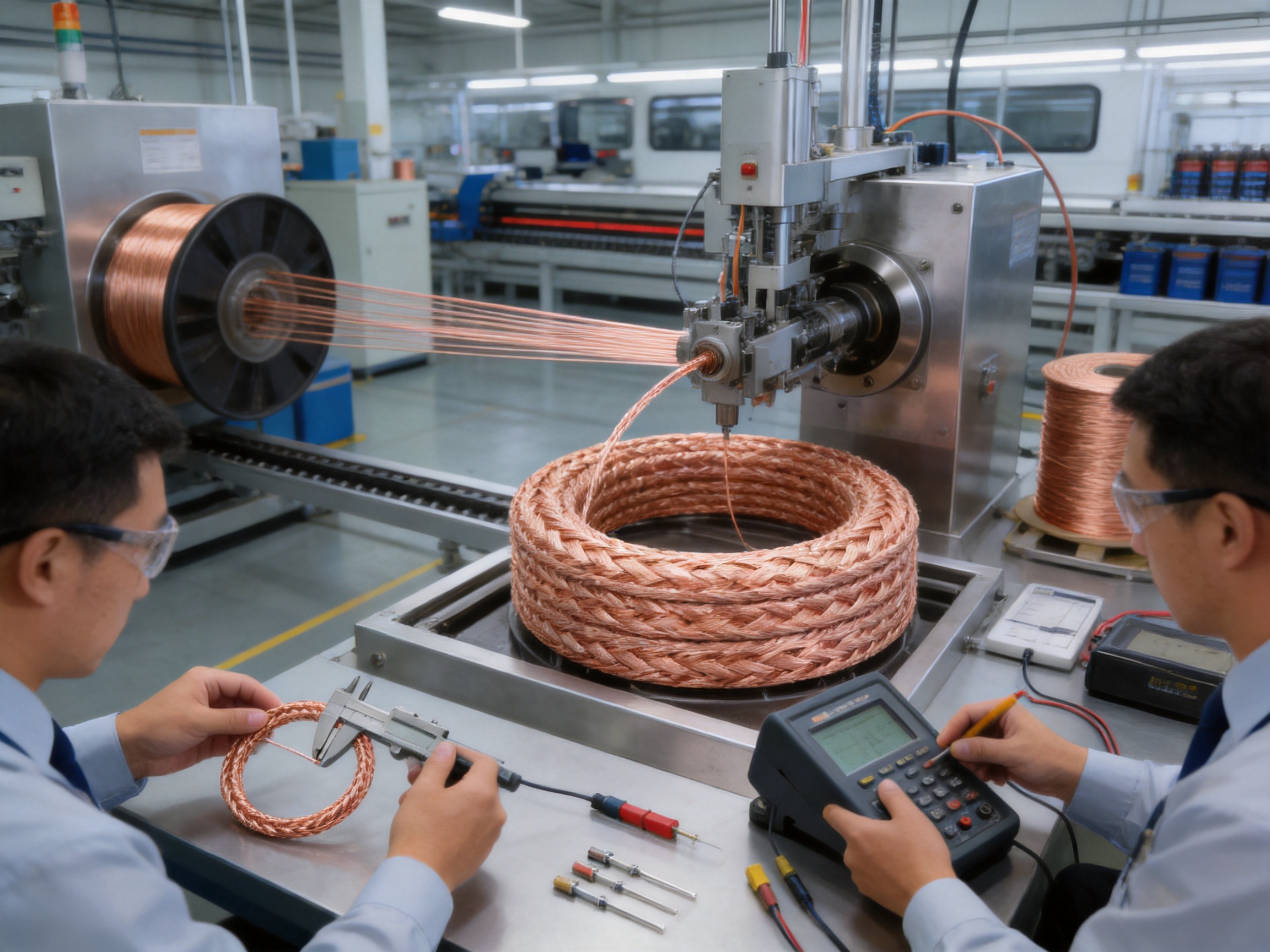
Introduction
Modern electrical and energy systems require connection components that combine high conductivity, mechanical flexibility, reliable current carrying capacity, and long-term durability. Conventional rigid conductors are effective in fixed installations, but they may become less suitable where equipment vibrates, expands thermally, moves during operation, or requires a compact connection between conductive parts. The RRCB Round Pure Copper Braided Band is designed for these demanding applications.
Manufactured from high-purity copper wires with a standard wire diameter of 0.15 mm, the RRCB product provides a flexible conductive path for grounding, electrical equipment, transformers, switchgear, power distribution assemblies, and high-current connections. Its braided structure enables movement and bending while maintaining a large effective conductive area. Supplied in 25-meter coils, it can also be cut, formed, and assembled according to the requirements of different projects.
Unlike a single solid conductor, a round copper braided band consists of numerous fine copper wires woven into a compact and flexible structure. This design helps accommodate vibration, thermal expansion, installation tolerances, and repeated mechanical movement. It can be used as a flexible connector, grounding braid, electrical soft connection, copper expansion joint, or conductive bonding element.
The product is manufactured by Zhejiang Zhongyan New Energy Co., Ltd., a specialist in new energy conductive components, copper foil soft connections, battery soft connections, special-shaped flexible connectors, and precision electrical connection solutions. Through material selection, precision braiding, dimensional control, inspection, and customized manufacturing support, the company serves applications in power transmission and distribution, electric vehicles, rail transit, communications, energy storage, and industrial electrical equipment.
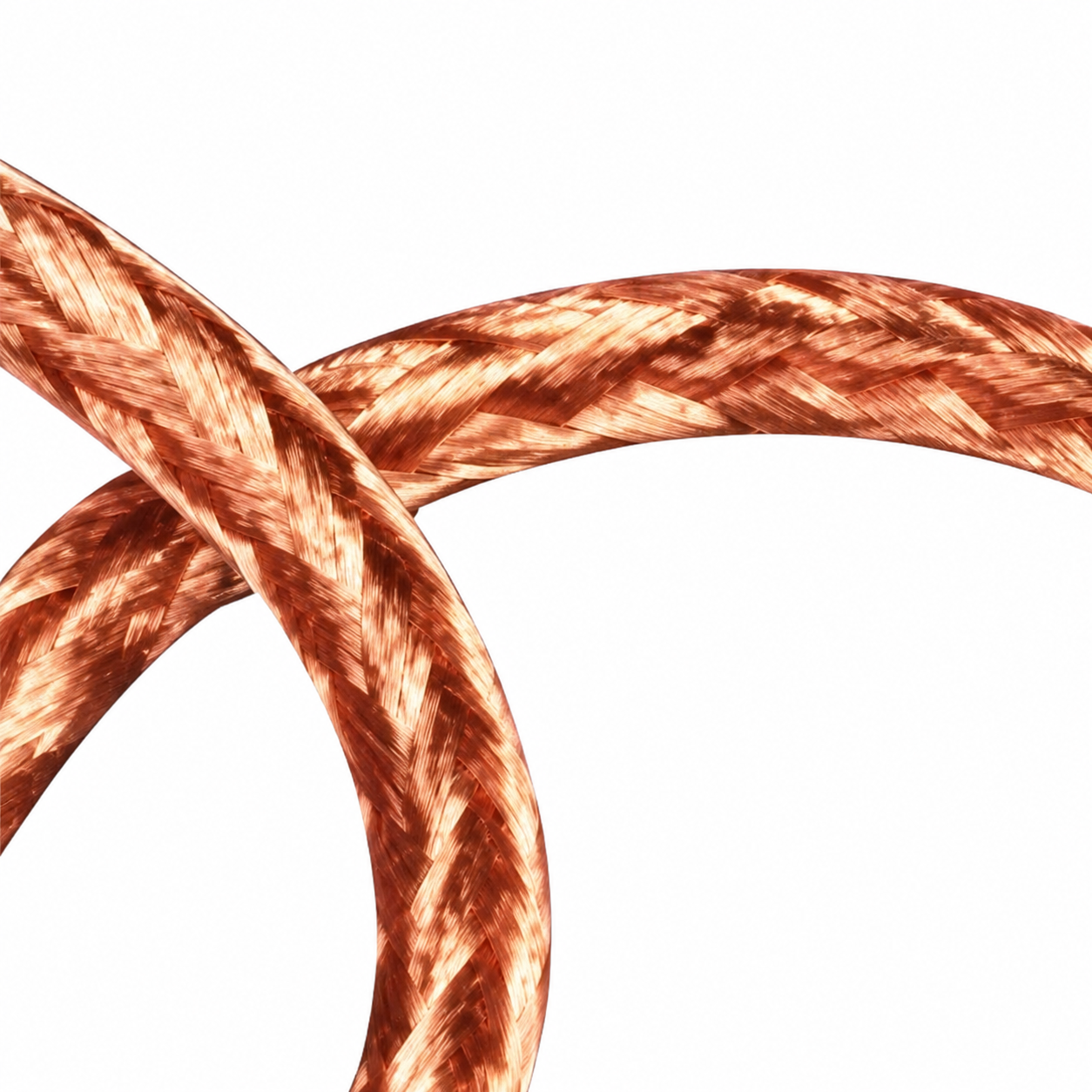
RRCB Round Pure Copper Braided Band
What Is a Round Pure Copper Braided Band?
A round pure copper braided band is a flexible conductor formed by interlacing multiple strands of fine copper wire. The wires are arranged into a tubular or rounded braided configuration rather than being compressed into a rigid bar or enclosed in an insulating jacket. The resulting product offers a combination of electrical performance and mechanical compliance.
The RRCB series uses fine copper wires with a standard diameter of 0.15 mm. Fine wires are important because they allow the braid to bend more easily than a thick solid conductor. Each individual wire can move slightly within the braided structure, reducing the concentration of stress at a single point. This flexibility is useful when a connector must absorb equipment movement or compensate for changes in alignment.
Pure copper is selected because it has excellent electrical conductivity, good thermal conductivity, strong compatibility with many electrical connection systems, and a proven history in power engineering. Copper also provides a balance between conductivity and mechanical workability. It can be braided, compressed, soldered, welded, crimped, or fitted with terminals depending on the final assembly design.
The round form provides additional installation flexibility. It can be routed through narrow spaces, bent around equipment edges, or positioned between terminals with different orientations. In applications where a flat copper strap would be difficult to install, a round braid can simplify routing and reduce the need for rigid alignment.
Because the braid is supplied in a 25-meter coil, users can cut sections according to their production needs. This format is particularly practical for manufacturers of electrical cabinets, switchgear, transformers, grounding assemblies, battery systems, and customized conductive components. It reduces the need to stock many fixed-length variants and makes the product suitable for both standard and custom fabrication.
Core Product Characteristics
High-Purity Copper Construction
The use of high-purity copper supports efficient current transmission and helps reduce unnecessary electrical resistance. In high-current systems, conductor resistance directly affects energy loss and heat generation. A well-designed copper braid can therefore contribute to improved thermal performance and greater connection reliability.
High-purity copper is also well suited to precision manufacturing. Its consistent material properties support stable braiding, forming, and terminal assembly. For customers requiring repeatable production results, material consistency is as important as the nominal cross-sectional area or overall dimensions.
Fine 0.15 mm Wire Diameter
The standard 0.15 mm wire diameter enables the braid to remain flexible while maintaining a dense conductive structure. Compared with larger individual wires, fine wires can accommodate tighter bends and distribute mechanical stress across many elements. This is advantageous in installations exposed to vibration, thermal cycling, or repeated movement.
The fine-wire construction also allows the braid to conform closely to mating surfaces. This can help improve installation fit and reduce the risk of excessive mechanical loading on connected terminals. The final performance still depends on the connector design, contact pressure, installation method, and operating environment, but the flexible braid provides a strong foundation for reliable assembly.
Flexible Mechanical Performance
Rigid busbars and solid copper strips are valuable where fixed geometry is required. However, they may transfer vibration or mechanical stress directly into terminals. A braided connector can act as a flexible transition between two conductive points, helping isolate the terminals from relative movement.
This feature is useful in transformers, switchgear, circuit breakers, power conversion equipment, battery modules, and industrial machinery. The braid can compensate for small differences in position and absorb movement caused by thermal expansion. It can also simplify maintenance because components may be disconnected or repositioned without requiring the entire conductor layout to be redesigned.
High Current Capability
The RRCB range is available in listed cross-sectional sizes from 6 mm² to 100 mm². The corresponding nominal current ratings range from 45 A to 360 A in the supplied product information. These values provide a reference for product selection, but actual allowable current depends on installation conditions, ambient temperature, duty cycle, ventilation, contact resistance, connection method, and applicable standards.
Users should evaluate the braid together with the complete electrical assembly. A conductor that performs well in open air may have a different thermal capacity when installed inside an enclosed cabinet or alongside other heat-producing components. Engineering validation should include temperature rise, short-circuit conditions, mechanical loading, and the actual operating environment.
Coil-Based Supply
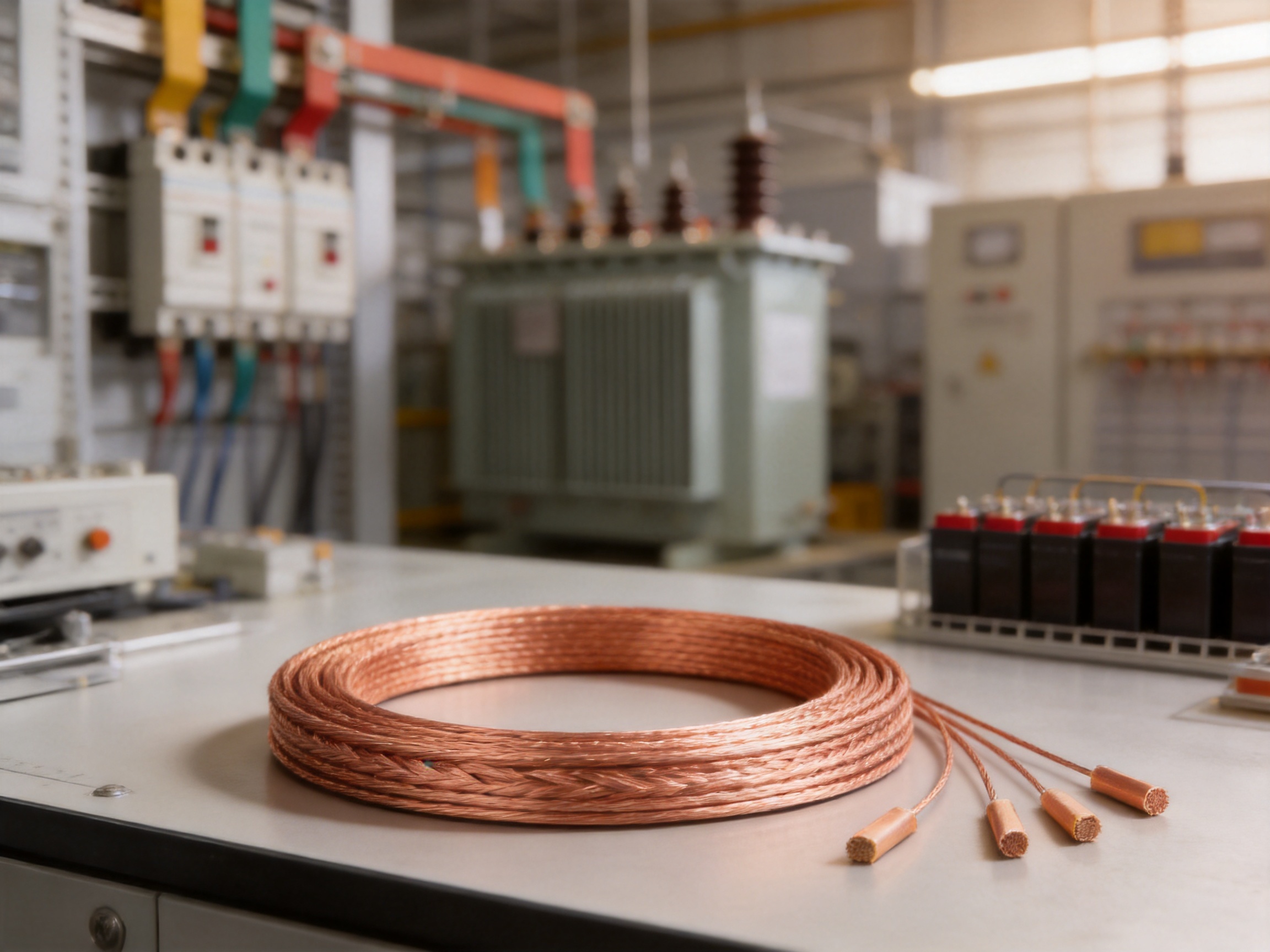
Each standard size is supplied in a 25-meter coil. Coil packaging is convenient for production lines and allows customers to cut the braid to their required length. It also supports the manufacture of multiple connector lengths from one package, which can simplify inventory management.
Coil delivery is especially beneficial for customers that produce custom flexible connectors, grounding straps, electrical assemblies, or battery connection parts. Instead of purchasing a separate finished connector for every application, the customer can use the braided band as a semi-finished conductive material and add terminals, lugs, insulation, or protective coverings as required.
RRCB Product Specifications
The following table summarizes the available standard configurations. The listed dimensions and nominal current values are based on the supplied product information. Before mass production or critical installation, customers should confirm the final technical drawing, tolerance, material grade, current rating, and connection method with the manufacturer.
| Part Number | Description | Cross-Sectional Area | Listed Dimension (mm) | Number of Cores | Nominal Current (A) | Packaging | Weight (kg) |
|---|---|---|---|---|---|---|---|
| 23000495 | RRCB 15-6 | 6 mm² | 4 | 352 | 45 | 25 m coil | 0.06 |
| 23000496 | RRCB 15-8 | 8 mm² | 4.5 | 464 | 65 | 25 m coil | 0.08 |
| 23000497 | RRCB 15-10 | 10 mm² | 5 | 560 | 75 | 25 m coil | 0.10 |
| 23000498 | RRCB 15-16 | 16 mm² | 6 | 900 | 120 | 25 m coil | 0.16 |
| 23000499 | RRCB 15-25 | 25 mm² | 8 | 1,416 | 150 | 25 m coil | 0.25 |
| 23000500 | RRCB 15-30 | 30 mm² | 9 | 1,680 | 180 | 25 m coil | 0.30 |
| 23000501 | RRCB 15-50 | 50 mm² | 11 | 2,820 | 250 | 25 m coil | 0.50 |
| 23000502 | RRCB 15-75 | 75 mm² | 14 | 4,236 | 300 | 25 m coil | 0.75 |
| 23000503 | RRCB 15-100 | 100 mm² | 18 | 5,652 | 360 | 25 m coil | 1.00 |
The product range covers relatively compact flexible conductors as well as larger braid sizes for higher-current applications. This allows engineers to select a conductor based on current demand, available installation space, flexibility requirements, and the desired balance between weight and conductivity.
Advantages Over Rigid and Conventional Conductors
Reduced Mechanical Stress
A solid copper bar has excellent rigidity, but rigidity can become a disadvantage where two connected components move relative to each other. Vibration, thermal expansion, or installation misalignment may place stress on bolts, terminals, insulators, and equipment housings. A braided band provides a compliant section that can reduce the transfer of these forces.
This does not mean that a braid eliminates all mechanical design requirements. It must still be supported correctly and protected from excessive bending, twisting, abrasion, and tensile loading. Nevertheless, its flexible structure generally provides more tolerance than a solid conductor in dynamic applications.
Improved Installation Adaptability
Rigid busbars normally require accurate measurement, bending, drilling, and alignment before installation. A flexible braid can accommodate moderate variations in the distance and angle between connection points. This can shorten assembly time and reduce the risk of forcing components into position.
The product is suitable for applications where space is limited or where the final equipment layout may change during engineering development. A 25-meter coil also enables users to produce multiple lengths without waiting for a new rigid part to be fabricated for each design change.
Better Accommodation of Thermal Expansion
Electrical equipment produces heat during operation. Copper components expand as temperature rises and contract as temperature falls. In large assemblies, repeated thermal cycling can cause fatigue if conductors are unable to accommodate movement. A flexible braid can provide a degree of movement capacity between fixed points.
Thermal performance must be evaluated as part of the full assembly. The braid should be installed with suitable bend radii, appropriate terminal pressure, and sufficient ventilation. Correct installation helps ensure that the flexible element provides movement capacity without creating a local hot spot.
Compact and Lightweight Connection Option
Compared with some rigid connection assemblies that require multiple brackets, bends, or support components, a braided band can offer a more compact solution. The low listed weights of the RRCB configurations are beneficial in applications where overall system weight matters, including mobile equipment, electric vehicles, rail systems, and battery storage assemblies.
Weight reduction can also simplify handling during production and maintenance. A lighter flexible connection may place less load on mounting points and can be easier for operators to route inside crowded electrical enclosures.
Efficient Use of Conductive Material
The braid is designed to provide a conductive path using a structured arrangement of copper wires rather than a solid block of metal. Depending on the application, this can provide a useful balance between current carrying capability, flexibility, weight, and material usage.
Material efficiency should always be assessed alongside electrical and thermal requirements. The correct cross-sectional area, braid geometry, terminal design, and installation method are essential to achieving the expected performance.
Applications of the Round Copper Braided Band
Grounding and Bonding Systems
Flexible copper braid is widely used for grounding and bonding between equipment parts. It can connect doors, panels, removable covers, frames, cabinets, transformer housings, and other conductive structures. The flexibility allows the bonded part to open or move while maintaining an electrical path.
Grounding applications require careful attention to contact surfaces, corrosion protection, fastening torque, and continuity testing. The braid itself is only one part of the grounding system. The connected components and termination points must be designed to maintain a dependable low-impedance path under expected operating and fault conditions.
Transformers
Transformers experience electromagnetic forces, thermal cycling, and vibration. Flexible copper connections can be used between transformer components, terminals, and external busbar systems where a rigid connection could transfer excessive mechanical stress.
The braid can help accommodate movement while maintaining a high-conductivity path. Engineers should consider insulation clearances, temperature rise, short-circuit forces, oil or environmental exposure, and the method used to attach the braid to the transformer terminals.
Switchgear and Distribution Equipment
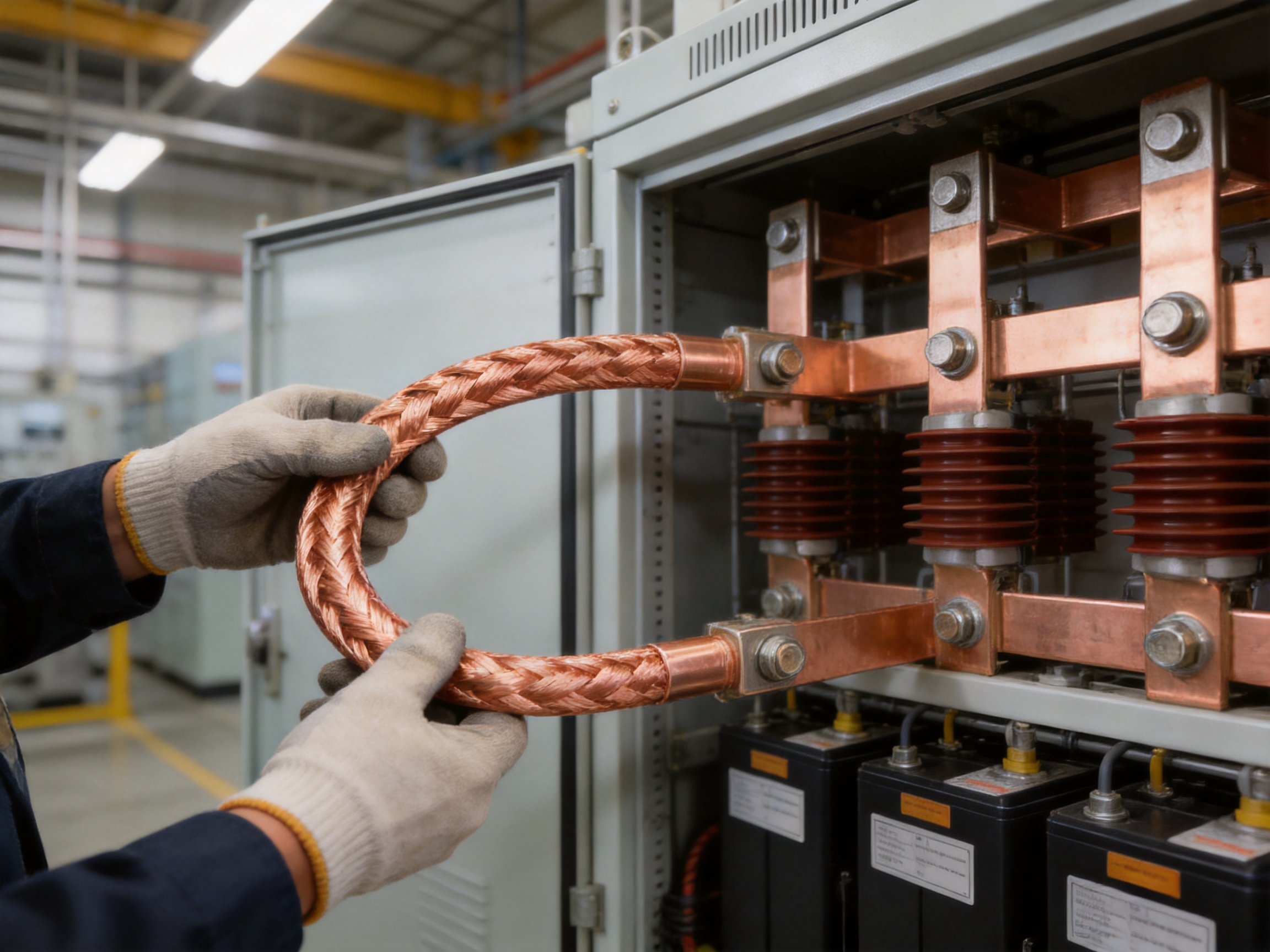
Switchgear and distribution panels often contain closely spaced conductive parts. A flexible copper braid can connect breakers, busbars, grounding points, moving mechanisms, and auxiliary conductive structures. Its ability to bend within a confined space may simplify panel design.
In switchgear, the connection must be selected not only for continuous current but also for possible short-circuit forces and thermal stress. The termination must be mechanically secure, and the braid should not interfere with moving components, insulation barriers, or required creepage and clearance distances.
High-Current Flexible Connections
Many electrical systems require a flexible link between two fixed conductive points. Examples include connections between busbars and power conversion equipment, battery terminals and distribution assemblies, rectifiers, inverters, charging equipment, and industrial power supplies.
The RRCB range provides multiple cross-sectional options for these applications. The selection should consider current magnitude, duty cycle, ambient conditions, conductor length, allowable voltage drop, and the expected amount of mechanical movement.
Battery and Energy Storage Systems
Energy storage systems require compact, reliable, and low-resistance electrical connections. Flexible copper braid can be used in battery racks, module interconnections, grounding assemblies, busbar transitions, and connection points exposed to vibration or thermal cycling.
Battery applications may also involve strict requirements for insulation, touch protection, flame performance, creepage, clearance, and fault containment. The bare braid can be combined with insulation sleeves, molded covers, heat-shrink materials, or custom protective components when required by the system design.
Electric Vehicles and Rail Transit
Electric vehicles and rail equipment subject electrical connections to vibration, movement, temperature variation, and space limitations. A flexible copper connection can provide a reliable transition between battery systems, power electronics, motors, grounding points, and vehicle structures.
Weight and packaging are important in mobile applications. The RRCB braid can support compact layouts while avoiding some of the alignment constraints associated with rigid conductors. Application-specific validation remains essential because vehicle systems may be exposed to severe vibration, moisture, contaminants, and repeated thermal cycles.
Communications and Industrial Equipment
Communications infrastructure, industrial automation equipment, power supplies, and control cabinets may require flexible grounding or bonding straps. The round braid can be routed through compact equipment layouts and connected to panels or frames that require periodic access.
In these applications, the braid may be selected for its mechanical flexibility even when the current requirement is moderate. A dependable bonding path can help control electrical potential differences and support equipment safety and electromagnetic compatibility strategies.
Manufacturing Process and Quality Strengths
Material Selection and Incoming Control
Product performance begins with the quality and consistency of the copper wire. Material control includes verifying the incoming wire diameter, surface condition, conductivity-related properties, and suitability for braiding. The standard 0.15 mm wire diameter must be controlled carefully because variation can affect braid geometry, flexibility, weight, and cross-sectional consistency.
Experienced manufacturing teams understand that fine copper wires require careful handling. Excessive tension, poor guiding, or improper storage can lead to scratches, kinks, or inconsistent feeding. Incoming material management therefore supports the stability of the entire production process.
Precision Braiding
Braiding is the central process that determines the structure of the round copper band. Multiple carriers guide the fine copper wires into an interlaced pattern. The braiding parameters influence the density, roundness, flexibility, dimensional stability, and mechanical integrity of the finished product.
Consistent production requires controlled wire tension, synchronized carrier movement, stable equipment operation, and suitable process settings. The manufacturing team must balance compactness with flexibility. An overly loose braid may have poor dimensional stability, while an overly tight braid may reduce flexibility or create unnecessary stress in the wires.
For a professional supplier, braiding is not simply a high-speed forming operation. It is a precision process that requires equipment capability, operator experience, process documentation, and inspection feedback. These factors help ensure that different production batches remain consistent.
Dimensional and Visual Inspection
Inspection may include checking the braid diameter or listed dimension, cross-sectional configuration, surface condition, coil length, number of wires or cores, and overall appearance. Visual checks can identify broken wires, loose sections, contamination, sharp projections, or irregular braiding.
Dimensional control is particularly important when the braid must fit into a terminal, sleeve, molded part, or customer-designed assembly. A stable dimension helps prevent installation difficulties and supports repeatable production at the customer’s facility.
Electrical Performance Verification
Electrical testing supports the evaluation of conductivity, resistance, continuity, and current-carrying performance. The appropriate test method depends on the product configuration and customer requirements. Testing can be performed on representative samples or according to an agreed quality plan.
For high-current applications, electrical verification should be combined with temperature-rise testing under defined conditions. The nominal current values in the product table are reference ratings and should not be treated as universal ratings for every installation environment.
Process Traceability
Traceability allows the manufacturer and customer to connect a finished coil or production batch with its material source, manufacturing date, equipment, inspection results, and packaging information. This is valuable for quality investigations, production planning, and long-term supply management.
Zhejiang Zhongyan New Energy has developed manufacturing and quality management capabilities around new energy conductive components and precision flexible connections. Its engineering teams work across product design, process development, manufacturing, testing, and verification. This integrated approach can help customers move from a basic concept to a repeatable production part.
Engineering and Customization Capabilities
Although the RRCB series includes standard configurations, flexible copper braid is often used in customized assemblies. The required length, termination, hole pattern, insulation, bend shape, braid width, and mounting method may differ from one project to another.
Custom Lengths
Customers can cut the 25-meter coil into lengths suitable for their equipment. For higher-volume production, finished cut lengths may also be developed according to approved drawings and tolerances. Accurate length control is important where the braid must fit between fixed terminals without excessive slack or tension.
Terminal and End Treatment
The braid may be integrated with copper lugs, terminal plates, crimped ends, welded ends, or other conductive components. End treatment should be selected according to current, mechanical load, available space, connection hardware, and the customer’s assembly process.
A suitable termination distributes current across the braid and prevents individual wires from becoming overloaded or damaged. It also supports mechanical retention and reduces the risk of loose strands entering nearby equipment.
Insulation and Protective Covering
Some applications require the braid to be insulated or protected from accidental contact, abrasion, moisture, chemicals, or adjacent conductive components. Depending on the design, the braid can be combined with sleeves, heat-shrink materials, molded insulation, protective tapes, or custom insulating covers.
Protective materials must be compatible with the operating temperature, voltage, environmental exposure, and required fire or chemical performance. The insulating solution should be evaluated as part of the complete connector rather than selected independently from the electrical design.
Special Shapes and Formed Connections
Where a simple straight length is not suitable, the manufacturer can support the development of special-shaped flexible connections. Formed components may be designed to follow a specific equipment contour or to connect terminals positioned at different angles.
Special-shaped solutions can reduce assembly steps and improve packaging efficiency. They are particularly useful in battery modules, power electronics, compact switchgear, and other systems in which cable routing space is limited.
Why Choose an Experienced New Energy Component Manufacturer?
The performance of a copper braid depends on more than the raw copper material. It also depends on manufacturing accuracy, process stability, engineering support, inspection capability, and the supplier’s understanding of the application. A specialist manufacturer can address these factors together.
Zhejiang Zhongyan New Energy Co., Ltd. was established in 2022 and focuses on new energy precision components, including high-voltage electrical copper foil soft connections, special-shaped soft connections, battery soft connections, and other conductive parts. The company combines product development with manufacturing and application support.
Its technical capabilities include polymer diffusion welding and laser technology used in the development of low-resistance, high-reliability electrical connection products. These technologies are relevant when a flexible braid must be integrated with terminals or other copper components while maintaining a stable conductive and mechanical connection.
The company’s experience extends into power transmission and distribution, electric vehicles, rail transit, communications, and energy storage. This cross-industry exposure helps its engineering team understand the different priorities of stationary and mobile applications, including current capacity, vibration resistance, thermal performance, compactness, insulation, and production repeatability.
The company has also supplied precision conductive components to recognized enterprises in the new energy and automotive sectors. Such projects generally require controlled processes, stable quality, engineering communication, and the ability to support product changes during development. These capabilities are valuable for customers seeking more than a commodity conductor.
Comparison with Alternative Connection Solutions
Versus Solid Copper Bars
Solid copper bars are strong, dimensionally stable, and suitable for fixed busbar layouts. However, they require precise fabrication and may transmit vibration or expansion forces to connected equipment. The RRCB braid is more flexible and can accommodate moderate movement and installation variation.
A rigid bar may remain the better choice where a fixed structural conductor, high short-circuit strength, or defined busbar geometry is required. The braided band is advantageous where flexibility, compact routing, and stress relief are more important.
Versus Flat Copper Straps
Flat copper straps provide a broad contact surface and can be convenient for grounding and bonding. However, their bending direction may be more limited, especially when the strap must twist or route through an irregular space. A round braid can offer greater freedom in three-dimensional routing.
The best option depends on terminal geometry and electrical requirements. In some systems, flat straps and round braids may be used together, with each serving a different connection function.
Versus Flexible Cables
Flexible cables contain stranded conductors inside an insulating jacket and are suitable for many power and control applications. A copper braid, by contrast, is an exposed conductive component that can be customized with terminals, sleeves, or molded protection.
The braid may provide a lower-profile connection and can be useful where a short flexible link is required between conductive parts. A cable may be more suitable when long-distance routing, complete insulation, environmental sealing, or multi-conductor transmission is needed.
Versus Generic Braided Products
Generic braided products may offer lower initial cost, but important differences can exist in copper purity, wire diameter, braid density, dimensional consistency, coil length, inspection, and customization support. In high-current or safety-related applications, these factors can influence service reliability.
The RRCB series is supported by a defined product range, listed part numbers, stated cross-sectional options, nominal current references, and a manufacturing organization focused on precision conductive components. These characteristics help customers establish a clearer specification and quality-control process.
Installation Recommendations
The braid should be installed without excessive tension. A flexible connection needs enough freedom to accommodate movement, but it should not hang in a way that creates unnecessary load on terminals. The recommended bend radius should be respected, and sharp bends should be avoided unless the product design specifically allows them.
Terminations should be clean, secure, and properly aligned. Contact surfaces must be free from contamination, excessive oxidation, burrs, and foreign material. Fasteners should be tightened according to the equipment manufacturer’s specified torque. Inadequate contact pressure can increase resistance and heat generation, while excessive pressure may damage the braid or terminal.
The braid should be protected from abrasion against sharp edges, moving mechanisms, and unprepared sheet-metal openings. Where necessary, use suitable edge protection, insulating sleeves, clamps, or routing supports. The braid should not be crushed or twisted beyond its intended configuration.
After installation, continuity and resistance checks should be performed as appropriate. High-current systems should also be evaluated under representative operating conditions, including temperature-rise observation where required. The completed connection should be inspected after initial operation and during scheduled maintenance.
Selection Guide for Engineers and Purchasers
Selecting the correct RRCB configuration begins with the application’s electrical requirements. Determine the continuous current, peak current, duty cycle, fault conditions, allowable voltage drop, and expected operating temperature. The cross-sectional area should be selected based on the complete thermal and electrical design rather than current alone.
Next, review the mechanical requirements. Identify the distance between connection points, required bend direction, available space, expected vibration, thermal movement, and maintenance access. A flexible braid should be long enough to install without tension but short enough to avoid unnecessary loops or movement.
Consider the termination design at the same time. The braid, terminal, fastener, and mating busbar must work as one connection system. If the braid is to be welded, crimped, bolted, or integrated into a custom part, the process should be confirmed before final product selection.
Environmental conditions are also important. Review exposure to moisture, salt spray, chemicals, dust, oil, temperature extremes, and electromagnetic requirements. Determine whether insulation, plating, sealing, or additional protection is necessary.
Finally, confirm quality documentation and production requirements. For a prototype, a standard 25-meter coil may be sufficient. For high-volume production, the customer may require cut lengths, serialized batches, inspection records, packaging controls, and a formal approval process.
Quality, Reliability, and Long-Term Value
The value of a flexible copper braid is measured not only by its purchase price but also by its contribution to system reliability, assembly efficiency, maintenance, and service life. A consistent braid can reduce installation variation and support stable electrical performance from one unit to the next.
Using a flexible connection where movement is expected may help reduce fatigue in terminals and equipment interfaces. Simplified routing can reduce assembly time and support more compact product designs. Coil packaging can reduce the number of separate stock items required for different connection lengths.
Long-term value also depends on engineering support. If a standard configuration does not fully satisfy the application, a supplier capable of developing a custom solution can help avoid compromises in current capacity, flexibility, insulation, or termination design.
Zhejiang Zhongyan New Energy’s focus on precision new energy components positions it to support customers that require customized conductive solutions. Its capabilities in research, design, manufacturing, testing, and process development provide a foundation for projects that must progress from sample evaluation to stable mass production.
Frequently Asked Questions
What material is used in the RRCB Round Pure Copper Braided Band?
The product is made from high-purity copper wires. The standard individual wire diameter is 0.15 mm. The fine copper wires are braided into a flexible round conductive structure.
How is the product supplied?
The standard product is supplied in 25-meter coils. Customers can cut the coil into the lengths required for their own assembly or request customized production support for defined lengths and terminations.
What cross-sectional sizes are available?
The listed standard range includes 6 mm², 8 mm², 10 mm², 16 mm², 25 mm², 30 mm², 50 mm², 75 mm², and 100 mm² configurations.
What current can the braid carry?
The supplied product data lists nominal current values from 45 A to 360 A, depending on the configuration. Actual allowable current depends on installation conditions, ambient temperature, ventilation, duty cycle, connection resistance, and applicable engineering standards.
Can the braid be used for grounding?
Yes. The round copper braided band is suitable for grounding and bonding applications when correctly terminated and installed. Grounding performance depends on the complete connection system, including contact surfaces, fasteners, corrosion control, and continuity verification.
Can it be used in battery systems?
Yes. It can be considered for battery racks, energy storage systems, battery module connections, grounding assemblies, and flexible busbar transitions. Battery applications may require insulation, touch protection, special terminals, and additional validation for vibration and thermal conditions.
Is the braid suitable for transformers and switchgear?
Yes. Its flexibility makes it suitable for connections between terminals, busbars, grounding points, and other conductive parts in transformers and switchgear. The design must account for current, temperature rise, short-circuit forces, insulation clearance, and mechanical support.
Can the product be customized?
Customization may include length, braid configuration, end terminals, insulation, protective covering, formed geometry, and special-shaped flexible connection design. Requirements should be confirmed through technical drawings and application information.
What are the advantages of fine copper wires?
Fine wires allow the braid to bend more easily and distribute mechanical stress across many individual elements. This can improve flexibility and help accommodate vibration, thermal expansion, and moderate movement compared with a single rigid conductor.
Does a copper braid replace every rigid busbar?
No. Rigid busbars remain appropriate for fixed layouts, structural support, and applications requiring defined geometry or high mechanical short-circuit strength. A braided band is most beneficial where flexibility, movement compensation, compact routing, or stress relief is required.
How should the nominal current rating be interpreted?
The nominal current is a reference value for the listed configuration. Engineers should verify the final rating under the actual installation conditions, including temperature, enclosure, airflow, duty cycle, terminal design, and allowable temperature rise.
What quality support can a specialist manufacturer provide?
A specialist manufacturer can support material selection, braid design, terminal integration, process development, dimensional inspection, electrical testing, prototype production, and mass-production quality control. This integrated support can be valuable for demanding energy, automotive, industrial, and electrical equipment projects.
Conclusion
The RRCB Round Pure Copper Braided Band provides a practical solution for electrical systems that require both conductivity and mechanical flexibility. Its high-purity copper construction, 0.15 mm wire design, multiple cross-sectional options, and 25-meter coil packaging make it suitable for grounding, transformers, switchgear, high-current flexible connections, battery systems, energy storage, electric vehicles, rail transit, and industrial equipment.
Compared with rigid conductors, the braid can better accommodate vibration, thermal movement, installation variation, and compact three-dimensional routing. Compared with generic flexible products, a defined product range and specialist manufacturing support can help customers establish more consistent electrical and mechanical performance.
The product’s final performance depends on correct selection, termination, installation, and system validation. For standard requirements, the listed RRCB configurations provide a convenient starting point. For specialized applications, Zhejiang Zhongyan New Energy can support customized lengths, terminals, protective coverings, special geometries, and integrated conductive components.
With experience in new energy precision components, copper foil soft connections, battery connections, polymer diffusion welding, laser processing, and customized electrical solutions, the company offers more than a standard conductive material. It provides a development and manufacturing platform for customers seeking reliable flexible connections in modern power, transportation, battery, and energy storage systems.
References
International Electrotechnical Commission, Electrical Installations and Low-Voltage Equipment Guidance, general principles for conductor selection and electrical safety.
International Electrotechnical Commission, Requirements for Low-Voltage Switchgear and Controlgear Assemblies.
International Electrotechnical Commission, Electrical Conductors and Conductivity Testing Practices.
Institute of Electrical and Electronics Engineers, Recommended Practices for Grounding and Bonding in Industrial and Commercial Power Systems.
ASTM International, Standard Methods for Testing Electrical Conductors and Copper Materials.
Product technical information supplied for the RRCB Round Pure Copper Braided Band series.
Product: RRCB Round Pure Copper Braided Band

Driven by the development of new energy and aiming for "zero carbon".
Copyright © Zhejiang Zhongyan New Energy Co., Ltd. All Rights Reserved.
