 English
 Español

Custom Nickel-Plated Aluminum Busbars for High-Conductivity and Lightweight Power Connection Solutions
Modern electrical and energy systems require conductors that can carry high currents safely while remaining lightweight, compact, durable, and easy to integrate. Busbars are central to this requirement. They provide a controlled path for electrical power distribution between batteries, inverters, switchgear, motor drives, power conversion units, charging equipment, and industrial control assemblies. As system designers continue to reduce weight, improve energy efficiency, and increase power density, aluminum busbars with engineered surface treatments have become an increasingly valuable alternative to conventional bare copper conductors.
A custom nickel-plated aluminum busbar combines the low weight and cost advantages of aluminum with the enhanced surface performance of nickel plating. The result is a conductive component designed for demanding electrical connections where corrosion resistance, solderability, mechanical stability, temperature performance, and long service life are important. By using precision cutting, bending, punching, tapping, and surface treatment processes, manufacturers can produce busbars that closely match the electrical, mechanical, and installation requirements of each project.
Zhejiang Zhongyan New Energy Co., Ltd. develops and manufactures conductive components for power transmission, new energy vehicles, battery systems, energy storage, rail transit, communication equipment, and industrial electrical applications. Its product capabilities include aluminum and copper busbars, flexible connections, battery soft connections, high-voltage electrical connections, special-shaped conductive components, and integrated battery connection solutions.
This article explains the construction, advantages, manufacturing processes, application areas, customization options, and selection considerations associated with nickel-plated aluminum busbars. It also examines why a specialized manufacturer with experience in precision conductive components can offer stronger performance and greater project support than a general metal fabrication supplier.
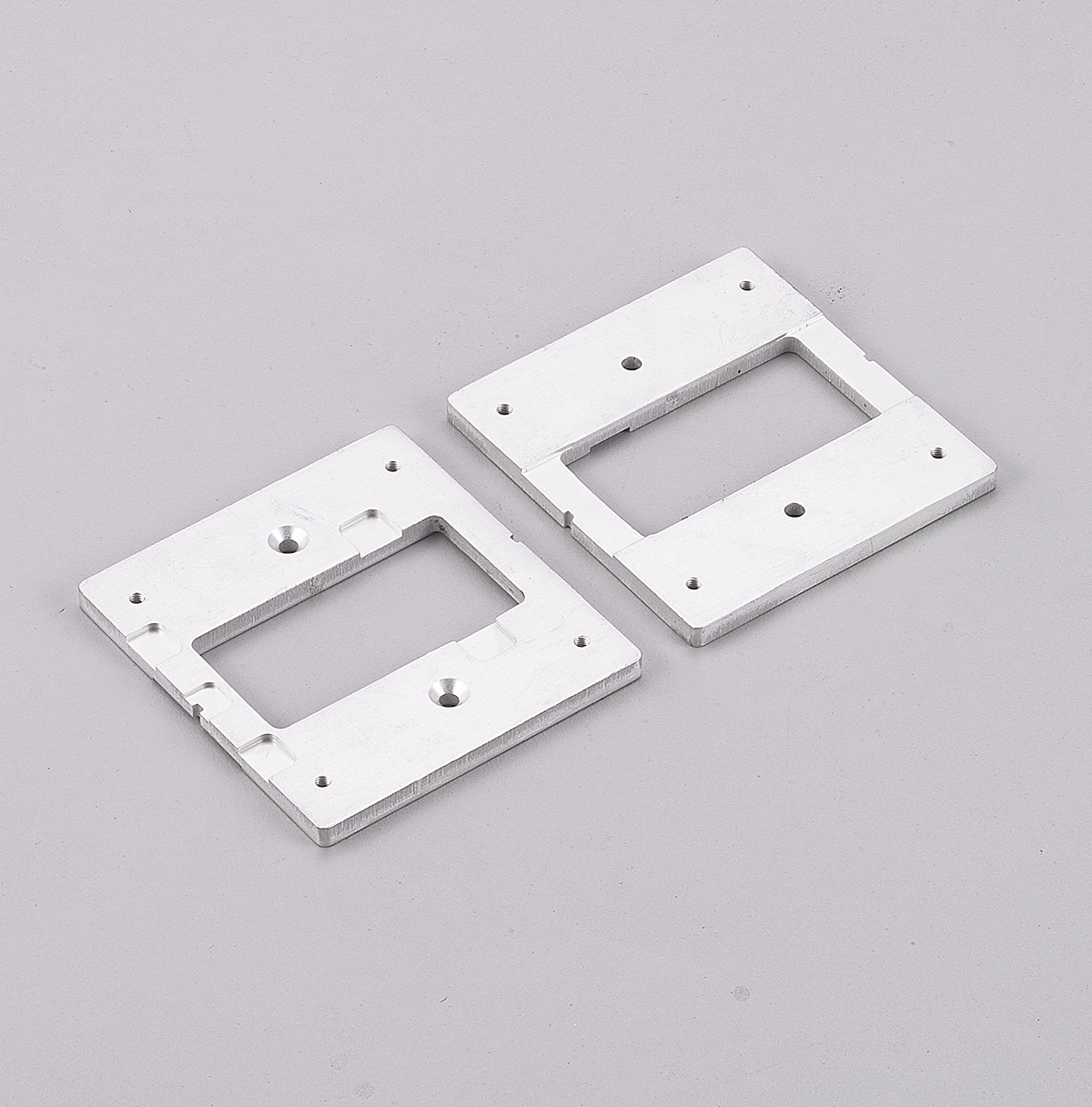
Custom Nickel Plated Aluminium Busbar For High Conductivity & Lightweight Power Connection Solutions
What Is a Nickel-Plated Aluminum Busbar?
An aluminum busbar is a flat, formed, or specially shaped electrical conductor used to distribute current within a power system. Compared with round cables, busbars can offer a more compact current path, easier assembly, better heat dissipation, and improved compatibility with high-current terminals. Their shape can be adapted to the available installation space, allowing electrical engineers to create short and efficient connection paths.
Nickel plating adds a controlled metallic layer to the aluminum surface. The aluminum body provides the primary combination of conductivity and low mass, while the nickel layer improves the exposed surface characteristics. Depending on the application and required thickness, the plated surface may provide better resistance to oxidation, improved contact durability, enhanced soldering behavior, and increased protection against environmental exposure.
It is important to distinguish the conductive aluminum core from the surface treatment. The core determines much of the busbar’s current-carrying capability, thermal behavior, and structural weight. The nickel coating primarily influences surface contact performance, corrosion resistance, joining behavior, and protection of the underlying material. The correct design must therefore consider both the bulk properties of the aluminum alloy and the requirements of the plated interface.
Common aluminum grades used for this type of busbar include 1060, 1070, and 6063. Grades 1060 and 1070 offer high purity and excellent electrical conductivity. Grade 6063 can provide useful forming and structural characteristics when the design requires more complex bending or greater mechanical support. The appropriate material depends on current level, geometry, thermal conditions, bending requirements, mechanical loading, and the desired balance between conductivity and strength.
Why Aluminum Is Valuable in High-Current Systems
Aluminum has a lower density than copper, which makes it attractive for applications where the total weight of the electrical assembly must be controlled. A properly designed aluminum busbar can reduce the mass of a connection system while maintaining an appropriate current capacity through the use of suitable cross-sectional dimensions and thermal design.
Weight reduction can be particularly valuable in electric vehicles, mobile equipment, rail systems, battery packs, renewable energy installations, and large-scale power conversion equipment. Lower conductor weight can simplify mounting structures, reduce transportation and handling requirements, and help engineers meet overall system weight targets.
Aluminum is also widely available and can offer cost benefits compared with copper. These benefits may become more significant in large battery systems, power distribution cabinets, solar inverters, and high-volume electrical assemblies that require substantial quantities of conductive material.
Another advantage is aluminum’s ability to dissipate heat effectively when the busbar is correctly sized and installed. Busbar geometry can be optimized to expose more surface area to surrounding air or to connect directly with heat-dissipating structural components. The final thermal performance depends on cross-sectional area, current waveform, ambient temperature, mounting method, ventilation, surface finish, and the presence of nearby heat sources.
Although aluminum requires careful attention to surface preparation and connection design, these challenges can be addressed through engineered plating, controlled processing, appropriate joining methods, and rigorous quality inspection. Nickel plating is one of the available approaches for improving surface reliability in demanding environments.
Advantages of Nickel-Plated Aluminum Busbars
High Conductivity with Reduced Weight
The aluminum core supports efficient current transmission while keeping the conductor lighter than an equivalent copper component with similar overall dimensions. The busbar can be designed with an appropriate thickness and width to achieve the required current-carrying capacity without unnecessarily increasing material usage.
For battery packs, energy storage cabinets, and power electronics, lower mass can improve assembly efficiency and reduce the structural burden placed on housings, supports, and terminal assemblies. The lighter construction can also make manual installation easier during service and maintenance operations.
Improved Surface Durability
Nickel provides a durable metallic surface that can help protect the aluminum substrate from direct environmental exposure. In applications exposed to humidity, industrial contaminants, temperature cycling, or repeated handling, a suitable nickel-plated surface can offer greater durability than untreated aluminum.
The effectiveness of the plating depends on coating thickness, adhesion, surface preparation, geometry, and operating conditions. For this reason, plating should be treated as part of a controlled manufacturing system rather than as a purely cosmetic finishing step.
Enhanced Contact Stability
Electrical connections depend heavily on the quality and stability of the contact interface. Surface oxidation, contamination, mechanical movement, and thermal cycling can increase contact resistance over time. A properly specified nickel-plated surface can improve the stability of the contact area and provide a more consistent interface for selected terminals, fasteners, welded joints, and soldered connections.
Nickel plating can also improve resistance to surface wear when the busbar is installed with mechanical terminals or subjected to repeated assembly and maintenance. The final contact design must still include correct fastener torque, suitable contact pressure, compatible mating materials, and appropriate environmental protection.
Good Corrosion Resistance
Electrical equipment may operate in conditions involving moisture, salt, dust, condensation, chemicals, or temperature fluctuations. Corrosion at a conductor interface can increase resistance and create localized heating. Nickel plating offers a protective surface that can improve resistance to many common forms of environmental attack.
For outdoor power equipment, charging systems, marine-adjacent installations, industrial control cabinets, and energy storage systems, corrosion resistance can contribute to longer maintenance intervals and more stable operating performance. A complete corrosion-control strategy should also consider enclosure design, sealing, ventilation, cleaning, and the compatibility of all connected metals.
Suitable for Customized Geometry
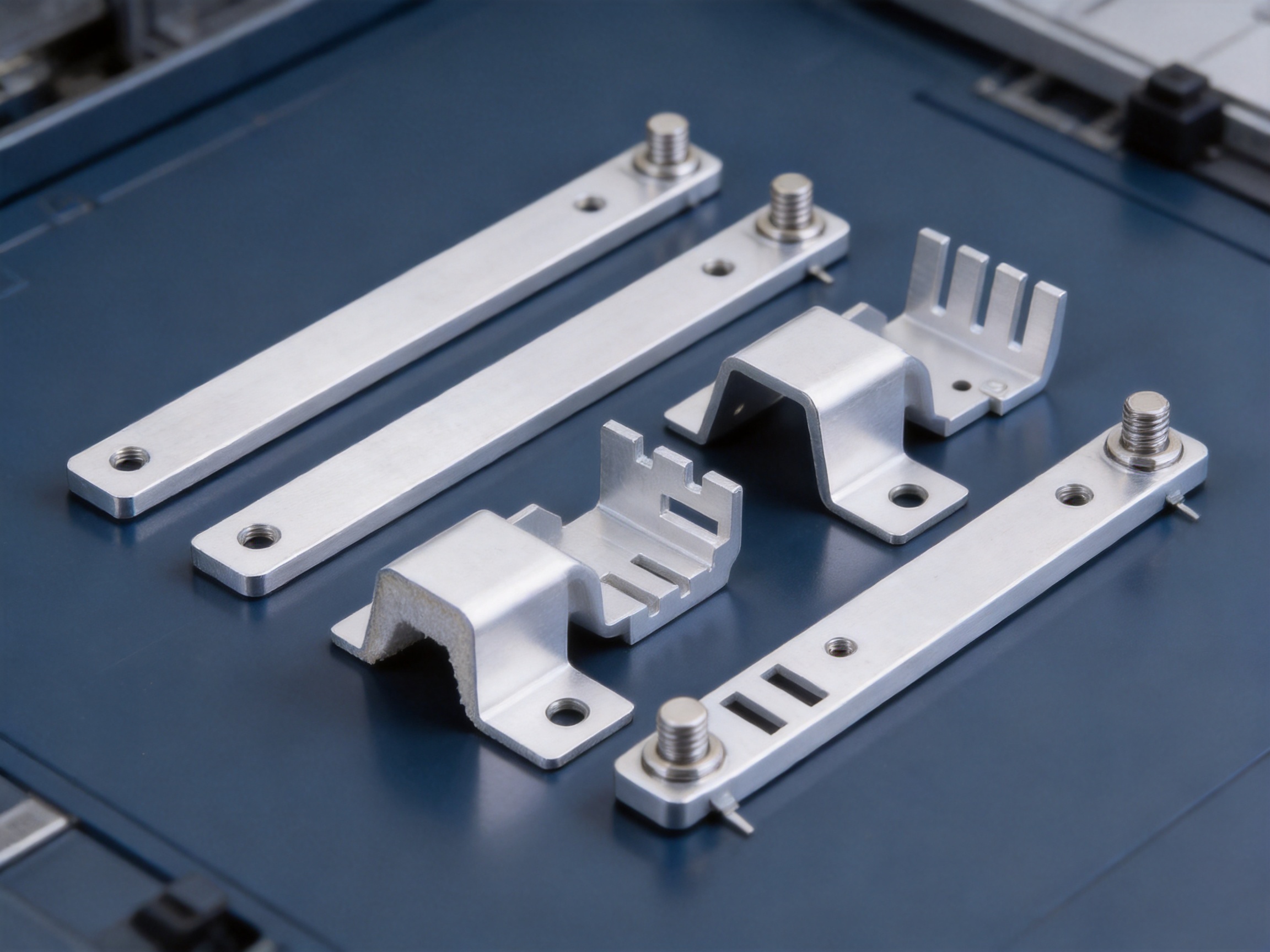
Busbars are not limited to simple rectangular strips. They may include stepped sections, offset bends, mounting flanges, slots, holes, threaded features, terminal extensions, and special three-dimensional forms. Custom geometry can reduce the number of separate cables, simplify installation, and improve the internal organization of an electrical assembly.
Precision laser cutting and CNC bending allow designers to develop components that follow the actual space available inside a cabinet, battery pack, inverter, or power module. This can reduce unnecessary routing and provide shorter current paths with fewer connection points.
Support for Automated Assembly
Consistent dimensions are essential for automated or semi-automated assembly. Accurate hole positions, bend angles, terminal spacing, and surface finishes help ensure that busbars fit correctly during production. Custom busbars can be developed with assembly features that support robotic handling, fixture positioning, torque-controlled fastening, welding, or integrated inspection.
Stable manufacturing tolerances reduce rework and improve interchangeability. For high-volume battery and electrical equipment production, this consistency can contribute to lower labor requirements and more predictable production scheduling.
Material Selection for Custom Busbar Production
Material selection should begin with the electrical and mechanical requirements of the application rather than with a standard catalog size. The main considerations include continuous current, peak current, short-circuit current, ambient temperature, allowable temperature rise, installation space, vibration, connection method, and required service life.
High-Purity Aluminum 1060
Aluminum 1060 is commonly selected when high conductivity, light weight, and good formability are primary requirements. Its high purity supports stable electrical performance, and it can be suitable for a wide range of battery, power distribution, and energy conversion applications.
High-Purity Aluminum 1070
Aluminum 1070 offers very high purity and strong conductivity characteristics. It may be considered for applications where electrical efficiency and low material resistance are particularly important. Design engineers should balance its conductivity advantages with the forming and structural requirements of the finished part.
Aluminum 6063
Aluminum 6063 is often used where formability, surface quality, and mechanical characteristics are important. It can be suitable for more complex profiles and formed components. The final selection should be confirmed through electrical, thermal, and mechanical evaluation of the complete busbar assembly.
Optional Copper Busbar Compatibility
Although the featured product is a nickel-plated aluminum busbar, a specialized conductive-component manufacturer may also support copper busbars, flexible copper connections, copper foil soft connections, and composite laminated busbars. Copper may be chosen when a design requires very high conductivity within a smaller cross-sectional area, while aluminum may be preferred when weight and cost are major priorities.
The choice between aluminum and copper should be evaluated according to current density, connection technology, thermal limits, available space, weight targets, material cost, and the risk of galvanic interaction between dissimilar metals. Surface treatment and interface design are especially important when aluminum busbars are connected to copper terminals or other conductive materials.
Custom Dimensions and Engineering Options
Custom manufacturing allows the busbar to be adapted to the electrical system instead of forcing the system to conform to a standard part. Typical dimensional capabilities include thicknesses from approximately 1 millimeter to 15 millimeters, widths from approximately 5 millimeters to 200 millimeters, and customized lengths up to approximately 3,000 millimeters, depending on the product configuration and production requirements.
These dimensions are reference ranges rather than universal limits. The practical size depends on the material, tooling, bend radius, plating requirements, handling method, inspection criteria, and quantity. Engineering review is recommended before finalizing a design for production.
Common customization features include:
• Straight busbars for direct power distribution.
• Angled and three-dimensional busbars for compact assemblies.
• Mounting holes and slots for bolted installation.
• Tapped holes for threaded fasteners.
• Terminal pads for welding, soldering, or mechanical connection.
• Stepped sections to accommodate insulation, clearance, or enclosure geometry.
• Rounded corners and controlled edge treatment to reduce stress concentration.
• Special cutouts for components, sensors, fuses, switches, and cooling structures.
• Matching left-hand and right-hand versions for symmetrical assemblies.
• Identification marks, orientation features, and assembly references.
By integrating multiple features into one component, a custom busbar can replace several short cables, separate brackets, and additional connection hardware. This may reduce assembly time and improve the consistency of the finished product.
| Design Parameter | Typical Options | Primary Engineering Consideration |
|---|---|---|
| Base material | 1060, 1070, or 6063 aluminum | Conductivity, strength, formability, and weight |
| Thickness | Approximately 1–15 mm | Current capacity, heat dissipation, and mechanical rigidity |
| Width | Approximately 5–200 mm | Cross-sectional area, available space, and terminal size |
| Length | Customized, up to approximately 3,000 mm | System layout, handling, and transportation |
| Surface finish | Bare, tin plated, nickel plated, or silver plated | Contact behavior, corrosion resistance, and joining method |
| Processing | Laser cutting, CNC bending, punching, and tapping | Dimensional accuracy and assembly compatibility |
| Operating temperature | Approximately -40°C to 125°C | Insulation, plating, thermal rise, and application conditions |
Advanced Manufacturing Process
The performance of a busbar is determined not only by its raw material but also by the consistency of the manufacturing process. A high-quality supplier should control material identification, cutting accuracy, forming, hole location, surface treatment, dimensional inspection, and final packaging.
Engineering Review and Design Verification
Production begins with review of the customer’s drawings, three-dimensional files, samples, electrical specifications, and installation requirements. Engineers examine the conductor path, bend positions, hole spacing, terminal surfaces, minimum bend radii, edge conditions, insulation clearances, and plating zones.
At this stage, potential manufacturing risks can be identified before tooling or mass production begins. For example, a bend that appears acceptable in a two-dimensional drawing may require a larger radius because of material thickness. A plated region may need to be masked or specially prepared to support a subsequent welding operation. A hole positioned too close to an edge may reduce mechanical strength or create a deformation risk during punching.
Design verification may include digital modeling, sample production, fit checks, electrical calculations, and assembly trials. Early validation reduces the risk of expensive changes after production has started.
Material Preparation
Aluminum sheet, strip, plate, or profile material is prepared according to the approved specification. Material certificates and incoming inspection records can be used to verify grade, thickness, surface condition, and dimensional conformity.
Clean material handling is important because oil, dust, oxide layers, and embedded particles may affect cutting, joining, and plating. Material should be stored and transported in a way that minimizes scratching, bending, contamination, and exposure to unsuitable environmental conditions.
Laser Cutting
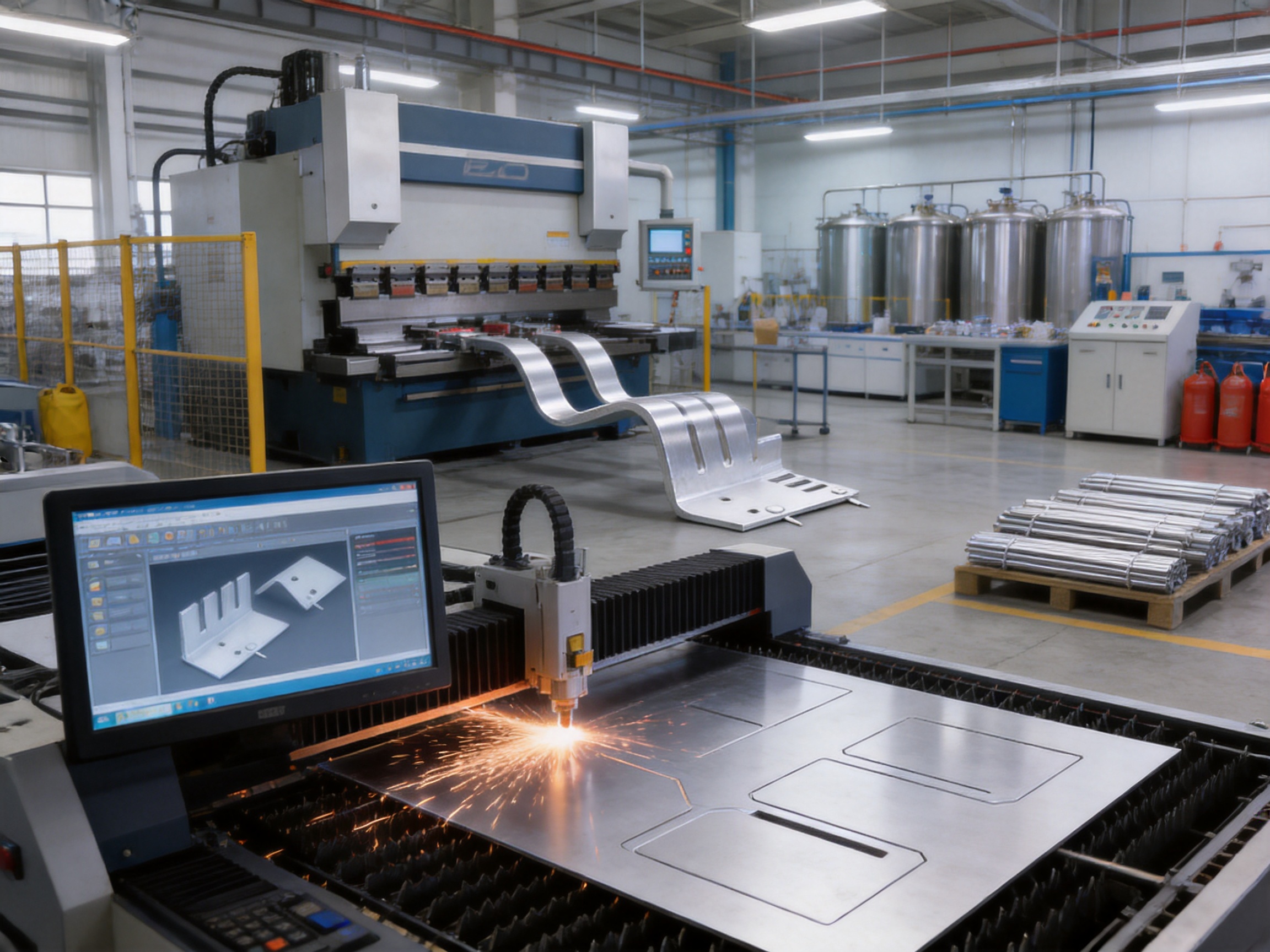
Laser cutting is used to create accurate external profiles, internal openings, slots, and complex outlines. Compared with manual cutting, computer-controlled laser processing provides greater repeatability and can produce intricate shapes without requiring dedicated hard tooling for every design.
Cutting parameters must be adjusted according to alloy, thickness, geometry, and required edge quality. After cutting, edges may be inspected for burrs, heat-affected conditions, sharp points, and dimensional accuracy. Edge treatment is especially important for busbars that will be insulated, inserted into battery modules, or installed near sensitive cables and electronic components.
Punching and Hole Processing
Punching can be used for repeated holes, slots, and standard mounting features. It is efficient for batch production and can provide consistent hole positions when the tooling and material support are properly controlled.
Tapping creates threaded holes for direct fastener installation. Thread size, depth, pitch, and alignment must be selected according to the required clamping force and service environment. Where a tapped hole is used as an electrical contact, the design should consider contact pressure, surface finish, thread wear, and the use of compatible fasteners.
CNC Bending and Forming
CNC bending transforms a flat blank into an angled or three-dimensional busbar. Precise control of bend position and angle is necessary to ensure correct fit within the final assembly. Bend sequencing is also important because one bend can affect access for subsequent forming operations.
Manufacturing engineers consider springback, material thickness, inside radius, grain direction where relevant, tooling clearance, and the risk of surface marks. A controlled bending process helps maintain consistent terminal alignment and reduces stress in the finished component.
Surface Preparation
Before nickel plating, the aluminum surface must be prepared carefully. Cleaning removes oil and particles, while controlled chemical or mechanical preparation helps create a suitable surface for subsequent treatment. Aluminum naturally forms an oxide layer, so the plating process must address the characteristics of this oxide layer to promote coating adhesion.
Surface preparation may include degreasing, rinsing, activation, intermediate treatment, and controlled handling before plating. Each stage must be managed to reduce contamination and ensure that the coating is continuous across the required surfaces.
Nickel Plating
Nickel plating is applied according to the required surface performance and coating specification. The process may be adjusted for different areas of the busbar, including contact faces, terminal zones, edges, and non-contact surfaces. Coating thickness, uniformity, adhesion, appearance, and coverage should be evaluated using suitable inspection methods.
The plating specification should be connected to the actual application. A busbar used in a dry indoor cabinet may have different requirements from one used in a humid energy storage environment or a system exposed to temperature cycling and vibration. Engineers should define the required thickness, allowable variation, contact performance, and environmental expectations rather than specifying plating only by name.
Where a design requires selective plating, masking and process control can be used to limit the treatment to specific areas. This can reduce cost and preserve other surfaces for welding, insulation bonding, or mechanical positioning.
Final Inspection and Packaging
Finished busbars can be inspected for dimensions, hole position, bend angle, surface condition, burrs, plating coverage, coating adhesion, and visible damage. Depending on the project, additional checks may include electrical resistance, contact resistance, thermal behavior, mechanical fit, and coating thickness.
Packaging is also important. Plated surfaces can be damaged by friction, impact, moisture, or contact with unsuitable materials during transport. Protective separators, individual wrapping, moisture-control measures, and identification labels may be used to preserve the product until installation.
Manufacturing Strengths and Technical Capabilities
A key advantage of working with a specialized conductive-component manufacturer is the ability to coordinate electrical design, metal processing, surface treatment, and application support through one production organization. This integrated approach can be more effective than dividing the project among unrelated suppliers.
Zhejiang Zhongyan New Energy Co., Ltd. focuses on precision conductive components for new energy and electrical applications. The company’s experience includes high-voltage copper foil soft connections, special-shaped flexible connections, battery soft connections, and other components that must perform reliably under current, vibration, thermal cycling, and restricted installation conditions.
The company combines experienced engineering personnel with professional production equipment and established quality management procedures. Its capabilities cover product design, research and development, manufacturing, testing, verification, and customized solution support.
Experience in soft connections and battery components is relevant to rigid busbar production because many modern assemblies combine rigid conductors with flexible sections. Battery packs, electric vehicles, and energy storage systems may require a complete connection architecture containing cell contact structures, laminated busbars, aluminum or copper rigid conductors, flexible foil connections, terminal insulators, and protective covers. A manufacturer familiar with the full connection environment can better understand how one busbar interacts with adjacent components.
The company was established in 2022 and has developed proprietary process capabilities involving polymer diffusion welding and laser technology. These technologies are intended to support low internal resistance, reliable electrical paths, and high consistency in precision connection products. Such process knowledge can be valuable when customers require more than a simple cut-and-bend component.
The company has also supplied conductive components to major enterprises in the automotive and battery industries. This type of experience generally requires strict control of documentation, traceability, dimensional consistency, delivery scheduling, and product validation. While every project must be evaluated independently, an established quality culture can reduce risk for customers developing high-volume or safety-critical products.
Comparison with Conventional Busbar Options
Compared with Bare Aluminum
Bare aluminum can provide low weight and good conductivity, but its exposed surface is more sensitive to oxidation and interface preparation. A nickel-plated version offers an engineered contact surface that may be better suited to demanding connection environments. It can also provide a more consistent appearance and improved resistance to handling and environmental exposure.
Compared with Conventional Copper
Copper offers excellent conductivity and is widely used in power systems. However, copper is heavier and may increase material cost, especially in large or high-volume assemblies. Nickel-plated aluminum can offer a more favorable weight-to-cost balance when the available installation space allows sufficient cross-sectional area.
The comparison should never rely on conductivity alone. Engineers must evaluate current density, temperature rise, mechanical strength, joint design, galvanic compatibility, available space, and manufacturing cost. In some compact high-current applications, copper may remain the preferred material. In other systems, the reduced mass and cost of aluminum can provide clear advantages.
Compared with Flexible Cables
Cables are useful where movement, routing flexibility, or vibration isolation is required. However, they may require terminals, crimping, bending space, supports, and additional insulation. A formed busbar can provide a shorter and more controlled current path with fewer parts.
Rigid busbars are especially useful inside battery packs, switchgear, cabinets, power modules, and inverter assemblies where the conductor follows a fixed route. Flexible copper or aluminum connections may still be used at moving interfaces or locations subject to differential expansion. A combined rigid-and-flexible architecture often provides the best overall solution.
Compared with Standard Off-the-Shelf Bars
Standard bars can be convenient for simple installations, but they may require field cutting, drilling, bending, and additional hardware. Custom busbars are produced according to the final assembly design, which can reduce installation work and improve dimensional consistency.
Custom parts may also reduce the number of joints. Every additional joint introduces potential resistance, mechanical complexity, and an inspection requirement. By integrating bends, holes, terminal pads, and mounting features into one component, a custom busbar can simplify the electrical and mechanical system.
Application Areas
Energy Storage Systems and Battery Packs
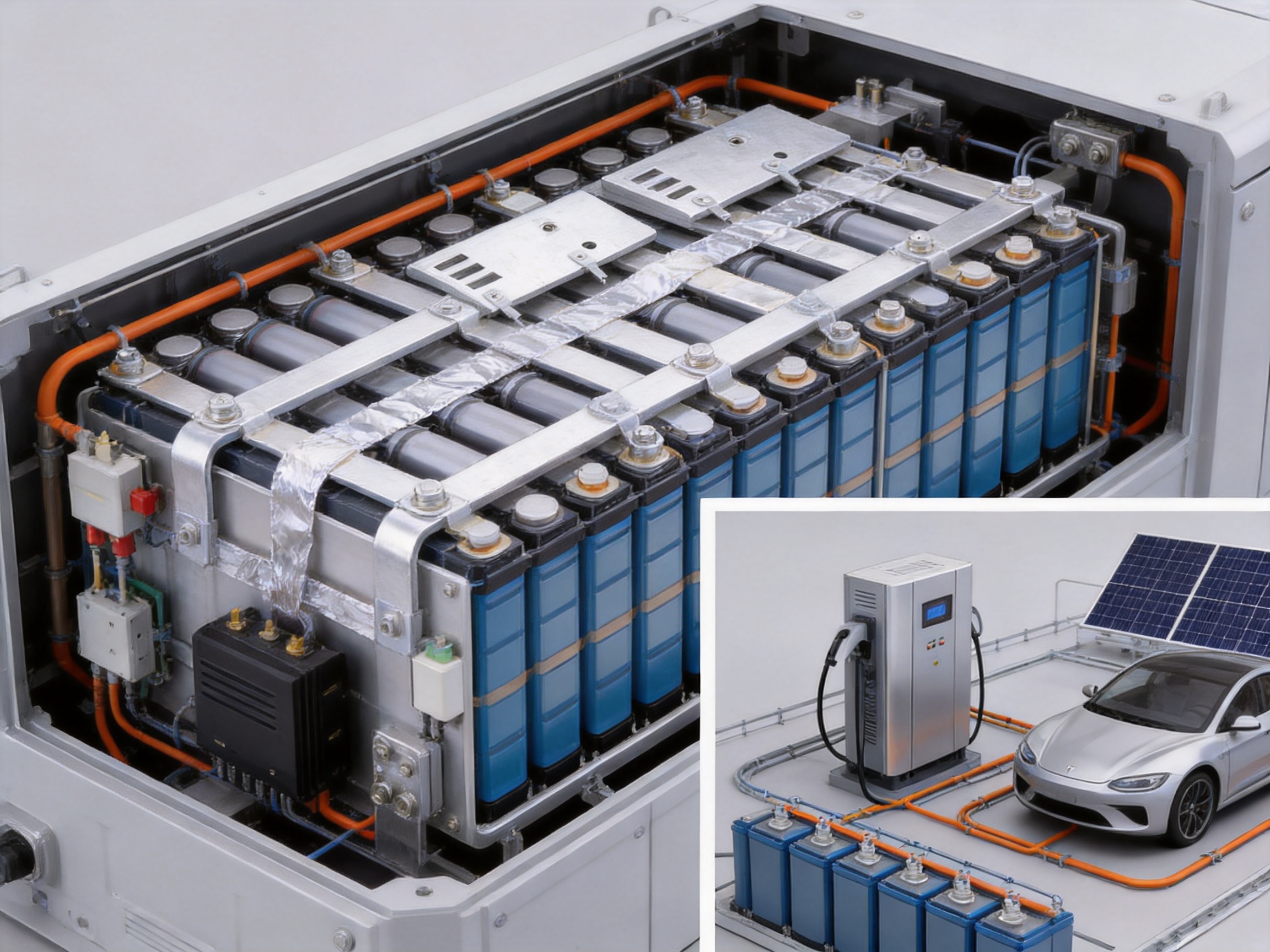
Energy storage systems require reliable connections between battery modules, busbar assemblies, contactors, fuses, service disconnects, inverters, and monitoring equipment. Nickel-plated aluminum busbars can help reduce system weight while providing a durable interface for selected terminal designs.
Battery packs often have restricted internal space. A custom busbar can follow the exact enclosure geometry, avoid interference with cells and cooling channels, and include mounting or insulation features. The design may also incorporate clearances that support electrical safety and service access.
Electric Vehicles and Charging Equipment
Electric vehicles place strong demands on power connections because of vibration, temperature changes, limited space, and the need for weight reduction. Busbars may be used in battery packs, high-voltage junction boxes, inverters, charging modules, and power distribution assemblies.
Charging equipment also benefits from carefully designed conductors. Custom geometry can support compact cabinets, reduce cable congestion, and simplify connection between input protection, conversion modules, and output terminals.
Solar Inverters and Wind Power Systems
Renewable energy equipment frequently operates for long periods and may be exposed to heat, humidity, dust, and outdoor environmental changes. Busbars are used to connect power conversion stages, protection devices, energy storage interfaces, and distribution sections.
The combination of light weight, heat dissipation, and surface protection can be helpful in inverter and renewable energy equipment, provided that the busbar is correctly rated and the enclosure environment is properly considered.
UPS Systems and Data Centers
Uninterruptible power supply equipment and data center power systems require stable, low-loss connections and predictable maintenance performance. Custom busbars can improve internal layout, make inspection easier, and support modular power distribution architectures.
Reduced conductor routing and fewer cable terminations can also make assembly more organized. For large systems, the manufacturer may produce multiple matched busbars with consistent dimensions and identification features.
Industrial Control Cabinets
Industrial cabinets often contain circuit breakers, contactors, variable-frequency drives, power supplies, and control equipment in a limited area. Custom busbars can connect these components while preserving separation, ventilation, and access for maintenance.
Nickel-plated surfaces may be useful where connection interfaces need additional resistance to handling, humidity, or industrial atmosphere. The selected finish should always be compatible with the terminal and installation method.
Switchgear and Power Distribution Equipment
Switchgear and distribution equipment rely on conductors that can withstand continuous current, fault-related mechanical forces, thermal stress, and repeated service operations. Busbars can be manufactured with precise mounting holes, phase separation features, insulation supports, and terminal arrangements.
For these applications, design verification should include appropriate electrical clearances, creepage distances, short-circuit considerations, temperature rise, and mechanical support. The busbar manufacturer should work with the system designer to ensure that the component is suitable for the complete assembly.
Insulation and Safety Considerations
Nickel plating improves the exposed metallic surface, but it does not replace insulation where insulation is required. Depending on the application, busbars may be used with heat-shrink materials, molded covers, insulating films, powder coatings, barriers, or custom terminal insulators.
Insulation design should consider operating voltage, creepage distance, clearance, temperature, mechanical movement, flame behavior, chemical exposure, and service access. Edges should be controlled to reduce the risk of cutting or damaging an insulating layer. Holes and bends should be positioned so that insulation can be applied consistently.
In battery assemblies, terminal insulator covers can help reduce the risk of accidental contact and incorrect installation. They may also provide a visual method of distinguishing positive and negative connections or separating high-voltage areas from low-voltage monitoring circuits.
Busbars must also be designed to avoid unintended contact with cells, housings, fasteners, cooling plates, and nearby conductive structures. A complete design review should include assembly tolerances, vibration movement, thermal expansion, and potential deformation during a fault event.
Electrical and Thermal Design
Current-carrying capacity is influenced by more than the nominal cross-sectional area. Engineers should consider continuous and intermittent current, ambient temperature, installation orientation, air movement, nearby heat sources, surface emissivity, connection resistance, and permissible temperature rise.
A busbar that carries current through a narrow terminal section may experience greater localized heating than the main body. Holes, slots, bends, and changes in width can create areas of increased current density. These details should be evaluated during design verification.
Contact resistance is another important factor. A well-designed conductor can still experience excessive heating if the connection interface is contaminated, inadequately clamped, poorly aligned, or incompatible with the mating material. Nickel plating can support contact durability, but correct assembly remains essential.
Thermal testing may be performed under representative current and environmental conditions. Test results can be used to confirm temperature rise, identify hot spots, and refine the busbar’s thickness, width, bend design, ventilation, or mounting structure.
For high-current systems, engineers should also consider short-circuit forces. A fault current can produce significant electromagnetic forces between parallel conductors. Correct spacing, support points, fastener selection, and mechanical strength are necessary to help prevent movement or damage.
Quality Control and Standards
Reliable busbar production requires quality control at multiple stages. Incoming material verification helps confirm the specified aluminum grade and thickness. Process inspections verify cutting, bending, punching, tapping, and surface preparation. Final inspections confirm that the completed part meets the approved drawing and finish requirements.
Typical inspection items include:
• Material grade and thickness.
• Overall length, width, and profile dimensions.
• Hole diameter, thread quality, and hole position.
• Bend angle, bend location, and three-dimensional alignment.
• Edge condition, burr removal, and corner radius.
• Nickel coating coverage, appearance, adhesion, and thickness.
• Electrical continuity and resistance where specified.
• Packaging condition and product identification.
Projects may require compliance with RoHS, ISO 9001-based quality systems, IEC-related requirements, CE-related market requirements, or customer-specific standards. Certification requirements should be identified at the beginning of the project because they may influence materials, documentation, testing, labeling, and traceability.
For automotive, battery, and energy storage applications, customers may also request process flow documents, control plans, inspection records, material certificates, sample approval reports, and change-control procedures. A manufacturer capable of supporting these documents can make supplier qualification and production transfer more efficient.
How to Select the Correct Busbar Supplier
The lowest unit price is not always the lowest total cost. A busbar supplier should be evaluated according to engineering capability, process control, surface treatment reliability, production capacity, inspection methods, communication efficiency, and ability to support design changes.
Customers should ask whether the supplier can manufacture the required aluminum grade, thickness, width, length, plating type, bend geometry, holes, threads, and insulation features. It is also useful to confirm whether the supplier can produce prototypes before mass production and whether engineering staff can review drawings and samples.
Another important question concerns manufacturing integration. A supplier that can coordinate laser cutting, bending, punching, tapping, plating, insulation, and final inspection may reduce the number of external interfaces. Fewer interfaces can improve accountability and shorten the time needed to resolve quality issues.
Customers should also evaluate experience in the target industry. Battery, electric vehicle, rail, industrial, and renewable energy projects each have different performance priorities. An experienced supplier is more likely to recognize issues involving vibration, thermal cycling, insulation clearance, contact resistance, material compatibility, and assembly sequence.
Recommended Project Development Process
Step One: Define the Application
Provide the intended current range, voltage, operating temperature, environment, installation space, expected service life, and connection method. Include information about vibration, humidity, chemicals, thermal cycling, and maintenance requirements.
Step Two: Share Drawings or Samples
Two-dimensional drawings, three-dimensional models, existing samples, or photographs with dimensions can help the manufacturer understand the required shape. If the design is still under development, a basic layout can be used for an initial feasibility review.
Step Three: Confirm Material and Surface Treatment
Discuss whether 1060, 1070, or 6063 aluminum is most appropriate. Confirm whether the busbar should be bare, tin plated, nickel plated, or silver plated. Define the surfaces that require treatment and identify any areas that must remain suitable for welding, bonding, or insulation.
Step Four: Review Manufacturing Tolerances
Not every dimension needs the same tolerance. Critical hole positions, terminal spacing, and mating surfaces may require tighter control than non-critical outer edges. A practical tolerance strategy can improve function without increasing cost unnecessarily.
Step Five: Produce Samples
Prototype busbars should be evaluated for fit, assembly sequence, terminal alignment, insulation installation, contact behavior, and thermal performance. Sample testing is particularly important when the busbar includes complex bends or connects dissimilar materials.
Step Six: Validate and Release for Production
After approval, the supplier should establish the final process, inspection plan, packaging method, and documentation requirements. Any design or material changes should be controlled and communicated before implementation.
Q&A: Nickel-Plated Aluminum Busbars
What is the main purpose of nickel plating on an aluminum busbar?
Nickel plating creates a durable engineered surface that can improve corrosion resistance, contact stability, surface wear resistance, and joining behavior. It protects and modifies the interface while the aluminum core provides the main combination of conductivity and low weight.
Are nickel-plated aluminum busbars lighter than copper busbars?
Yes. Aluminum has a substantially lower density than copper. The final weight advantage depends on the required cross-sectional area, geometry, plating thickness, insulation, and mounting hardware, but aluminum is generally attractive for designs where weight reduction is important.
Can the busbar be manufactured in a special shape?
Yes. Custom busbars can include bends, offsets, holes, slots, tapped features, terminal pads, stepped sections, cutouts, and other geometry. Laser cutting and CNC forming support the production of components designed for specific battery packs, cabinets, inverters, and power modules.
Which aluminum grades are available?
Common options include 1060, 1070, and 6063 aluminum. Grades 1060 and 1070 are associated with high-purity conductivity, while 6063 may be selected when forming and structural characteristics are important. The final choice should be based on the complete application.
Can nickel-plated aluminum be connected to copper?
It can be used in assemblies that contain copper, but the interface must be engineered carefully. Designers should consider galvanic compatibility, contact pressure, surface treatment, joining method, environmental exposure, and long-term resistance. The manufacturer should review the complete joint rather than evaluating the busbar in isolation.
What surface treatments are available besides nickel plating?
Depending on the product and application, available finishes may include bare aluminum, tin plating, nickel plating, and silver plating. The appropriate finish depends on solderability, contact requirements, corrosion conditions, joining technology, appearance, and cost.
Can the busbar be insulated?
Yes. Busbars may be combined with insulating covers, films, coatings, heat-shrink materials, molded components, or terminal insulator covers. The insulation method should be selected according to voltage, temperature, clearance, mechanical movement, and environmental requirements.
What operating temperature can be supported?
A typical stated working range for the described product is approximately -40°C to 125°C. Actual performance depends on the aluminum grade, plating system, insulation, current level, temperature rise, mounting method, and surrounding environment. Application-specific validation is recommended.
Are these busbars suitable for battery energy storage systems?
Yes. They can be designed for battery packs, energy storage systems, battery modules, inverters, contactors, power distribution units, and related equipment. The design must address electrical isolation, thermal performance, vibration, short-circuit forces, and connection reliability.
What information is needed for a quotation?
Useful information includes material preference, thickness, width, length, drawing or sample, hole and thread details, bend geometry, plating requirement, annual or batch quantity, insulation needs, operating current, working environment, testing requirements, and delivery expectations.
How can a custom busbar reduce assembly cost?
A custom busbar can integrate several bends, holes, terminal pads, and mounting features into one component. This may reduce cable routing, manual cutting, drilling, crimping, and the number of separate fasteners or connection points. Savings depend on the design and production volume.
What certifications may be available?
Products and manufacturing systems may be supported by requirements associated with RoHS, ISO 9001, IEC, and CE. The exact documentation and testing depend on the product, market, and customer specification and should be confirmed during project development.
Why Customization Creates a Competitive Advantage
Customization is more than changing the length of a standard metal strip. It is an opportunity to optimize the entire electrical connection. A custom busbar can reduce current path length, improve terminal alignment, increase usable internal space, simplify insulation, and reduce the number of assembly operations.
Compared with suppliers that only provide standard profiles, a specialized manufacturer can participate in design optimization. It can identify opportunities to combine parts, modify bend sequences, adjust terminal locations, select a more suitable aluminum grade, or apply plating only where it provides functional value.
Customization can also improve supply continuity. When the drawing, process route, inspection plan, and packaging method are managed together, the customer receives a repeatable component rather than a part that depends on variable manual finishing after delivery.
For high-volume customers, the benefits may extend to tooling optimization, production scheduling, batch traceability, automated inspection, and ongoing engineering changes. For lower-volume projects, custom manufacturing can still provide a better fit and reduce installation difficulties.
Conclusion
Custom nickel-plated aluminum busbars provide a practical solution for modern electrical systems that require efficient current transmission, reduced weight, controlled dimensions, and durable connection surfaces. Their aluminum core offers a favorable combination of conductivity, low density, heat dissipation, and cost efficiency. Nickel plating can improve surface durability, contact stability, and resistance to environmental exposure when correctly specified and applied.
The greatest value comes from integrating material selection, precision fabrication, surface treatment, insulation, inspection, and application engineering into one controlled process. Laser cutting, CNC bending, punching, tapping, and plating enable the production of busbars that fit the exact requirements of battery packs, energy storage systems, electric vehicles, charging equipment, renewable energy units, UPS systems, industrial cabinets, switchgear, and power distribution assemblies.
Zhejiang Zhongyan New Energy Co., Ltd. supports these requirements through experience in new energy conductive components, flexible electrical connections, battery soft connections, special-shaped conductors, and precision manufacturing. Its engineering and production capabilities are suited to customers seeking customized electrical connection solutions rather than generic off-the-shelf parts.
For project inquiries, customers can provide drawings, samples, dimensional requirements, current ratings, surface treatment preferences, and application information to manager@haiyanxny.com. The company is located at No. 198, Weishiqi Road, Yueqing Economic Development Zone, Zhejiang, China. Contact support is available by telephone at +86-577-61616256 or +86-13968745082, including WhatsApp communication.
References
1. International Electrotechnical Commission. Low-Voltage Switchgear and Controlgear Assembly Requirements and Verification Principles.
2. International Electrotechnical Commission. Electrical Installations and Current-Carrying Capacity Guidance for Conductors and Busbar Systems.
3. International Organization for Standardization. Quality Management System Principles for Manufacturing Organizations.
4. Aluminum Association. Aluminum Standards and Material Designations for Electrical and Structural Applications.
5. ASTM International. Standard Practices for Metallic Coatings, Surface Preparation, Adhesion, and Coating Thickness Evaluation.
6. RoHS Directive. Restriction of Hazardous Substances Requirements for Electrical and Electronic Equipment.
7. Society of Automotive Engineers. Recommended Practices for High-Voltage Electrical Connections in Electrified Vehicles.
8. Battery Energy Storage System Engineering Guidance. Design Considerations for Thermal Management, Electrical Isolation, and High-Current Interconnections.
Product: Custom Nickel Plated Aluminium Busbar For High Conductivity & Lightweight Power Connection Solutions

Driven by the development of new energy and aiming for "zero carbon".
Copyright © Zhejiang Zhongyan New Energy Co., Ltd. All Rights Reserved.
