 English
 Español

FTCB 20 Flat Tinned Copper Braided Tape: Flexible, Reliable, and Precision-Engineered Electrical Connectivity
Modern electrical systems increasingly require conductors that combine high current-carrying capability with exceptional flexibility, compact dimensions, and dependable long-term performance. Conventional rigid conductors can provide efficient electrical transmission, but they may transmit vibration, resist installation movement, or place excessive mechanical stress on terminals. Flat copper braided tape addresses these challenges by creating a conductive path that is flexible, lightweight, and adaptable to demanding installation environments.
The FTCB 20 Flat Tinned Copper Braided Tape is designed for applications that require a reliable flexible connection in electrical equipment, power distribution assemblies, battery systems, industrial machinery, renewable energy equipment, and other precision conductive components. Manufactured with copper wires featuring a standard diameter of 0.20 mm, this product combines fine-wire flexibility with the electrical conductivity of copper. Its flat braided structure provides a broad contact profile while maintaining the ability to absorb movement, vibration, and installation tolerances.
Available in cross-sectional sizes from 3 mm² to 25 mm², the FTCB 20 series supports a range of current requirements. The product family includes compact versions for lower-current connections and larger versions for higher-current applications. Depending on the model, the nominal current rating ranges from 30 A to 150 A, while packaging options range from 100 meters to 500 meters.
Beyond the basic conductor material, the product is distinguished by its tinned copper construction, flat geometry, extra-long flex holder concept, and manufacturing support from a company specializing in new energy conductive components and precision flexible connections. These characteristics make the product suitable for designers and manufacturers seeking a practical alternative to rigid copper links, ordinary stranded wire, or less adaptable conductive straps.

FTCB 20 Flat Tinned Copper Braided Tape
Understanding Flat Tinned Copper Braided Tape
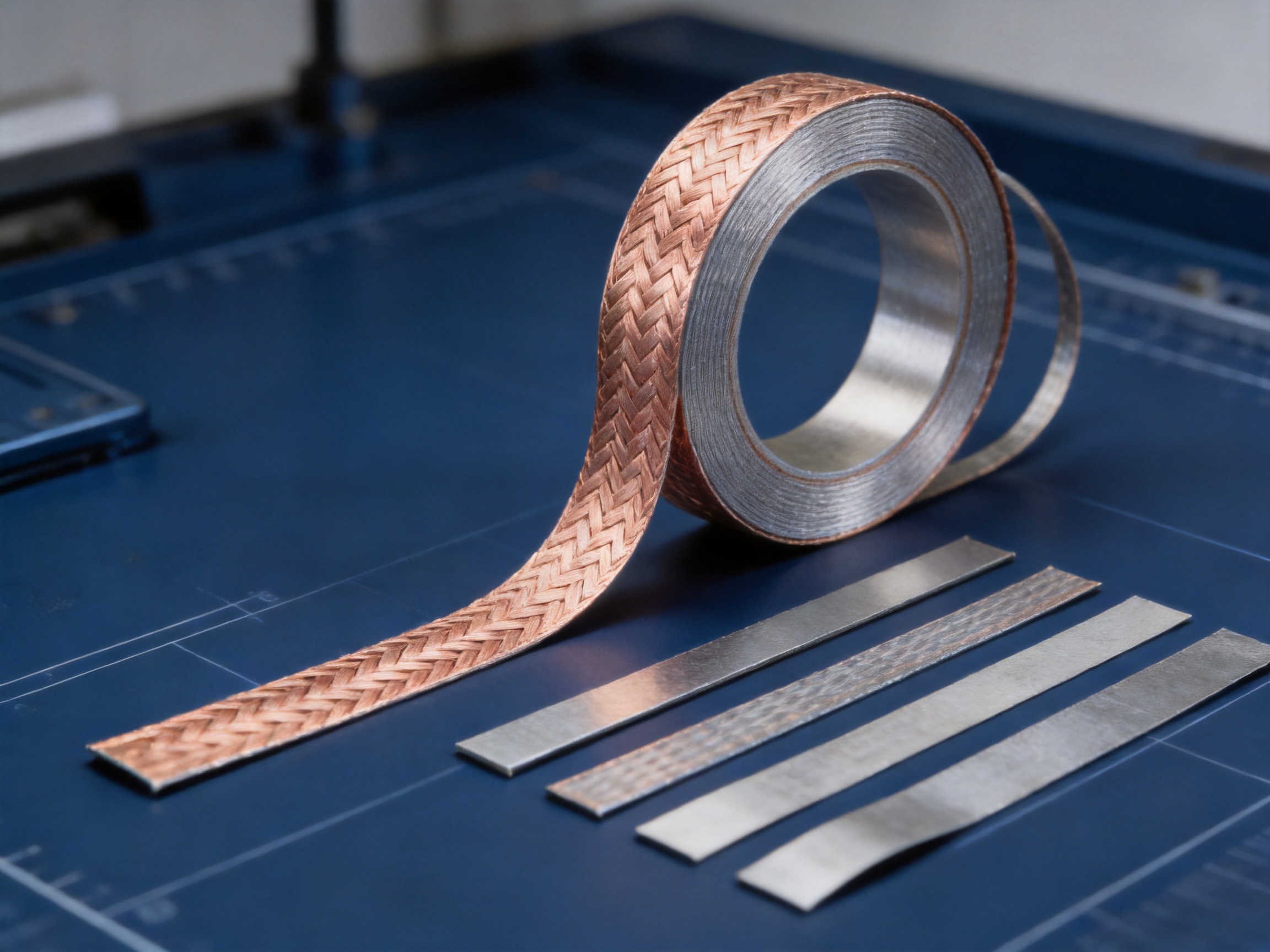
Flat tinned copper braided tape is a flexible electrical conductor made by interweaving numerous fine copper wires into a flat, ribbon-like structure. Unlike a single solid strip, the braided construction contains many individual wires that can move slightly in relation to one another. This allows the conductor to bend repeatedly and accommodate mechanical movement without concentrating all stress at one point.
The FTCB 20 series uses a standard wire diameter of 0.20 mm. Fine wires are important because smaller individual filaments generally create a more flexible braid than a conductor made from a few thick wires. When these wires are woven into a flat configuration, the finished product offers a useful balance between flexibility, cross-sectional area, and contact width.
The copper base provides efficient electrical conduction and good thermal performance. Tinning adds a protective metallic layer to the copper surface. This layer can help improve resistance to oxidation and support more stable connection performance in storage, assembly, and service environments. Tinned copper is also widely used where the conductor may encounter humidity, handling, or connection conditions that could otherwise affect bare copper surfaces.
The flat profile is another important feature. A round wire or cable may require additional space and may not sit evenly against a flat terminal or conductive surface. A braided tape can lie across a connection area, helping engineers create a compact and mechanically compliant connection. The geometry is especially useful where equipment packaging is narrow, where terminals are positioned close together, or where a connection must follow a controlled path.
Flexible Conductivity for Moving Assemblies
Electrical connections in batteries, switchgear, industrial equipment, and power electronics are rarely exposed to purely static conditions. Equipment may experience vibration, thermal expansion, assembly movement, maintenance access, or repeated operation. A rigid busbar can be effective in fixed installations, but it may transfer mechanical stress to bolts, terminals, housings, and connected components.
A braided tape provides a degree of mechanical decoupling. Its fine strands allow the conductor to flex rather than forcing the connected components to absorb all movement. This can make the connection more tolerant of manufacturing variation and operating vibration. The flexible structure may also simplify routing during assembly, particularly when the required path is not perfectly straight.
Flat Geometry and Contact Efficiency
The flat form factor can provide a wider connection surface than a single round conductor of a similar cross-sectional area. In suitable applications, this may support efficient placement against a terminal, copper plate, busbar, or battery connection point. The tape can also be stacked, folded, or arranged according to the requirements of the connection design, provided that the installation method follows the relevant engineering and safety specifications.
Flat geometry can also help reduce the height of a connection. This is valuable in compact electrical cabinets, battery modules, power conversion equipment, and assemblies where vertical clearance is limited. Instead of routing a bulky cable through a tight area, an engineer may use a flat flexible braid to create a lower-profile conductive bridge.
Key Product Characteristics of the FTCB 20 Series
The FTCB 20 series is built around a consistent 0.20 mm wire diameter and a family of standard cross-sectional sizes. This creates a product range that can be matched to different current demands and physical installation conditions. The product information identifies the braid as an extra-long flex holder, emphasizing its ability to support flexible connection requirements.
The core characteristics include:
• Fine 0.20 mm copper wire construction.
• Tinned copper surface for improved surface protection and connection durability.
• Flat braided structure for low-profile installation and broad contact positioning.
• Multiple cross-sectional options from 3 mm² to 25 mm².
• Nominal current ratings from 30 A to 150 A, depending on model and application conditions.
• Long packaging lengths suitable for production cutting and repeated assembly use.
• Compatibility with customized conductive component manufacturing and flexible connection solutions.
Electrical engineers should treat nominal current ratings as design references rather than universal operating limits. Actual permissible current depends on ambient temperature, installation method, contact resistance, duty cycle, ventilation, nearby materials, allowable temperature rise, and applicable standards. Final selection should always be confirmed through application-specific electrical and thermal evaluation.
| Part Number | Description | Cross Section | Dimensions | Number of Cores | Nominal Current | Packaging | Weight |
|---|---|---|---|---|---|---|---|
| 23000474 | FTCB 20-3 | 3 mm² | 5 × 1 mm | 96 | 30 A | 500 m | 0.03 kg |
| 23000475 | FTCB 20-5 | 5 mm² | 8 × 1 mm | 168 | 45 A | 500 m | 0.05 kg |
| 23000476 | FTCB 20-10 | 10 mm² | 10 × 1.5 mm | 312 | 75 A | 150 m | 0.10 kg |
| 23000477 | FTCB 20-16 | 16 mm² | 15 × 2 mm | 512 | 120 A | 150 m | 0.16 kg |
| 23000478 | FTCB 20-25 | 25 mm² | 25 × 1.5 mm | 792 | 150 A | 100 m | 0.25 kg |
The product range allows customers to select a suitable braid according to current demand, available installation space, required flexibility, and production volume. Smaller cross-sections can be useful in compact control or low-voltage connection assemblies, while larger versions are appropriate for higher-current links in power equipment and energy storage systems.
Advantages Compared with Conventional Rigid Conductors
Improved Mechanical Compliance
A solid copper bar has high rigidity. That property is useful when the conductor must maintain a fixed position or provide structural support, but it can become a disadvantage when connected equipment moves or vibrates. A rigid conductor may require precise alignment and careful forming. If the connected components shift, the stress may be transferred to fasteners, solder joints, welded areas, or terminal interfaces.
The FTCB 20 braided tape provides a more compliant connection. The individual wires and woven structure allow controlled bending and movement. This can reduce installation stress and make the conductor more forgiving of small positional differences. It is particularly valuable in assemblies where components are mounted on separate supports or where thermal expansion causes relative movement.
Lower Installation Complexity
Rigid busbars often require cutting, drilling, bending, deburring, surface treatment, and precise dimensional inspection before they can be installed. A flexible braid can simplify routing and may reduce the number of forming operations. Production teams can cut the required length from a continuous roll, prepare the ends, and position the braid according to the assembly design.
The use of long packaging lengths can support efficient production. The 3 mm² and 5 mm² versions are supplied in 500-meter packages, while the larger sizes are offered in 100-meter or 150-meter packages. These lengths can reduce the frequency of material replacement in a production line and support consistent cutting of repeated connection parts.
Better Suitability for Vibration-Prone Equipment
Industrial machinery, vehicles, battery systems, rail equipment, and power conversion units may experience continuous or intermittent vibration. A flexible braid can absorb some of the movement that would otherwise be transferred directly into the electrical interface. The result is a connection architecture that is better suited to dynamic equipment than a purely rigid link.
However, flexibility does not eliminate the need for correct mechanical support. The braid should be routed with suitable bend radius, protected from abrasion, and secured so that it does not experience uncontrolled rubbing or excessive tension. Proper terminal preparation and fastening remain essential to safe and stable operation.
Efficient Use of Installation Space
The flat design can be advantageous in crowded assemblies. It can fit into shallow spaces and follow a surface more closely than a round cable. This may help equipment designers reduce enclosure size or improve the arrangement of adjacent components. In battery modules and compact distribution systems, even small reductions in connection height can improve packaging efficiency.
Advantages Compared with Ordinary Bare Copper Braid
Uncoated copper braid can provide excellent conductivity and flexibility, but the exposed copper surface may be more vulnerable to oxidation, discoloration, and environmental handling effects. A tinned surface creates an additional protective layer over the copper wires. This can help preserve surface quality during storage and assembly and may support more consistent contact behavior over time.
Tinning can also improve compatibility with certain termination and joining processes. Depending on the design, the braid may be connected using crimping, soldering, welding, bolting, clamping, or a specialized terminal interface. The selected process must be validated for the actual braid construction and application. The important advantage is that the tinned surface provides a controlled and recognizable conductor finish rather than leaving the copper exposed.
In applications where humidity, condensation, airborne contaminants, or frequent handling are possible, the tinned finish can offer an additional layer of protection. It is not a substitute for environmental sealing or proper enclosure design, but it can contribute to a more durable conductive assembly when combined with appropriate protection measures.
Applications Across New Energy and Industrial Systems
Battery Modules and Battery Packs
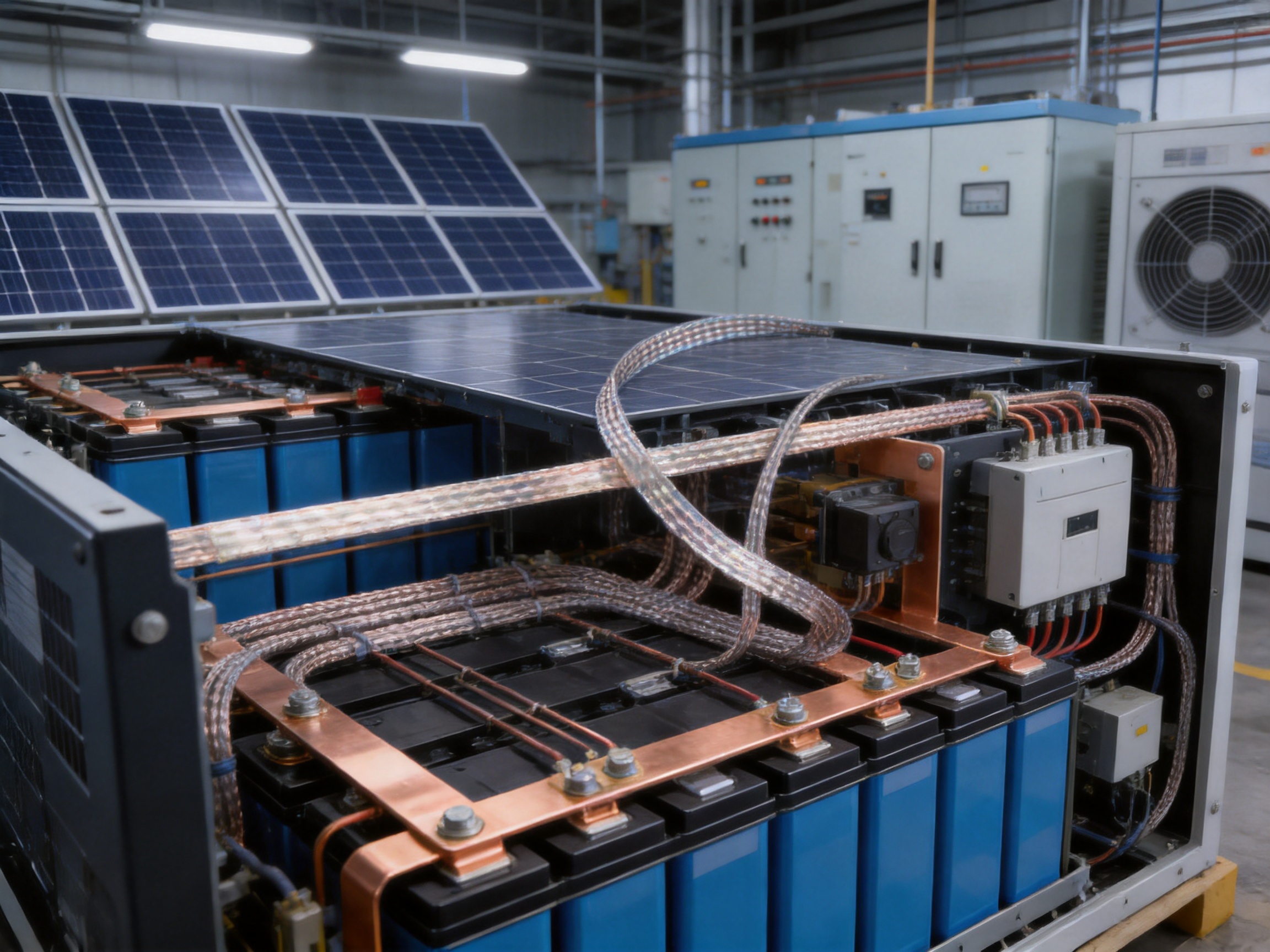
Battery systems require reliable electrical connections between cells, modules, busbars, monitoring components, and external terminals. These connections must often fit within limited spaces while tolerating vibration and thermal cycling. Flat braided tape can be used as a flexible conductive link where a rigid bar would be too difficult to route or where movement must be isolated from a sensitive connection point.
The product can support battery pack manufacturers in developing compact interconnects and flexible terminal connections. Its flat form may be placed along a designed path within a module, while its fine-wire structure can accommodate movement between cell groups or subassemblies. The appropriate cross-section should be selected according to the continuous current, peak current, temperature rise, short-circuit requirements, and mechanical design.
Battery applications also demand careful control of insulation, clearances, creepage distances, thermal behavior, and accidental short-circuit risk. The braid itself is a conductive component and may require an insulating cover, protective sleeve, molded housing, or controlled routing arrangement. Application engineers should evaluate the complete connection system rather than selecting the conductor in isolation.
Energy Storage Systems
Stationary energy storage systems contain battery racks, power conversion equipment, protection devices, and distribution assemblies. Flexible copper connections can be used between components that are subject to installation tolerances, vibration from cooling equipment, or thermal expansion. The FTCB 20 series offers several sizes for different current levels, enabling designers to standardize the conductor family across multiple system sections.
Long packaging lengths are useful in energy storage production because many assemblies use repeated connection patterns. A continuous braid can be cut to length according to the bill of materials, helping reduce material variation and simplify procurement. When combined with standardized end termination, it can support repeatable manufacturing across multiple cabinet or rack configurations.
Power Distribution and Electrical Equipment
Switchboards, control panels, distribution cabinets, and power conversion equipment often contain rigid copper bars as the primary current path. Flexible braided tape can complement these bars by connecting moving, removable, hinged, or vibration-sensitive sections. Examples include links between a fixed busbar and a removable panel, connections across a hinged door, or flexible bridges between closely positioned conductive components.
In these situations, the braid may reduce stress on terminals and make maintenance access easier. A removable panel can be opened without requiring a rigid conductor to be disconnected or sharply bent. The flat profile can also help maintain a clean internal layout when space around the busbar system is limited.
Renewable Energy Equipment
Solar power converters, battery inverters, charging equipment, and wind energy electrical systems require conductive components that can perform reliably under changing electrical and environmental conditions. Flexible braid may be used in internal equipment connections where vibration, thermal cycling, and compact packaging are relevant design factors.
Renewable energy equipment is often expected to operate for long periods with limited maintenance. A carefully designed tinned copper flexible connection can contribute to stable performance by combining good conductivity, mechanical compliance, and surface protection. The product must still be integrated with appropriate enclosure protection, terminal technology, and thermal management.
Rail Transit and Transportation Equipment
Transportation systems expose electrical components to repeated vibration, shocks, movement, and limited installation space. Flexible braided conductors can be used in power, grounding, control, and equipment interconnection applications when properly engineered for the vehicle environment. The braid can help accommodate motion between mounted assemblies and reduce mechanical loading on connection points.
Transportation projects generally involve demanding qualification and validation requirements. Material selection, insulation, fire behavior, electromagnetic compatibility, mechanical endurance, and environmental performance must be evaluated according to the applicable project specifications. The FTCB 20 product can serve as a flexible conductor component within such a system when the complete design is validated.
Precision Manufacturing Capabilities Behind the Product
Zhejiang Zhongyan New Energy Co., Ltd. specializes in new energy conductive components and precision flexible connection products. Its product scope includes high-voltage electrical copper foil soft connections, special-shaped soft connections, battery soft connections, and related conductive components. This specialization is directly relevant to the design and production of flexible copper braid because such products require control of materials, geometry, joining methods, and final electrical performance.
The company was established in 2022 and has developed capabilities covering product design, research and development, manufacturing, testing, and solution support. Its technical teams include experienced engineers who work across materials science, precision machining, process development, and verification. This combination allows the company to approach a flexible conductor not simply as a commodity wire, but as part of a complete electrical connection system.
Process Control from Material to Finished Component
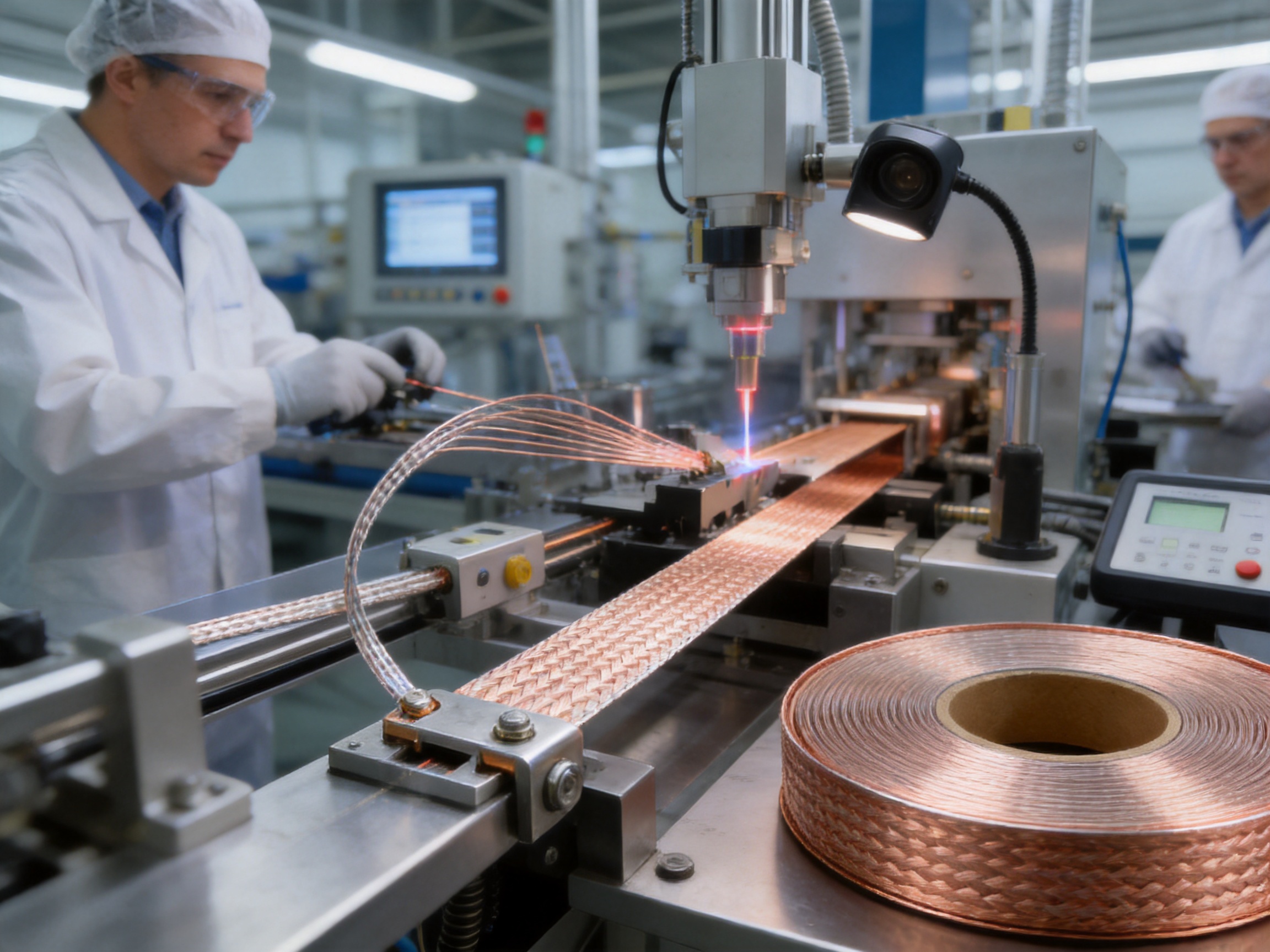
Consistent performance begins with material control. Copper wire diameter, copper purity, tin surface condition, tensile behavior, and dimensional consistency all influence the final braid. A standard 0.20 mm wire diameter provides a defined basis for producing the FTCB 20 series. During manufacturing, control of wire handling and braiding tension is important because excessive variation can affect flatness, width, thickness, flexibility, and the distribution of wires across the tape.
Once braided, the material must be inspected for visual defects, incomplete weaving, loose strands, irregular edges, and dimensional variation. The production process should also maintain controlled packaging so that the tape can be unwound, cut, and handled efficiently during customer assembly. Long-length packaging is practical only when the braid remains consistent throughout the roll.
For finished flexible connection components, additional operations may include cutting, end preparation, terminal forming, welding, diffusion joining, laser processing, or insulation integration. The company’s broader expertise in soft connections and new energy components supports the development of these downstream processes according to customer requirements.
Polymer Diffusion Welding and Laser Technology
The company has independently developed polymer diffusion welding and laser technology patents for new energy precision components. These technologies are associated with the production of low-resistance, high-reliability conductive connections. While the exact process used for a particular customer assembly depends on the design, this technical background demonstrates an ability to work with advanced joining and precision manufacturing methods.
Low internal resistance is especially important in battery and power applications. Every connection introduces some resistance, and excessive resistance can result in voltage drop, heat generation, and energy loss. Precision joining technologies can help create a more uniform interface between conductive layers or flexible components. Proper process control also supports repeatability across high-volume production.
Testing and Verification
Flexible conductors must be evaluated both electrically and mechanically. Relevant evaluation may include dimensional inspection, resistance measurement, current-carrying performance, temperature-rise testing, bend testing, tensile testing, terminal pull testing, vibration evaluation, and environmental exposure. The exact test program should reflect the customer’s application and applicable standards.
A company with internal design, manufacturing, and verification capabilities can shorten the feedback cycle between testing and process improvement. If a customer requires a different width, cross-section, length, end treatment, or connection structure, engineering teams can assess how the modification affects electrical and mechanical performance before moving to production.
Why Manufacturing Specialization Matters to Customers
Purchasing a flexible copper braid is not only a matter of comparing nominal current ratings. Customers also need confidence in dimensional consistency, delivery stability, technical communication, and the supplier’s ability to support product integration. A manufacturer focused on new energy conductive components is familiar with the challenges of compact high-current systems, battery interconnections, and precision soft connections.
This specialization can benefit original equipment manufacturers in several ways. First, it provides access to engineers who understand how flexible conductors interact with terminals, busbars, batteries, and enclosures. Second, it creates a pathway for customization when a standard product does not fully meet the application. Third, it supports process coordination when the customer needs a finished connection rather than raw braid alone.
Zhejiang Zhongyan New Energy serves industries including power transmission and distribution, electric vehicles, rail transit, communications, and energy storage. These fields require high consistency and careful management of electrical interfaces. Experience across multiple sectors can help the manufacturer identify common design risks, such as insufficient bend allowance, inadequate terminal support, thermal concentration, or excessive mechanical loading.
Customization Options for OEM and Project Applications
The standard FTCB 20 sizes provide a practical starting point, but many projects require a tailored configuration. Customization may involve braid width, thickness, cross-sectional area, cut length, end termination, hole pattern, connection orientation, insulation, protective sleeve, or assembly geometry. The correct customization depends on the installation space, current profile, required flexibility, and manufacturing method.
Cross-Section and Current Matching
Customers can select among 3 mm², 5 mm², 10 mm², 16 mm², and 25 mm² options. A smaller braid may be suitable for compact low-current links, while a larger braid may be needed for higher-current power paths. In practice, selection should account for continuous operation, overload conditions, transient current, ambient temperature, cooling, and the required service life.
It is also important to distinguish between the electrical cross-section and the physical dimensions of the braid. Two conductors with similar current capacity may occupy different widths or thicknesses. The correct product must fit the available space while maintaining suitable thermal and mechanical margins.
End Termination and Integration
A braid is only as reliable as its connection to the surrounding system. End termination may be designed for bolted assembly, welded attachment, crimped terminals, or another approved joining method. A customized end can improve installation efficiency by eliminating manual shaping and reducing the number of assembly steps.
For repeated production, pre-terminated flexible connections can improve consistency. The manufacturer can coordinate braid length, terminal dimensions, hole locations, joining conditions, and inspection requirements with the customer. This approach can reduce on-site labor and help ensure that each connection is produced according to the same drawing and process specification.
Insulation and Protection
In high-density electrical assemblies, bare conductive braid may need protection against accidental contact, abrasion, contamination, and short circuits. Depending on the application, customers may request insulation, sleeving, molded covers, or integration into a larger connection assembly. The protection system must be compatible with operating temperature, voltage, flexibility, and environmental exposure.
The product category served by the manufacturer includes insulated flexible busbars and battery terminal insulator covers, creating opportunities for coordinated development of conductive and insulating components. A combined approach can simplify system design and improve the match between the conductor and its protective elements.
Installation and Design Considerations
Allow Adequate Flexibility
Although braided tape is flexible, it should not be forced into an extremely tight bend. The design should provide a suitable bend radius and enough length to accommodate movement without placing the conductor under continuous tension. A braid that is stretched tightly between two terminals may lose the mechanical advantage that makes flexible connections valuable.
Protect Against Abrasion
Fine copper wires can be damaged by repeated rubbing against sharp edges or moving metal parts. During installation, the tape should be routed away from burrs, corners, and uncontrolled contact points. Where movement is expected, the assembly should include suitable support, edge protection, or insulation.
Control the Connection Interface
Terminal surfaces should be clean, flat, and compatible with the selected termination method. Fasteners should be tightened according to the relevant engineering specification. Excessive pressure may deform the braid, while insufficient pressure may increase contact resistance. The connection should be inspected for strand damage, uneven compression, and unwanted gaps.
Consider Thermal Conditions
Current rating depends on heat dissipation and operating temperature. A braid installed in an open, ventilated space may perform differently from one enclosed in insulation or positioned near heat-generating components. Engineers should consider the thermal environment, allowable temperature rise, duty cycle, and adjacent materials when selecting the cross-section.
Verify Dynamic Performance
For applications involving vibration or repeated movement, the complete connection should be tested in its actual routing configuration. Testing only the loose braid may not reveal stress caused by terminals, clamps, bends, or nearby components. System-level validation can help confirm that the design remains stable under expected operating conditions.
Quality, Reliability, and Production Consistency
Reliability in a flexible conductor depends on more than high copper conductivity. The braid must maintain consistent geometry, stable strand distribution, secure termination, and acceptable resistance throughout its service life. Manufacturing controls are therefore essential at every stage, from incoming material inspection to final packaging.
The company’s modern production and quality management systems are intended to provide stable and consistent products and services. A structured quality process can include documented specifications, process parameter control, equipment maintenance, in-process inspection, final testing, traceability, and corrective action. These controls are particularly important for battery and energy storage applications, where a small connection defect can affect system performance or safety.
Consistency is also important for OEM customers. When a conductor is used in a repeated assembly, variations in width, length, terminal position, or resistance can complicate production and quality inspection. A controlled manufacturing process helps customers establish repeatable assembly conditions and predictable electrical behavior.
The company’s customer base includes leading enterprises in the new energy sector, including BYD, CATL, and Jaguar. These relationships reflect experience serving demanding industrial customers, although each application remains subject to its own technical specifications, qualification procedures, and approval requirements.
Environmental and Long-Term Value
Flexible copper braid can contribute to equipment durability by reducing mechanical stress at electrical interfaces. When a connection accommodates vibration and thermal expansion instead of transmitting all movement to a terminal, the overall assembly may experience fewer mechanical concentration points. Longer-lasting connections can reduce maintenance requirements and replacement costs over the equipment life cycle.
The flat design may also support material-efficient packaging. In compact equipment, reducing unused space can help manufacturers optimize cabinet, module, or enclosure dimensions. Smaller assemblies may require less structural material and may be easier to transport and install. These benefits depend on the complete product design, but flexible connection technology can be an important enabler.
The manufacturer’s focus on green energy and energy-storage technologies aligns with the growing need for efficient electrical interconnections. Battery systems, renewable power equipment, electric vehicles, and power distribution systems all depend on conductive components that can operate reliably while supporting compact and increasingly integrated designs.
Choosing the Appropriate FTCB 20 Model
Model selection should begin with the electrical requirement. The FTCB 20-3 model has a listed nominal current of 30 A, while the FTCB 20-5 is listed at 45 A. The FTCB 20-10, FTCB 20-16, and FTCB 20-25 are listed at 75 A, 120 A, and 150 A respectively. These values provide an initial comparison, but the final selection should be based on the actual operating conditions.
The next consideration is available space. The 3 mm² model measures approximately 5 × 1 mm, while the 25 mm² model measures approximately 25 × 1.5 mm. Wider braids may provide greater cross-sectional capacity but require more lateral space. The 16 mm² version, at approximately 15 × 2 mm, may be useful where a particular thickness and current capacity are required.
Number of cores is another useful specification. The range includes 96 cores for the 3 mm² version, 168 cores for the 5 mm² version, 312 cores for the 10 mm² version, 512 cores for the 16 mm² version, and 792 cores for the 25 mm² version. These values illustrate how the braid scales its conductive structure across different sizes.
Packaging requirements should also be considered. High-volume production may benefit from 500-meter packaging for the smaller sizes, while the larger products are packaged in 100-meter or 150-meter lengths. Customers should confirm whether the packaging format matches their cutting equipment, storage area, material handling process, and production schedule.
Frequently Asked Questions
What is the FTCB 20 Flat Tinned Copper Braided Tape used for?
The product is used for flexible electrical connections in battery systems, energy storage equipment, power distribution assemblies, industrial equipment, renewable energy systems, and other applications where a flat, compliant copper conductor is required.
What does the 0.20 mm wire diameter mean?
It refers to the standard diameter of the individual copper wires used to form the braid. Fine wires generally improve flexibility because the braid can bend through the combined movement of many small strands.
Why is the copper tinned?
Tinning provides a protective surface layer over the copper. It can help reduce oxidation-related surface deterioration and support more stable handling and connection performance. Environmental protection and correct termination are still required for the complete application.
What cross-sectional sizes are available?
The standard FTCB 20 series includes 3 mm², 5 mm², 10 mm², 16 mm², and 25 mm² options. The available models are FTCB 20-3, FTCB 20-5, FTCB 20-10, FTCB 20-16, and FTCB 20-25.
What is the highest listed nominal current?
The FTCB 20-25 model has the highest listed nominal current at 150 A. Actual current capacity depends on installation, temperature, duty cycle, ventilation, contact resistance, and applicable design requirements.
Can the braid replace every rigid copper busbar?
No. Flexible braid and rigid busbars serve different design purposes. A rigid busbar may be preferable where structural stiffness, fixed positioning, or a specific short-circuit withstand capability is required. Flexible braid is advantageous where movement, vibration, low-profile routing, or installation compliance is important. Engineers should select the conductor type according to the complete system design.
Can the product be customized?
Customized manufacturing support is available for conductive components and flexible connection solutions. Potential customization areas may include length, width, cross-section, end termination, insulation, protective structures, and assembly geometry. Requirements should be reviewed against the application’s electrical, thermal, mechanical, and production specifications.
How should the braid be installed?
The braid should be routed with adequate bend allowance, protected from sharp edges and abrasion, and connected using a validated termination method. Terminals should be aligned correctly, and fastening should follow the specified torque or joining parameters. The finished assembly should be checked for mechanical freedom, electrical continuity, and acceptable temperature rise.
Is the product suitable for battery applications?
Yes, the product is suitable for consideration in battery modules, battery packs, energy storage systems, and related conductive assemblies. Battery applications require additional evaluation of insulation, voltage clearance, temperature, vibration, short-circuit protection, and connection reliability before production approval.
What makes a specialized manufacturer valuable for this product?
A specialized manufacturer can provide knowledge of flexible connections, battery components, precision joining, testing, and new energy system requirements. This may help customers move from a raw braid specification to a complete, validated connection assembly.
Conclusion
The FTCB 20 Flat Tinned Copper Braided Tape provides a practical solution for electrical systems that need conductivity, flexibility, low-profile geometry, and reliable surface protection. Its 0.20 mm copper wires are woven into a flat braid that can accommodate movement and simplify routing compared with many rigid conductor designs. The tinned finish supports improved surface stability, while the range of cross-sections and current ratings allows engineers to select a suitable standard model for different applications.
Its value is especially clear in battery systems, energy storage equipment, power distribution assemblies, industrial machinery, transportation equipment, and renewable energy products. In these environments, flexible conductors can reduce mechanical stress, improve packaging efficiency, and support more adaptable assembly designs.
The product is supported by a manufacturer focused on new energy conductive components, soft connections, battery connection technologies, precision manufacturing, and customized solutions. Experience in polymer diffusion welding, laser technology, product development, manufacturing, testing, and verification provides a strong foundation for serving OEM customers and project-based applications.
For the best results, customers should evaluate the FTCB 20 series as part of a complete connection system. Cross-section, current, temperature, bend radius, termination, insulation, vibration, and environmental conditions must all be considered. When correctly selected and integrated, flat tinned copper braided tape can provide a durable, efficient, and highly adaptable alternative to conventional rigid electrical links.
References
1. Product specification data for the FTCB 20 Flat Tinned Copper Braided Tape series, including dimensions, cross-sections, core counts, nominal current ratings, packaging, and weight.
2. Technical information on copper conductors, braided flexible connections, and tinned copper surface treatments.
3. General engineering principles for electrical conductor sizing, temperature rise, contact resistance, and flexible connection design.
4. Manufacturing information concerning precision conductive components, battery soft connections, polymer diffusion welding, and laser joining technologies.
5. General application guidance for battery systems, energy storage equipment, power distribution assemblies, renewable energy equipment, and industrial electrical systems.
Product: FTCB 20 Flat Tinned Copper Braided Tape

Driven by the development of new energy and aiming for "zero carbon".
Copyright © Zhejiang Zhongyan New Energy Co., Ltd. All Rights Reserved.
