 English
 Español

Flat Tinned Copper Braided Tape for High-Current and Flexible Electrical Connections
Modern electrical systems increasingly require conductors that combine high current capacity, mechanical flexibility, vibration resistance, and long-term contact reliability. Conventional rigid copper bars are effective for fixed installations, but they can become difficult to integrate where components move, expand thermally, or experience repeated vibration. Flexible copper braided tape provides an alternative by combining the conductivity of copper with a woven structure that can absorb movement and mechanical stress.
The FTCB 15 Flat Tinned Copper Braided Tape is designed for these demanding connection environments. It is manufactured from annealed T2 pure copper wires and formed into a flat braided conductor suitable for electrical installation, switchgear, power distribution, batteries, electric furnaces, renewable energy equipment, industrial machinery, and transportation systems. Its tin-plated surface improves resistance to oxidation and corrosion while supporting reliable contact performance in humid, polluted, or otherwise challenging operating conditions.
Unlike a conventional solid busbar, the product can flex and conform to installation geometry. Unlike an ordinary round braided wire, its flat profile provides a broad contact area and efficient heat dissipation. This combination makes it suitable for power links that must carry substantial current while accommodating vibration, thermal expansion, equipment movement, or limited installation space.
Content
- Product Overview
- Why Flexible Braided Tape Is Important in Modern Power Systems
- Core Material and Electrical Performance
- Advantages of the Tin-Plated Surface
- Flat Geometry and Mechanical Flexibility
- Product Range and Technical Selection
- Applications in Battery Packs and Energy Storage Systems
- Applications in Electrical Distribution and Industrial Equipment
- Use in Renewable Energy and Power Electronics
- Use in Transportation, Rail, and Heavy Industry
- Comparison with Alternative Conductor Designs
- Manufacturing Process and Production Strengths
- Engineering and Customization Capability
- Installation and Design Recommendations
- Packaging, Handling, and Storage
- Value for OEM and Project Customers
- Frequently Asked Questions
- What is FTCB 15 Flat Tinned Copper Braided Tape?
- What copper material is used?
- Why is the braid tin plated?
- What cross-sectional sizes are available?
- Can the product be customized?
- Can FTCB 15 be used in battery packs?
- Is the braid insulated?
- How should nominal current ratings be interpreted?
- What is the difference between flat braid and rigid busbar?
- How is the product packaged?
- What termination methods can be used?
- What makes this product suitable for vibration environments?
- Conclusion
- References
- Product: FTCB 15 Flat Tinned Copper Braided Tape
Product Overview
FTCB 15 is a flat tinned copper braided tape series available in multiple cross-sectional areas. The product range extends from compact 3 square millimeter versions to high-capacity 100 square millimeter versions. Standard configurations are supplied in 25-meter packaging, with options for rolls, spools, or wooden drums depending on production and logistics requirements.
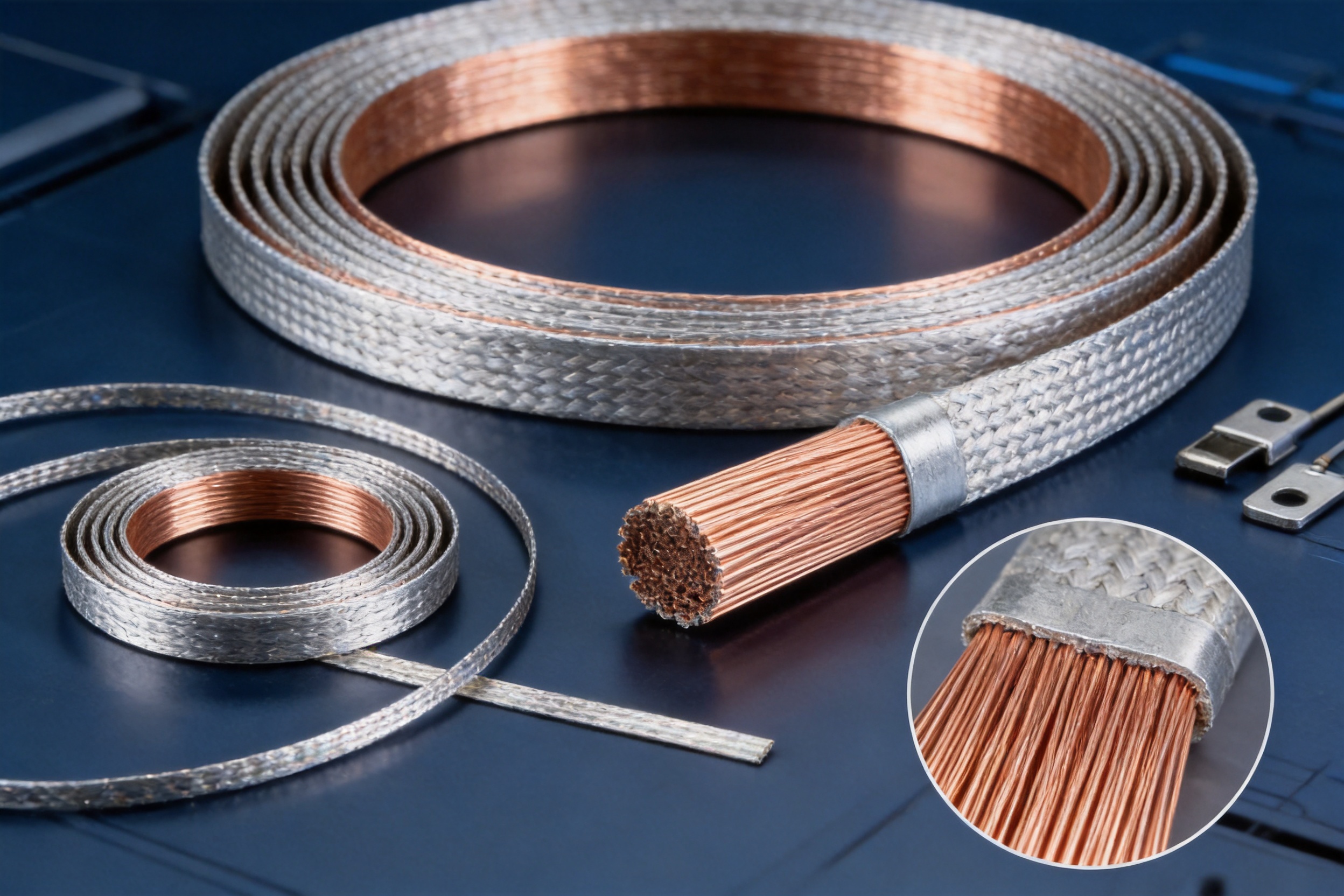
The conductor consists of multiple fine copper wires woven into a flat, flexible structure. The copper is annealed to improve flexibility, allowing the tape to bend more easily than a rigid copper strip. Depending on the selected design, the braid can also be terminated with lugs, terminals, or other connection hardware. Custom cutting and termination support can simplify assembly for battery modules, switchgear, grounding systems, and industrial control equipment.
The standard product uses copper with a copper content of at least 99.95 percent. The available finish options include bare copper, tin plating, nickel plating, and silver plating. The FTCB 15 product described here uses a tin-plated finish, which is especially suitable where corrosion resistance, solderability, and stable contact performance are important.
Typical application environments include electrical cabinets, battery packs, energy storage systems, electric vehicles, inverters, transformers, industrial machinery, telecommunications equipment, rail transit systems, and marine or mining installations. The braid may function as a flexible current conductor, grounding strap, bonding connection, battery interconnect, or vibration-resistant power link.
Why Flexible Braided Tape Is Important in Modern Power Systems
Electrical connection design is no longer limited to selecting a conductor with sufficient nominal current capacity. Engineers must also consider movement, temperature variation, installation tolerances, electromagnetic compatibility, contact stability, service life, and assembly efficiency. These requirements are particularly important in electric vehicles, battery storage systems, renewable energy equipment, and automated industrial machinery.
Rigid conductors can transmit high current efficiently, but they transfer mechanical stress directly to connection points. When two connected components move relative to one another, a solid conductor may experience bending fatigue or place excessive force on terminals. Thermal expansion can create a similar problem. Repeated heating and cooling may cause the conductor and surrounding components to expand at different rates, increasing stress at bolts, welds, terminals, and insulating supports.
A braided conductor distributes movement across many fine wires. Instead of concentrating bending at one narrow point, the woven structure allows small movements throughout the braid. This characteristic helps absorb vibration and thermal displacement, reducing the likelihood of fatigue-related failure when the product is correctly selected and installed.
The flat form is also valuable. It can be positioned against a terminal, enclosure, grounding point, or battery connection with a broad contact surface. It can often be routed in compact spaces where a rigid bar or bulky cable would be difficult to install. For high-current applications, the broad geometry can assist heat dissipation and reduce localized current concentration at the connection interface.
FTCB 15 Flat Tinned Copper Braided Tape
Core Material and Electrical Performance
T2 Pure Copper Construction
The FTCB 15 series uses T2 pure copper, also identified as Cu-ETP or C11000 in common material classifications. The specified copper content is at least 99.95 percent. High-purity copper is selected because it offers excellent electrical conductivity and low resistance, which are essential for efficient power transmission.
Low conductor resistance reduces voltage drop and limits resistive energy loss. In high-current circuits, even a small increase in resistance can result in significant heat generation. The use of high-purity copper helps the conductor maintain efficient current transfer when used within the appropriate current, temperature, installation, and environmental limits.
The copper wires are annealed before or during processing. Annealing reduces hardness and improves ductility, allowing the fine wires to bend repeatedly without behaving like a stiff solid strip. This is a key distinction between a flexible braid and a rigid copper bar. The material is not selected solely for conductivity; it is also processed to support mechanical flexibility and reliable handling during assembly.
Low-Resistance Current Transfer
The braided structure contains numerous parallel copper wires. These wires work together to carry current through the conductor. The actual performance of a finished connection depends on several factors, including cross-sectional area, braid geometry, wire diameter, contact quality, operating temperature, routing, and termination method.
The product range includes several single-wire diameters, such as 0.05 millimeter, 0.07 millimeter, 0.10 millimeter, 0.12 millimeter, 0.127 millimeter, 0.15 millimeter, 0.20 millimeter, 0.25 millimeter, and 0.254 millimeter. Fine wires contribute to flexibility, while the number of carriers and the braid dimensions determine the total conductive area and current capability.
For engineering purposes, the nominal current values in the product table should be treated as reference values rather than universal limits. The permissible current depends on ambient temperature, installation spacing, airflow, duty cycle, permissible temperature rise, termination design, and applicable electrical standards. A final design should be validated through calculation, testing, and the requirements of the relevant application.
Advantages of the Tin-Plated Surface
Corrosion and Oxidation Resistance
Copper naturally forms oxide layers when exposed to air, humidity, industrial pollutants, or other corrosive influences. Surface oxidation can increase contact resistance and make soldering or joining more difficult. Tin plating creates a protective surface that helps reduce direct exposure of the copper to the surrounding environment.
This protection is valuable in battery systems, renewable energy installations, transportation equipment, industrial control cabinets, and outdoor electrical systems. These environments may involve humidity, condensation, salt spray, chemical vapors, or airborne contaminants. The tin layer helps maintain more stable surface conditions over time, provided that the coating remains intact and the product is installed according to the application requirements.
Improved Solderability
Tin is widely used as a termination and contact finish because it supports soldering and can simplify the joining process. A tin-plated braid can be easier to prepare for soldered connections than untreated oxidized copper. This can be useful in battery module assembly, electronics, control systems, grounding straps, and custom cable harnesses.
Soldering conditions must still be controlled. The selected solder, flux, heating profile, joint geometry, and cleaning process influence the quality of the finished connection. Tin plating does not eliminate the need for proper process control, but it can provide a more suitable and consistent surface for many joining operations.
Stable Contact Performance
Reliable power transfer depends on the interface between the conductor and the terminal. A tin-plated surface can help support a stable connection by limiting surface oxidation and providing a compatible contact finish. When combined with correct compression, appropriate hardware, and suitable torque, it can contribute to consistent electrical performance during service.
The tin-plated surface is particularly relevant to systems that are assembled, serviced, or exposed to changing environmental conditions. It also provides a practical finish for customers who need a balance between conductivity, corrosion resistance, process compatibility, and cost.
Flat Geometry and Mechanical Flexibility
The flat profile is one of the principal advantages of FTCB 15. Compared with a round flexible wire, flat braided tape can present a larger surface area to a terminal or mounting point. This can support more uniform contact pressure and simplify the design of low-profile connections.
Flat tape can also be folded, bent, or routed around components while maintaining a compact installation profile. In battery packs and electrical cabinets, available space is often limited by cell arrangement, enclosure dimensions, cooling channels, insulation barriers, and service clearances. A flexible flat conductor can be positioned around these constraints more easily than a rigid bar.
The braid absorbs vibration and repeated movement by allowing the individual strands to shift slightly relative to one another. This helps reduce mechanical stress transmitted to terminals and adjacent components. The same characteristic can accommodate thermal expansion and contraction, which may occur in high-current systems during load cycling.
Flexibility should not be confused with unlimited bending capability. The minimum bend radius, bend direction, clamping method, and movement frequency all influence service life. The braid should not be twisted excessively, crushed by fasteners, sharply folded, or installed under tension. Proper routing is necessary to preserve both electrical and mechanical performance.
Optional Insulation Protection
For applications requiring additional electrical protection, PVC or TPE black insulation can be specified. An insulating layer can help reduce the risk of accidental short circuits, contact with conductive enclosures, and abrasion against nearby components. It may also provide additional resistance to selected chemicals, ultraviolet exposure, and mechanical wear.
The need for insulation depends on the system voltage, clearance requirements, enclosure design, installation method, and applicable safety standards. Bare or tin-plated braid may be preferred for grounding straps or direct terminal connections, while insulated braid may be more suitable for battery packs, power electronics, and densely populated assemblies.
Product Range and Technical Selection
The FTCB 15 range is designed to provide multiple conductor sizes for different current and installation requirements. A larger cross-sectional area generally supports higher current capacity, but current selection must consider the complete thermal design rather than cross-sectional area alone.
| Part Number | Model | Cross-Sectional Area | Approximate Dimensions | Number of Cores | Nominal Current | Standard Packaging |
| 23000437 | FTCB 15-3 | 3 square millimeters | 5 x 1 millimeter | 168 | 30 amperes | 25 meters |
| 23000438 | FTCB 15-5 | 5 square millimeters | 8 x 1 millimeter | 288 | 45 amperes | 25 meters |
| 23000439 | FTCB 15-8 | 8 square millimeters | 8 x 1.5 millimeters | 456 | 65 amperes | 25 meters |
| 23000440 | FTCB 15-10 | 10 square millimeters | 10 x 1.5 millimeters | 576 | 75 amperes | 25 meters |
| 23000441 | FTCB 15-16 | 16 square millimeters | 15 x 1.5 millimeters | 896 | 120 amperes | 25 meters |
| 23000442 | FTCB 15-20 | 20 square millimeters | 20 x 1.5 millimeters | 1120 | 140 amperes | 25 meters |
| 23000443 | FTCB 15-25 | 25 square millimeters | 23 x 1.5 millimeters | 1404 | 150 amperes | 25 meters |
| 23000444 | FTCB 15-30 | 30 square millimeters | 23 x 2 millimeters | 1692 | 180 amperes | 25 meters |
| 23000445 | FTCB 15-35 | 35 square millimeters | 23 x 2.5 millimeters | 1980 | 200 amperes | 25 meters |
| 23000446 | FTCB 15-40 | 40 square millimeters | 25 x 2.5 millimeters | 2272 | 220 amperes | 25 meters |
| 23000447 | FTCB 15-50 | 50 square millimeters | 28 x 3 millimeters | 2848 | 250 amperes | 25 meters |
| 23000448 | FTCB 15-60 | 60 square millimeters | 30 x 3 millimeters | 3392 | 280 amperes | 25 meters |
| 23000449 | FTCB 15-70 | 70 square millimeters | 30 x 3.5 millimeters | 3968 | 290 amperes | 25 meters |
| 23000450 | FTCB 15-75 | 75 square millimeters | 30 x 4 millimeters | 4256 | 300 amperes | 25 meters |
| 23000451 | FTCB 15-100 | 100 square millimeters | 40 x 4 millimeters | 5664 | 360 amperes | 25 meters |
The range allows designers to select a compact braid for lower-current grounding or control applications and a larger braid for high-current battery, inverter, and power distribution connections. The dimensions shown in the table describe the nominal flat profile, while the actual installed geometry may vary according to braid compression, termination, insulation, and routing.
How to Select the Correct Size
The first selection factor is continuous current. The conductor must be able to carry the expected load without exceeding the permitted temperature rise. Designers should distinguish between continuous current, short-duration surge current, peak fault current, and intermittent operating current.
The second factor is installation environment. A conductor installed in an enclosed cabinet with limited airflow may have a lower practical current capacity than the same conductor installed in open air. Ambient temperature, nearby heat sources, grouping with other conductors, and insulation type can all influence thermal performance.
The third factor is mechanical movement. If the braid is expected to flex continuously, the design should allow sufficient free length and avoid placing the bending point directly at the terminal. A slightly longer flexible connection may provide better service life than a short connection forced into a sharp bend.
The fourth factor is terminal compatibility. The width and thickness of the braid must match the available terminal, bolt, washer, lug, or clamping surface. The connection should provide enough contact area and mechanical support without crushing the woven conductor.
The fifth factor is the operating environment. Tin plating is advantageous in humid and corrosive environments, but additional sealing, insulation, or protective enclosure measures may still be required. For high-voltage battery systems, creepage, clearance, insulation coordination, and touch protection must be considered as part of the complete assembly.
Applications in Battery Packs and Energy Storage Systems
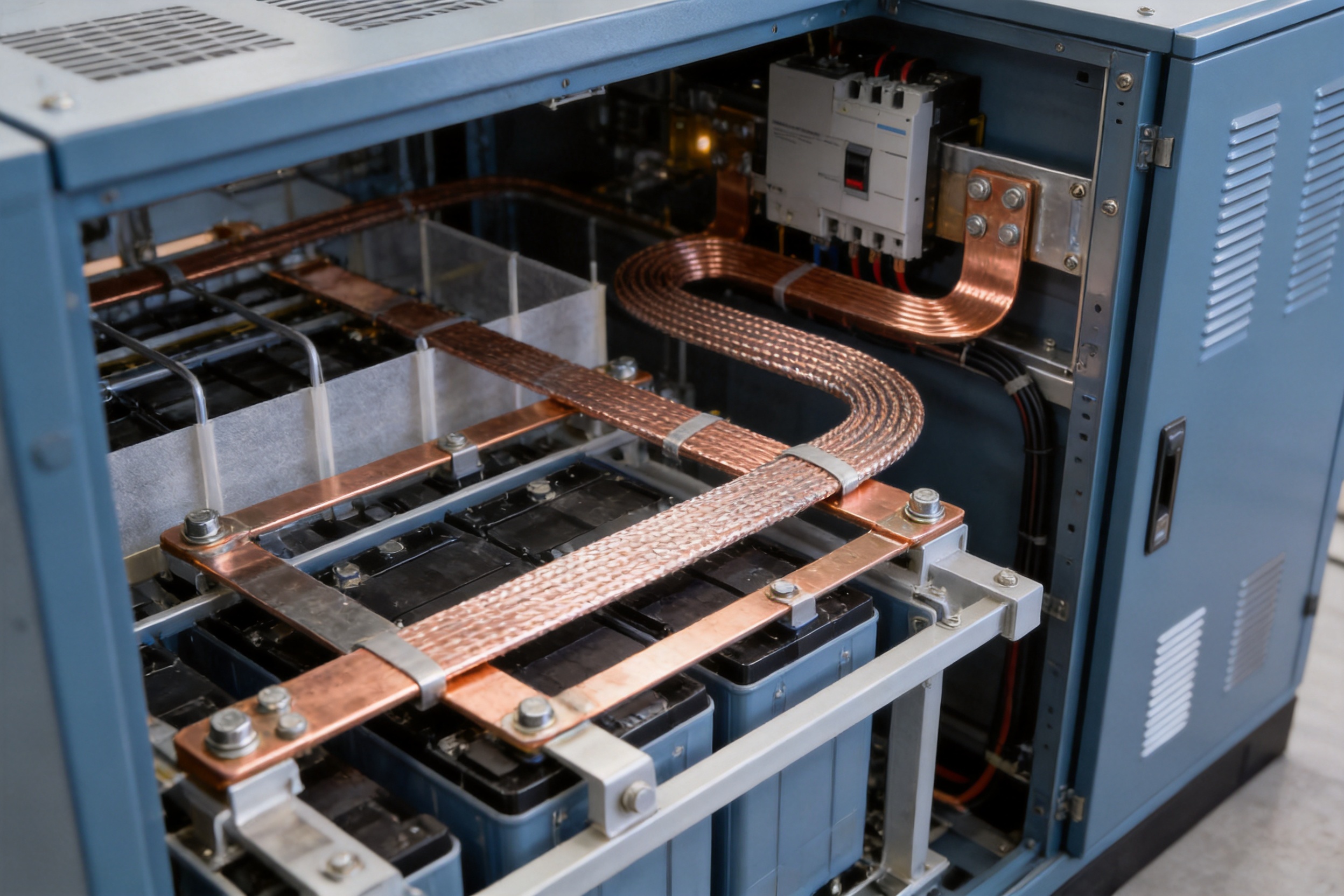
Battery packs require compact, reliable, and mechanically tolerant conductive connections. Cells and modules may experience vibration, temperature cycling, assembly tolerances, and controlled movement within the enclosure. Flexible braided tape can connect battery modules, busbars, contactors, fuses, disconnect devices, inverter interfaces, and grounding points.
In electric vehicles, the conductor may be installed near components that experience road vibration and repeated thermal cycling. A flexible connection helps reduce stress between battery modules and fixed electrical hardware. The flat design can also support efficient packaging in spaces where conventional cables may require greater bend clearance.
In stationary energy storage systems, braided tape can be used for battery module connections, cabinet grounding, flexible links between power electronics and busbars, and connections around service disconnects. Tin plating can be useful where the equipment may be exposed to humidity or where stable contact performance is needed during long operating periods.
Battery applications require careful attention to short-circuit protection. A flexible conductor can carry high current, but it must be routed away from sharp edges and protected against accidental contact. Insulation, barriers, terminal covers, and appropriate overcurrent protection should be selected as part of the complete battery safety design.
When used near lithium iron phosphate battery systems, the braid can support low-resistance power transfer between cells, modules, and external connection points. The product itself does not replace battery management systems, fuses, contactors, insulation monitoring, or other safety components. Instead, it functions as one element within an engineered electrical interconnection system.
Applications in Electrical Distribution and Industrial Equipment
FTCB 15 is suitable for flexible links inside switchgear, control cabinets, distribution panels, transformer assemblies, and industrial power equipment. It can connect hinged doors, removable panels, moving assemblies, grounding points, and high-current components that require mechanical accommodation.
Grounding and bonding are common uses. A braided copper strap can connect conductive equipment sections while allowing doors, covers, and panels to move. The flexible structure helps maintain a bonding path without interfering with normal operation. Tin plating can improve durability in locations where moisture or industrial contamination may be present.
In electric furnaces and other thermal equipment, flexible copper connections may be required near high-current sources and components subject to expansion. The braid can accommodate movement more effectively than a rigid connection, although the application must be evaluated for ambient temperature, radiated heat, insulation requirements, and permissible conductor temperature.
In industrial automation equipment, the product can connect motors, controllers, power supplies, and moving machine sections. It may also be used as a flexible grounding connection to reduce the risk that repeated movement will loosen or damage a rigid conductor.
Use in Renewable Energy and Power Electronics
Solar and wind power systems contain inverters, energy storage units, distribution assemblies, and switching devices that may require flexible high-current connections. FTCB 15 can be used for inverter links, grounding straps, cabinet bonding, and connections between rigid busbars and equipment terminals.
Power electronics often generate heat and experience repeated load changes. A flexible braid helps accommodate thermal expansion between components with different materials or mounting structures. The flat profile can also be integrated into compact assemblies where heat dissipation and clearance are important.
Renewable energy installations may be exposed to outdoor humidity, temperature changes, dust, and pollution. The tin-plated finish provides an additional barrier against oxidation and corrosion. Engineers should still use suitable enclosure ratings, cable glands, sealing methods, and environmental protection because surface plating alone cannot protect an improperly sealed assembly.
Use in Transportation, Rail, and Heavy Industry
Rail vehicles, locomotives, subway equipment, and other transportation systems are exposed to vibration, shock, and repeated movement. Flexible copper braid is suitable for bonding, grounding, equipment interconnection, and vibration-resistant power links when its electrical and mechanical characteristics match the system requirements.
Heavy machinery, mining equipment, and marine electrical systems also benefit from flexible conductors. These environments may combine mechanical shock with humidity, dust, salt exposure, and frequent maintenance. Tin-plated copper can provide a more durable contact surface than untreated copper when the braid is correctly protected and terminated.
Marine and coastal equipment require particular attention to corrosion. The selected plating, insulation, sealing, fasteners, and enclosure materials should be evaluated together to reduce galvanic and environmental corrosion risks. Product selection should also account for the applicable marine or transportation standards of the final system.
Comparison with Alternative Conductor Designs
Compared with Rigid Copper Busbars
Rigid busbars are efficient for fixed, straight-line connections and can provide excellent current capacity. However, they require accurate dimensional control and may need bends, supports, expansion provisions, or additional flexible joints when connected components move. Installation changes can also be more difficult after a rigid bar has been fabricated.
Flat braided tape offers greater flexibility and can accommodate small alignment differences. It is easier to route around obstructions and can reduce the mechanical load applied to terminals. For applications involving vibration or thermal displacement, the braid may provide a more durable connection approach than a rigid conductor.
A rigid busbar may still be preferable where precise spacing, structural support, very low inductance, or high short-circuit withstand capability is the primary requirement. The correct choice depends on the system design. In many assemblies, rigid busbars and flexible braided links are used together.
Compared with Conventional Flexible Cable
Flexible cable provides insulation and can be routed through complex paths. However, cable may occupy more volume, require larger bend radii, and rely on crimped or molded terminals at both ends. A flat braid offers a low-profile alternative with a broad conductive surface and direct visual access during assembly.
The braid can also provide a useful grounding and bonding path, especially where a wide connection is desirable. On the other hand, cable may be preferred where complete insulation, long-distance routing, environmental sealing, or high flexibility in multiple directions is required.
Compared with Bare Copper Braid
Bare copper braid offers excellent conductivity and flexibility, but its exposed surface is more susceptible to oxidation and environmental contamination. The tin-plated FTCB 15 version provides additional surface protection and improved compatibility with many soldering and terminal processes.
The tin coating is especially valuable in systems where maintenance intervals are long or where surface condition may change because of humidity and pollution. It should not be regarded as a substitute for correct contact pressure, clean assembly, or protection against severe mechanical damage.
Compared with Ordinary Narrow Braided Wire
A narrow round braid may be suitable for low-current grounding or compact signal applications, but it may not provide the same broad contact area or heat dissipation characteristics as a flat high-current tape. FTCB 15 offers a broad, selectable profile designed for power connections ranging from moderate to high current.
The available sizes also simplify standardization. A design team can use the same product family across multiple current levels rather than sourcing unrelated conductor types for every assembly.
Manufacturing Process and Production Strengths
Material Preparation
Manufacturing begins with the selection and preparation of high-purity copper wire. The material specification calls for annealed copper suitable for flexible braided conductors. Incoming material control is important because wire diameter, copper purity, surface condition, and mechanical properties affect both braid quality and electrical performance.
Wire is processed into fine strands using controlled drawing and annealing operations. Drawing establishes the required diameter, while annealing restores ductility after mechanical reduction. The available wire diameters allow the manufacturer to balance flexibility, carrier count, braid density, current capacity, and finished dimensions.
Precision Braiding
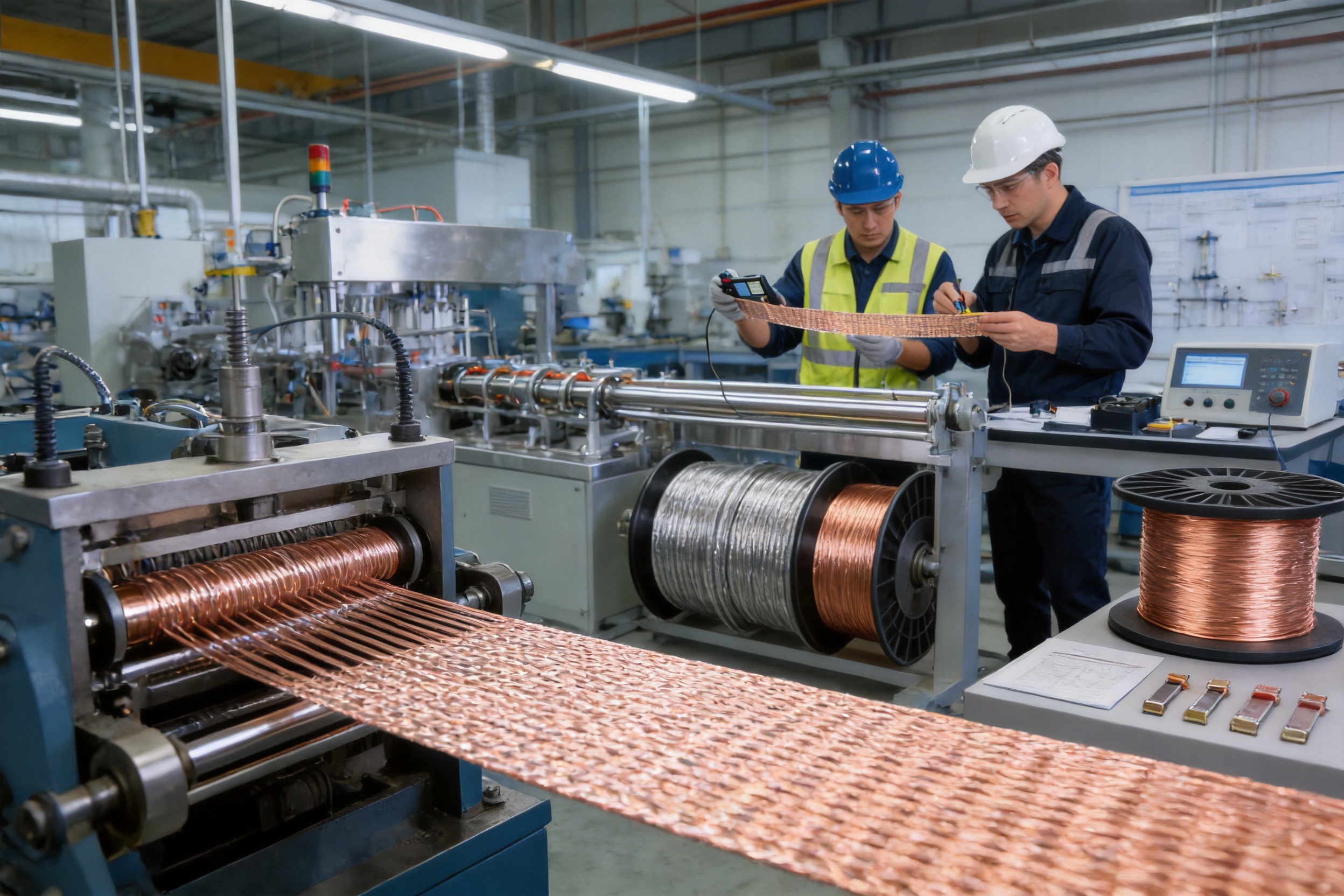
The prepared wires are assembled on braiding equipment with multiple carriers. Each carrier feeds a group of wires into the interwoven structure. The number of carriers, wire count, feed tension, braiding speed, and take-up control influence the final width, thickness, density, and flexibility of the tape.
Consistent tension is essential. If wire tension varies significantly, the braid may become uneven, develop loose sections, or show inconsistent dimensions. Advanced production control helps maintain a uniform structure throughout the length of the product.
The flat geometry is formed through controlled braiding and subsequent shaping or calibration. The objective is to produce a stable profile that can be handled, wound, terminated, and installed without excessive deformation. A controlled flat surface also supports consistent contact with terminals and connection hardware.
Surface Finishing
For the tinned version, the copper braid receives a tin-plated finish using a controlled plating process. Surface preparation is important because contaminants, oxides, and residues can reduce coating adhesion and create inconsistent coverage. Cleaning and activation steps help prepare the copper for the plating operation.
Plating control includes bath chemistry, temperature, current density, line speed, and rinsing. These parameters influence coating uniformity and surface quality. A properly controlled tin layer should cover the exposed copper consistently while maintaining the flexibility required by the braided structure.
After plating, the braid is inspected for visual defects, discoloration, exposed areas, roughness, and dimensional consistency. The product can then be wound into rolls or prepared for further processing, such as cutting, insulation, or terminal attachment.
Optional Insulation and Termination
Where specified, PVC or TPE insulation can be applied to the braided tape. The insulation process must account for the flexible and relatively broad geometry of the braid. Uniform coverage, adhesion, thickness, and surface quality are important for preventing weak points and maintaining the required electrical protection.
Termination can include lugs, terminals, holes, or other customer-defined end configurations. The termination method must preserve the conductive path while providing sufficient mechanical strength. Pressing, crimping, welding, soldering, or other joining methods may be selected according to the application and customer requirements.
Customized length and end processing can reduce assembly work for customers. Instead of receiving a continuous roll and performing all cutting and termination operations internally, a customer may request pre-cut components matched to the design of a battery pack, switchgear assembly, or power distribution unit.
Inspection and Quality Management
Quality control may include incoming material verification, wire diameter checks, braid dimension measurement, surface inspection, electrical resistance testing, plating inspection, tensile or mechanical checks, and verification of finished packaging. The specific inspection plan should correspond to the product configuration and customer quality requirements.
Production consistency is particularly important for high-current connections. Variations in cross-sectional area, braid density, or terminal attachment can lead to differences in resistance and temperature rise. A mature manufacturing system helps reduce variation between batches and supports repeatable performance for OEM and project customers.
Zhejiang Zhongyan New Energy Co., Ltd. combines engineering personnel, specialized equipment, product development capability, and modern production and quality management systems. Its experience in flexible electrical connections supports the development of copper foil soft connections, special-shaped flexible connections, battery soft connections, and other precision conductive components.
Engineering and Customization Capability
Different customers may require different braid widths, thicknesses, lengths, finishes, insulation materials, terminal configurations, and packaging methods. A standard product range provides a starting point, but OEM projects often require a customized connection that fits a specific enclosure, cell arrangement, or terminal layout.
Customization may involve selecting the correct cross-sectional area, changing the finished length, adding insulation, applying a different plating finish, or attaching customer-specified terminals. The design may also require special bends, offset ends, formed sections, or integrated connection features.
The manufacturer’s broader experience with battery soft connections and precision conductive components supports this type of engineering cooperation. Product development can include material selection, structural design, sample production, electrical testing, mechanical verification, and design adjustments before volume production.
For battery and energy storage customers, the connection design may be integrated with cell contact systems, battery terminals, insulating covers, and other conductive components. This broader capability can help reduce interface problems between separate suppliers and support a more coordinated approach to electrical and mechanical integration.
The company was established in 2022 and focuses on new energy precision components. Its technical development activities include polymer diffusion welding and laser technologies for producing low-resistance, high-reliability connections. These capabilities complement braided copper tape production by expanding the available connection methods for battery and power applications.
Installation and Design Recommendations
Terminal Contact
The braid should be installed with a terminal area large enough to support the conductor without cutting or sharply compressing the wires. Washers or suitable clamping components may be used to distribute pressure. The contact surface should be clean and free from oil, dirt, loose oxide, and burrs.
Fasteners should be tightened according to the specified torque for the terminal system. Excessive torque can damage the braid or distort the terminal, while insufficient torque can increase contact resistance and allow movement. The connection should be checked for mechanical stability and, where appropriate, tested for resistance and temperature rise.
Routing and Bend Control
Flexible tape should be routed with smooth bends. The braid should not be folded into a sharp crease or twisted along its length. If repeated movement is expected, the free length should be sufficient to accommodate the full movement without placing tensile force on the termination.
Edges, corners, and nearby metal parts should be protected when they could abrade the braid or its insulation. In battery and automotive applications, clips, barriers, grommets, and protective sleeves may be required. The braid should also be secured against uncontrolled vibration while retaining enough freedom to perform its intended flexing function.
Thermal Considerations
Nominal current values must be evaluated together with temperature rise. The designer should consider ambient temperature, enclosure ventilation, heat sources, duty cycle, conductor grouping, and insulation. If the braid is installed near cells, inverters, furnace components, or other heat-generating equipment, thermal testing may be necessary.
Terminations often create the highest local resistance in a flexible connection. Testing should therefore include the complete assembly rather than only the braid itself. Infrared inspection, thermocouple measurement, resistance measurement, and load testing can help identify local heating during design validation.
Electrical Safety
High-current battery and power distribution systems can produce hazardous arc energy during faults. The braid should be integrated with appropriate fuses, contactors, disconnect devices, barriers, insulation, and service procedures. Insulated versions may reduce accidental contact risk, but insulation selection must match the system voltage and environmental conditions.
For high-voltage applications, designers should evaluate creepage distance, clearance, dielectric requirements, insulation coordination, and enclosure protection. The final assembly should comply with the applicable electrical, automotive, industrial, energy storage, or transportation standards.
Packaging, Handling, and Storage
FTCB 15 can be supplied in rolls, on spools, or on wooden drums. Standard listed configurations use 25-meter packaging. Packaging selection depends on conductor size, customer handling requirements, production quantity, transport conditions, and downstream processing equipment.
The braid should be protected from crushing, excessive bending, moisture, and contamination during transport and storage. Tinned surfaces should remain clean and dry. If the product is stored for an extended period, it should be kept in suitable packaging and away from corrosive materials or areas with condensation.
During unwinding, the tape should be supported so that it does not become twisted or dragged across sharp surfaces. Customers using automated cutting or termination equipment may require spool dimensions and winding tension to be coordinated with their production line.
Value for OEM and Project Customers
For original equipment manufacturers, a flexible braided tape supplier must provide more than a catalog dimension. The supplier should be able to support product selection, drawing review, sampling, documentation, quality control, and repeatable delivery. FTCB 15 offers a scalable product family for customers that need several conductor sizes across different assemblies.
The combination of standard products and customization can reduce engineering time. A customer may begin with an available cross-section and then define length, insulation, plating, terminal design, and packaging according to the project. This approach can simplify procurement while preserving the ability to adapt the conductor to the final equipment.
The manufacturer serves industries including power transmission and distribution, new energy vehicles, rail transit, communications, and energy storage. Its product portfolio includes flexible copper connections, battery connection components, composite laminated busbars, battery storage connectors, and related conductive parts. This broader product knowledge can be useful when the braid must work with other specialized busbar or battery components.
Advanced production capabilities, engineering support, and experience with major new energy customers strengthen the supplier’s ability to participate in demanding OEM programs. The company reports supplying leading enterprises including BYD, CATL, and Jaguar. Such customer experience indicates familiarity with the quality, consistency, traceability, and development requirements commonly associated with automotive and energy storage applications.
Frequently Asked Questions
What is FTCB 15 Flat Tinned Copper Braided Tape?
FTCB 15 is a flat flexible conductor made from braided annealed copper wires with a tin-plated surface. It is intended for high-current electrical connections, flexible grounding, battery links, switchgear, power distribution equipment, and other applications requiring both conductivity and mechanical flexibility.
What copper material is used?
The product uses T2 pure copper, also commonly identified as Cu-ETP or C11000. The specified copper content is at least 99.95 percent. The wires are annealed to improve flexibility and mechanical performance.
Why is the braid tin plated?
Tin plating helps protect the copper surface against oxidation and corrosion. It can also improve solderability and support more stable contact performance in humid, polluted, or demanding environments.
What cross-sectional sizes are available?
The listed FTCB 15 range covers cross-sectional areas from 3 square millimeters to 100 square millimeters. Intermediate sizes include 5, 8, 10, 16, 20, 25, 30, 35, 40, 50, 60, 70, and 75 square millimeters.
Can the product be customized?
Yes. Available customization may include length, insulation, plating finish, terminal or lug configuration, special end processing, and packaging. The final design should be reviewed according to current, voltage, mechanical movement, environmental exposure, and installation requirements.
Can FTCB 15 be used in battery packs?
Yes. It can be used for battery module links, battery terminals, inverter connections, grounding, contactor connections, and other flexible high-current paths. Battery applications require additional consideration of insulation, short-circuit protection, creepage, clearance, thermal performance, and mechanical protection.
Is the braid insulated?
The standard tinned braid is an exposed conductive product. PVC or TPE black insulation can be specified when additional protection against short circuits, abrasion, chemicals, or ultraviolet exposure is required.
How should nominal current ratings be interpreted?
Nominal current values are reference values for the listed product configurations. Actual allowable current depends on ambient temperature, duty cycle, installation, ventilation, grouping, termination, and permitted temperature rise. The complete connection should be validated in the intended application.
What is the difference between flat braid and rigid busbar?
A rigid busbar is structurally stable and efficient for fixed connections, while flat braid provides mechanical flexibility and vibration absorption. Flat braid is generally more suitable where connected components move or expand relative to one another. Both products may be used together in the same power system.
How is the product packaged?
The product can be packed in rolls, on spools, or on wooden drums. The listed standard packaging is 25 meters for the FTCB 15 configurations.
What termination methods can be used?
Depending on the design, the braid may be terminated with lugs or terminals using suitable crimping, pressing, welding, soldering, or other joining methods. The selected method must provide both adequate electrical contact and mechanical strength.
What makes this product suitable for vibration environments?
The woven structure distributes movement among many fine wires. This allows the conductor to absorb vibration and thermal expansion more effectively than a rigid strip. Correct routing and termination remain essential for achieving the expected service life.
Conclusion
FTCB 15 Flat Tinned Copper Braided Tape provides a practical connection solution for electrical systems that require high conductivity together with flexibility, vibration resistance, corrosion protection, and installation adaptability. Its T2 pure copper construction supports efficient current transmission, while the annealed fine-wire braid allows the conductor to accommodate mechanical movement and thermal expansion.
The flat profile provides a broad contact area and compact routing option, making the product suitable for battery packs, energy storage systems, switchgear, industrial equipment, renewable energy inverters, rail transit, telecommunications, and heavy machinery. Tin plating adds protection against oxidation and corrosion and improves compatibility with many soldering and terminal processes.
The product range from 3 to 100 square millimeters allows engineers to select a suitable configuration for different current and space requirements. Optional insulation, customized lengths, terminal processing, and flexible packaging support OEM production and project-specific integration.
Behind the product is a manufacturer focused on new energy conductive components and precision flexible connections. Its engineering team, specialized equipment, quality systems, and capabilities in polymer diffusion welding and laser technology support the development of reliable customized electrical solutions. For customers seeking an alternative to rigid busbars, ordinary flexible cables, or unprotected copper braid, a properly selected and manufactured tin-plated flat braid can improve both electrical performance and mechanical reliability.
References
1. JB/T 6313.2-2011, Flexible Copper and Aluminum Conductors and Related Industrial Requirements.
2. ASTM B187, Standard Specification for Copper, Bus Bar, Rod, and Shapes.
3. ASTM B33, Standard Specification for Tin-Coated Soft or Annealed Copper Wire for Electrical Purposes.
4. IEC 60228, Conductors of Insulated Cables.
5. IEC 61439, Low-Voltage Switchgear and Controlgear Assemblies.
6. IEC 62619, Secondary Cells and Batteries Containing Alkaline or Other Non-Acid Electrolytes for Industrial Applications.
7. ISO 6469, Electrically Propelled Road Vehicles and Electrical Safety Requirements.
8. C11000 and Cu-ETP Copper Material Classification References.
9. Manufacturer technical data for FTCB 15 Flat Tinned Copper Braided Tape.
10. Manufacturer information concerning flexible copper connections, battery soft connections, conductive components, and new energy electrical systems.
Product: FTCB 15 Flat Tinned Copper Braided Tape

Driven by the development of new energy and aiming for "zero carbon".
Copyright © Zhejiang Zhongyan New Energy Co., Ltd. All Rights Reserved.
