 English
 Español
Automotive Busbars for Electric Vehicles 2026: Types, Materials and Automotive-Grade Requirements
An automotive busbar is not an industrial busbar with a different label on it. The fundamentals are the same — copper, cross-section, resistance — but a busbar that goes into an electric vehicle is qualified against a completely different set of requirements. It has to survive a decade of vibration, it has to be light, it has to be identical for every one of a million parts, and every one of those parts has to be traceable back to its material batch.
This guide covers where busbars sit inside an electric vehicle, which busbar types an EV programme actually buys, and what genuinely changes when a part has to be automotive grade.
Content
- Where busbars sit in an electric vehicle
- The busbar types an EV programme actually buys
- What actually makes a busbar automotive grade
- Voltage architecture: what changes at 400 V and 800 V
- Joining: where EV busbars are won or lost
- Copper or aluminium in an EV?
- What a vehicle programme should specify
- Frequently asked questions
- Busbars built for vehicle programmes
Where busbars sit in an electric vehicle
In a modern EV, conductive busbars appear in at least five places, and each has different priorities:
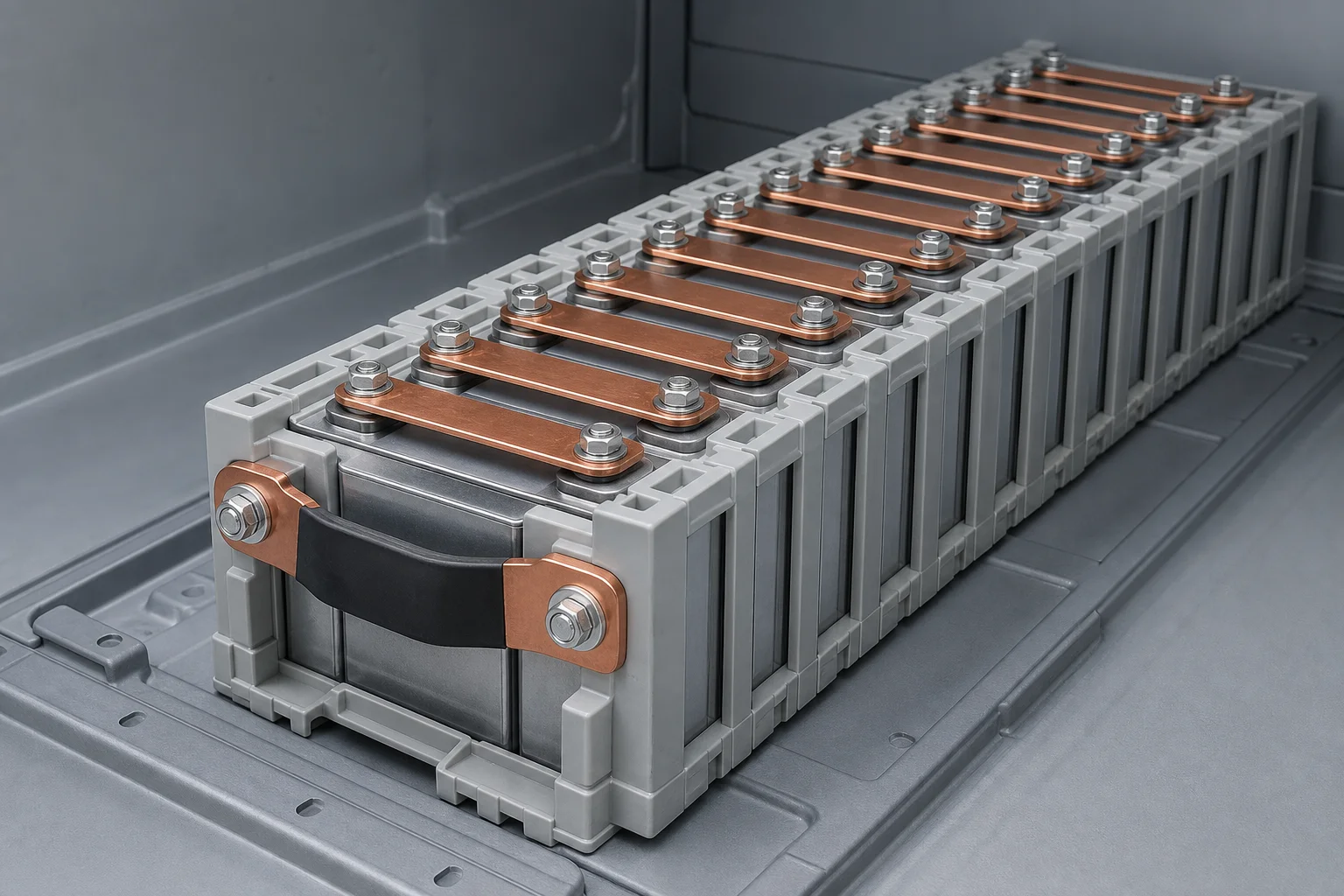
- Inside the battery pack, interconnecting cells and modules. This is the highest-current, highest-count application, and where most busbar engineering effort goes.
- In the cell contact system, the sensing and interconnection layer that links every cell terminal to the battery management system. Often supplied as an integrated assembly rather than separate parts.
- In the traction inverter and power electronics, where the priority is low inductance rather than weight, because fast switching demands a tight go-and-return path.
- At the charging interface, carrying high current from the charge port into the pack.
- In low-voltage and auxiliary distribution, including 48 V mild-hybrid systems, where weight and cost dominate.
The common thread is that all of them are exposed to the vehicle environment: vibration, thermal cycling, moisture, salt in winter markets, and a design life measured in years rather than commissioning dates.
The busbar types an EV programme actually buys
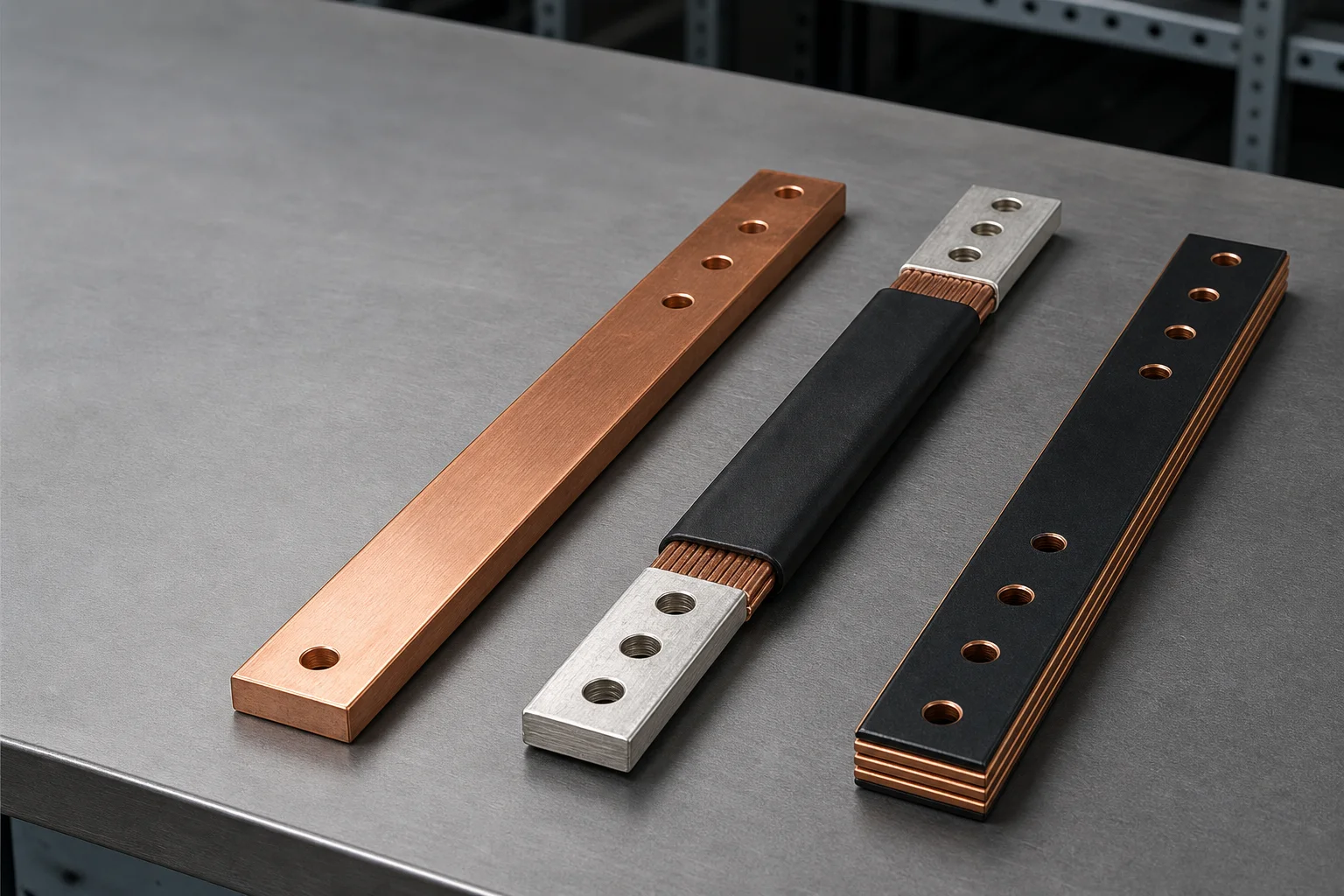
An electric vehicle programme does not buy "busbars". It buys a set of specific constructions, each chosen for a particular job. These are the types that appear repeatedly in EV conductor specifications.
Insulated flexible busbars — copper foil soft connections
A flexible busbar is built from a stack of thin copper foils, compressed and drilled at both ends so they can be bolted or welded, with the middle section left free to bend. Insulation is applied over the flexible section. In Chinese battery industry terminology this is the "soft connection", and it is the standard answer wherever a conductor must absorb movement.
In a vehicle, that movement is constant. Cells expand and contract with state of charge and temperature, modules move slightly relative to each other, and the whole pack flexes with the chassis. A rigid bar bolted across two moving points loads the joint every cycle. A foil stack absorbs that motion without transferring it into the joint or the cell terminal.
Rigid and solid copper busbars
Where nothing moves relative to anything else, a rigid bar is cheaper, stiffer and carries more current per unit of cross-section. Rigid bars dominate intra-module interconnection — the short, fixed links between adjacent cell terminals.
Composite laminated busbars
A laminated busbar bonds several conductors into a single sandwich with thin insulating layers between them. In a vehicle it does two jobs at once: it collapses the loop area between go and return conductors, which cuts inductance for fast-switching power electronics, and it saves the space and assembly steps that separate bars and insulators would need.
CCS integrated busbars
The cell contact system combines the cell interconnection conductors with the voltage-sensing circuits and the insulating carrier into one integrated part. Instead of a battery pack builder assembling separate busbars, a harness and a holder, a CCS arrives as a single unit that is welded or bolted into the module in one operation.
This matters commercially as much as technically: fewer parts, fewer assembly steps, fewer opportunities for a wrong connection, and one supplier accountable for the whole layer.
Aluminium busbars
Weight is a first-order constraint in a vehicle in a way that it is not in a fixed installation. Aluminium is roughly a third of the density of copper, and even after upsizing the cross-section to match conductivity it still saves substantial mass — which translates directly into range. The trade-off is joint behaviour: aluminium needs surface preparation and correct torque because of its oxide layer, so the joining process has to be controlled rather than improvised.
Copper braided busbars and stranded copper connectors
Braided and stranded constructions give flexibility in a different way from foil stacks — they tolerate multi-axis movement and repeated flexing, and they are used for shielding, earthing and connections where the motion is not purely in one plane. Tin plating is normal here: a vehicle sees condensation, temperature swings and, in winter markets, road salt.
Dip-coated and spray-painted busbars
Insulating a busbar by dipping or spraying it gives electrical insulation and, usefully, raises surface emissivity. For a coated bar carrying real current that is a genuine thermal benefit on top of the insulation — the coating helps the bar reject heat rather than trapping it.
Battery storage connectors and terminal insulator covers
The small parts around the joints matter as much as the conductor. Terminal insulator covers prevent accidental contact with live terminals during assembly and service, and they protect the joint from contamination. In a high-voltage pack they are a safety component, not an accessory.
What actually makes a busbar automotive grade
This is the part that separates a vehicle part from an industrial one. Six requirements change the design, the process and the price.
1. Vibration and shock
A busbar in a vehicle is on a moving structure for its entire life. Fasteners can back out, joints can fret, and a conductor that is too stiff will fatigue at its bends. This is the single strongest argument for flexible connections at every point where two structures could move relative to one another, and for proper support of any long rigid run.
2. Thermal cycling
Automotive electrical components are commonly qualified across a very wide temperature range — frequently around −40 °C to +125 °C — and the cycling happens thousands of times. A joint that is fine at a steady temperature can loosen over cycles as the materials expand differently. This drives spring-loaded joint design, controlled torque, and plating that keeps contact resistance stable rather than allowing an oxide layer to build up.
3. Weight
Every kilogram in the conductor system is a kilogram the vehicle carries for its whole life. That is why aluminium appears in EV busbars where an industrial installation would use copper without a second thought, and why laminated and thin-foil constructions are preferred over solid bar wherever the current allows.
4. Dimensional consistency at volume
Making one busbar to a tolerance is straightforward; making a million identical ones is a manufacturing problem. Hole positions, bend angles and flatness all have to hold across every part and every production batch, because the parts are welded and assembled robotically. A manufacturer working to plus or minus 0.1 mm on laser-cut profiles is not doing anything exotic — but holding that consistently at volume is a different capability from hitting it once.
5. Traceability and documentation
An automotive programme needs to know where the material in a given part came from, and to be able to demonstrate that the process was capable and controlled. This is what a quality management system certified to the automotive standard is for — IATF 16949, which is the automotive extension of ISO 9001 and is required by most vehicle manufacturers of their suppliers. Practically, it means material certificates, dimensional reports, and process records that survive an audit.
6. Design life and reliability
A vehicle expects its conductor system to work for the life of the car without maintenance. There is no annual torque check in a battery pack. Every joint has to be right at assembly and stay right for a decade.
Voltage architecture: what changes at 400 V and 800 V
Busbars carry current, but the voltage class of the pack determines their insulation design, and this is where EV busbar engineering diverges most sharply from other applications.
| System | What it means for the busbar |
|---|---|
| 12 V / 48 V auxiliary | Voltage drop dominated, because the budget is a small fraction of a low system voltage. Weight and cost drive the design; insulation is simple. |
| 400 V class | Now a high-voltage part. Insulation, clearance and creepage distances, and a documented dielectric withstand requirement all become design inputs, not afterthoughts. |
| 800 V class | Doubling the voltage halves the current for the same power, which reduces conductor cross-section and loss — but it raises the insulation and clearance challenge further, and makes partial-discharge behaviour a real consideration for the insulating system. |
The practical consequence is that an 800 V programme can use lighter conductors for the same power, but cannot compromise on the insulation system. Coated and sleeved constructions, and the insulator covers around terminals, move from convenience to safety-critical.
Joining: where EV busbars are won or lost
The conductor is rarely the failure point. The joint is. EV pack assembly is highly automated, and the joining method has to be fast, repeatable and inspectable.
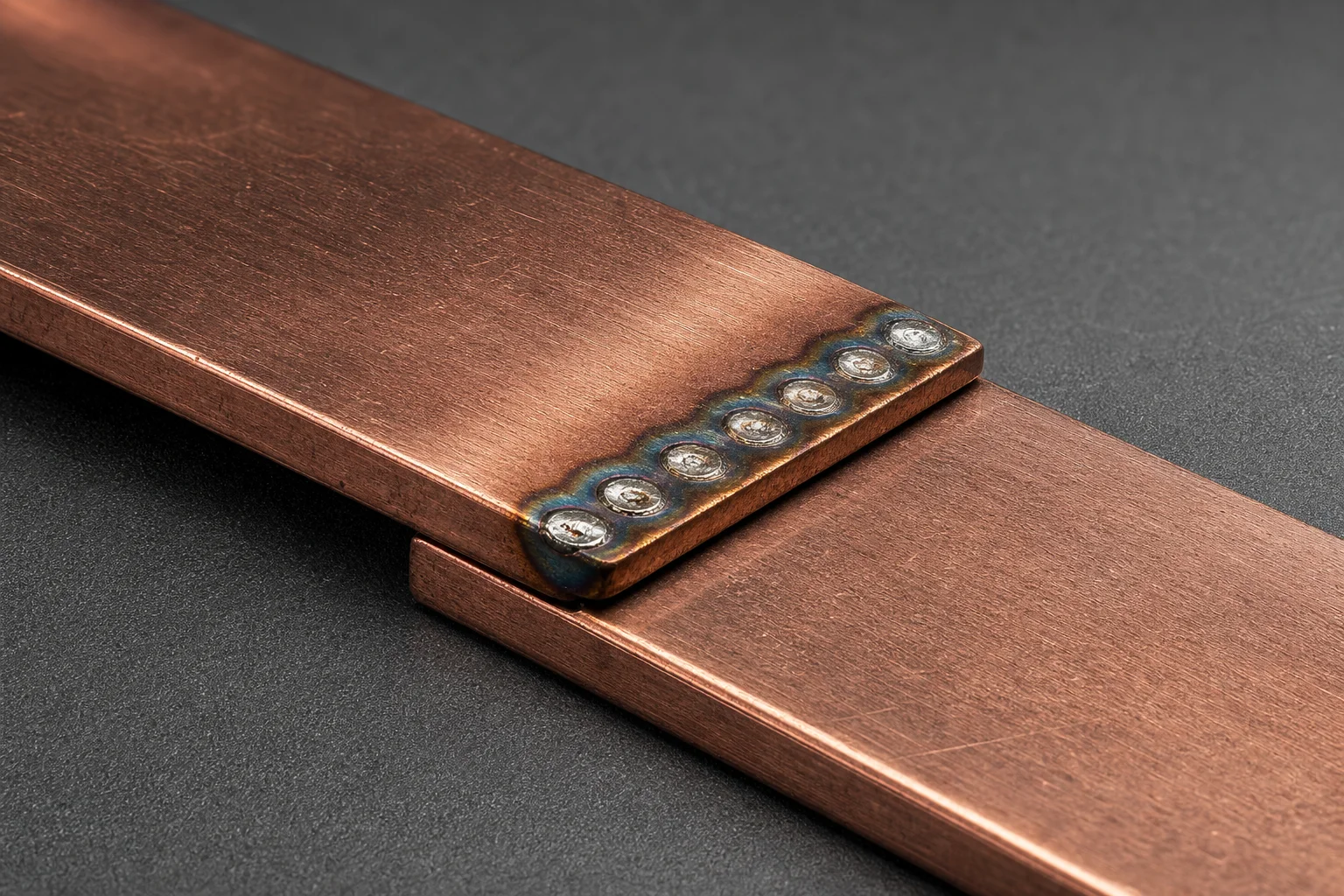
- Laser welding gives a fast, localised, low-heat-input joint and is now the standard method for cell and busbar interconnection. It is the reason busbar material and thickness have to be consistent from part to part: a laser process tuned for one thickness does not transfer to another.
- Ultrasonic welding joins dissimilar and plated metals without melting them, which suits aluminium-to-copper transitions and foil stacks where a fusion weld would damage thin material.
- Diffusion welding bonds a stack of foils into a solid, homogeneous block at the ends of a flexible busbar. The quality of this step decides the current-carrying capability of the whole flexible connector, because the foils must be fully bonded across the full contact area.
- Bolted joints remain where serviceability is needed, and rely entirely on correct torque and stable contact resistance.
The defect that matters most in all of these is the one that looks correct from outside: a weld that has fused only superficially, or a diffusion bond that has joined the outer foils and left the inner ones unbonded. The part passes a visual inspection and carries current in the lab, then overheats in service. This is the reason an EV busbar supplier has to validate the process with destructive testing — peel tests, cross-section metallography and pull tests on production samples — rather than relying on appearance.
Copper or aluminium in an EV?
Both appear in the same vehicle, doing different jobs.
- Copper where space is tight, current density is high, joints are numerous and small, or joint resistance stability matters most — which describes the inside of a battery module.
- Aluminium where the run is long and the mass saving is real, where the conductor is large enough that joint preparation can be controlled in production, and in 48 V auxiliary systems where cost and weight dominate.
- Plated aluminium where the weight saving is wanted but the joint must behave like copper. Tin plating solves the oxide problem and lets an aluminium bar be joined to a copper one without an unreliable bimetallic interface.
What a vehicle programme should specify
If you are specifying busbars for an EV programme, these are the items that determine whether the parts work in production rather than only in a sample report:
- The full dimensional definition — drawing plus 3D model — including the tolerances that matter for robotic assembly, not just nominal dimensions.
- The material grade and temper, explicitly. "Copper" is not a specification, and the grade affects both conductivity and how the part behaves when formed and welded.
- The joining process and its validation, agreed up front, with the destructive test method defined so it can be repeated on production parts.
- The sampling and inspection plan — what is checked, how often, and what happens when a measurement drifts.
- The documentation package required for each batch.
- The vibration, thermal-cycling and dielectric requirements the part must be validated against.
- The quantity ramp. A supplier who can make fifty prototypes may not be able to hold the same tolerance at fifty thousand, and the time to discover that is before tooling is committed.
Frequently asked questions
What is an automotive busbar?
A busbar designed and qualified for use in a vehicle. Electrically it does the same job as any busbar, but it is engineered for vibration, wide temperature cycling, minimum weight, volume dimensional consistency, traceability and a design life matching the vehicle. In an EV it appears in the battery pack, the cell contact system, the traction inverter, the charging path and low-voltage distribution.
Why do EV battery packs use flexible busbars instead of solid bars?
Because things move. Cells expand and contract with state of charge and temperature, and modules move relative to each other and to the chassis. A rigid bar bolted across two moving points transfers that movement into the joint and the cell terminal. A foil-stack flexible busbar absorbs the movement instead, which keeps joint resistance stable over the life of the pack.
What is a CCS integrated busbar?
It is a cell contact system: the cell interconnection conductors, the voltage-sensing circuit and the insulating carrier supplied as one integrated assembly rather than as separate parts. It reduces the number of components and assembly operations in the module and puts one supplier in charge of the whole interconnection and sensing layer.
Is aluminium acceptable for EV busbars?
Yes, and it is increasingly common because of weight. It needs a larger cross-section than copper for the same current, and its joints require proper surface preparation and controlled torque because of the oxide layer that forms on aluminium. Plating the aluminium with tin solves most of the joint difficulty and lets it be joined directly to copper.
Why does IATF 16949 matter when choosing a busbar supplier?
Because it is the evidence that the manufacturer's processes are controlled and traceable to the standard the vehicle industry requires. It covers material certificates, dimensional reporting and process records that survive an audit. For a safety-relevant part in a high-voltage pack, a supplier without it is a risk the programme carries rather than transfers.
What is the most common quality failure in EV busbars?
An incomplete joint that looks complete — a laser weld fused only at the surface, or a diffusion-welded foil stack bonded at the outer foils but not through the middle. It passes visual inspection and performs correctly on a bench, then overheats under real load. It is found by destructive testing on production samples, not by looking at the part.
Busbars built for vehicle programmes
An EV busbar programme is decided less by the conductor than by the discipline around it: the joining process, the dimensional consistency, the documentation and the willingness to validate by destructive test rather than by appearance. Get those right and the electrical performance follows.
Zhejiang Zhongyan New Energy Co., Ltd. manufactures insulated flexible busbars, rigid and solid copper busbars, aluminium busbars, dip-coated and spray-painted busbars, copper braided busbars, stranded copper wire and connectors, composite laminated busbars, CCS integrated busbars, battery storage connectors and battery terminal insulator covers — with laser cutting to ±0.1 mm, diffusion and laser welding, and a quality system certified to IATF 16949. Share your drawing, your quantity ramp and your validation requirements, and our engineering team will work with you on a manufacturable, automotive-grade part.
Driven by the development of new energy and aiming for "zero carbon".
Copyright © Zhejiang Zhongyan New Energy Co., Ltd. All Rights Reserved.
