 English
 Español
12V Busbar Guide 2026: DC Power Distribution for Off-Grid, Marine, RV and Vehicle Systems
Anyone who has sized a mains busbar and then sized one for a 12 V system has discovered that the rules do not transfer. At 12 volts, the voltage-drop budget is so small that bars and cables are chosen by how much voltage they lose, not by how hot they get. A conductor that would be comfortable in a 400 V panel can be hopelessly undersized at 12 V carrying the same current.
This guide covers DC power distribution busbars — the bars that collect battery, alternator, charger and load connections in off-grid systems, boats, campervans, vehicles and control cabinets — and what actually determines whether they work.
Content
- What a DC distribution busbar is
- Why low-voltage DC is harder than it looks
- What a 12 V system actually draws
- Sizing a DC bar for voltage drop
- Choosing the material for a DC distribution bar
- Stud spacing, hardware and what to specify
- Mounting, insulation and protection
- Positive, negative and earthing bars
- Five mistakes that show up again and again
- Frequently asked questions
- Sizing DC distribution properly
What a DC distribution busbar is
It is a flat conductive bar, usually tinned copper, carrying a row of connection points. There are two common formats:
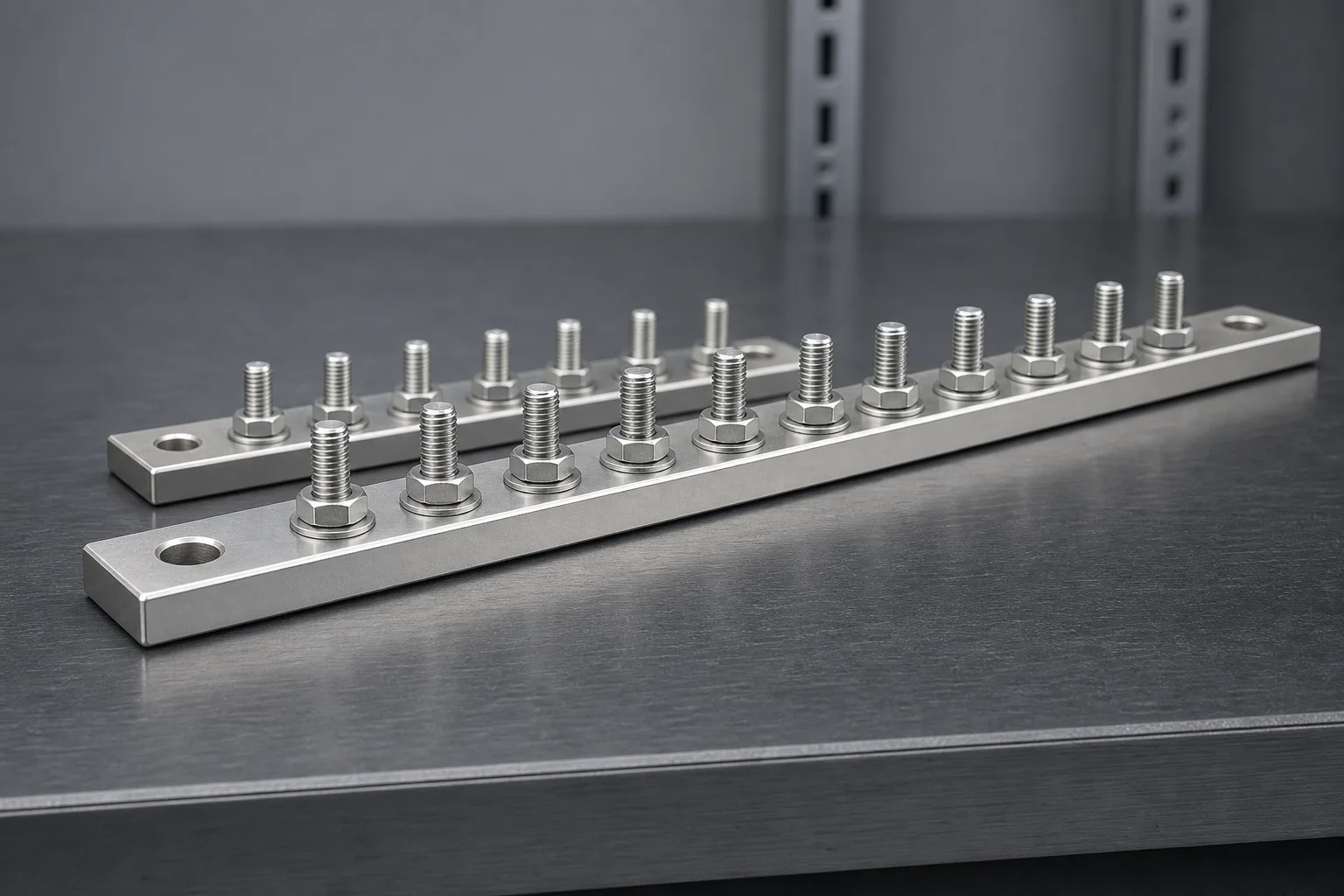
- Stud bars. Threaded studs pressed or welded into the bar, each taking a nut and washer so ring terminals can be bolted on and removed individually. This is the dominant format for DC distribution because connections change over time.
- Hole bars. Plain drilled and sometimes tapped holes, usually for a fixed set of connections or where a lug is bolted directly to the bar.
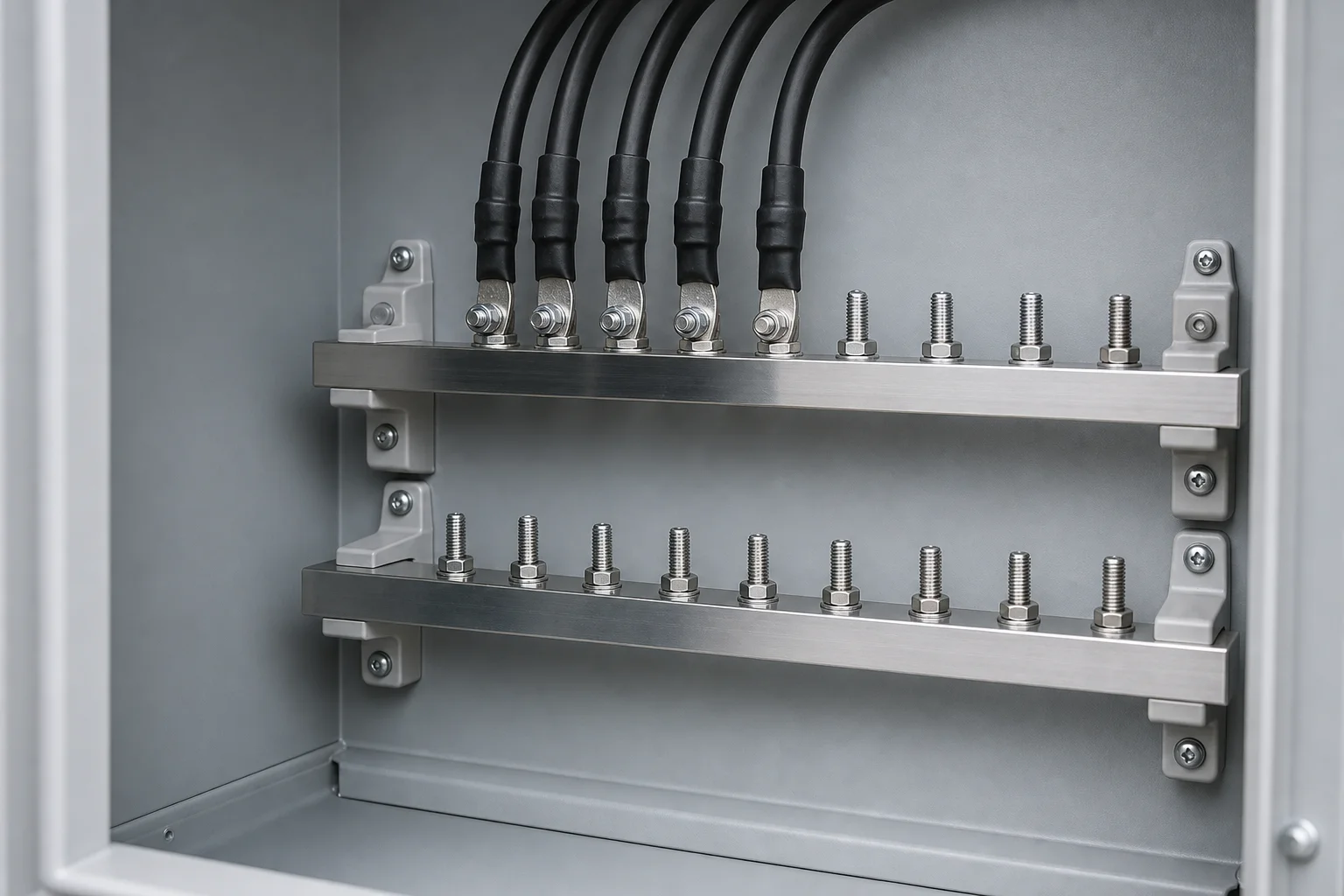
Pairs are normal: a positive bar and a separate negative or return bar, often a common earth or common negative in vehicle and marine practice. Some systems add a third bar for a specific circuit group.
Why low-voltage DC is harder than it looks
At 230 V or 400 V, a couple of tenths of a volt lost in a busbar is irrelevant — it is a fraction of a per cent. At 12 V, the same loss is a much larger share of the whole supply, and the consequences are practical: inverters that trip out under load, chargers that never reach absorption voltage, lights that dim when a pump starts.
The arithmetic explains it. A typical acceptable drop for a DC power circuit is a few per cent of system voltage. Three per cent of 12 V is 0.36 V. That is the entire budget for the whole circuit — bar, cable, fuse, terminals and the return path combined.
Because the budget is fixed and small, DC distribution design is dominated by resistance, and resistance is dominated by the path length and the cross-section. This is exactly why a solid busbar outperforms cable so dramatically at the currents involved.
What a 12 V system actually draws
It is easy to underestimate DC current because the loads are quoted in watts. Converting is simple:
Current (A) = Power (W) / Voltage (V)
So an inverter rated at 3000 W running from a nominal 12 V draws roughly:
- 3000 W / 12 V = 250 A
And that is before inverter efficiency, so the real figure at full load is higher. A 24 V system halves it; a 48 V system quarters it. This is the single strongest argument for higher system voltages on any installation above modest power, because increasing voltage reduces current proportionally for the same power, and losses fall with the square of current.
Sizing a DC bar for voltage drop
The calculation is the standard resistance relationship from any electrical reference: R = ρ × L / A, with copper resistivity of about 1.724 × 10⁻⁸ Ω·m at 20 °C.
Worked comparison: 250 A over one metre of path
A 50 × 10 mm tinned copper bar (500 mm²):
- R per metre = 1.724 × 10⁻⁸ / (500 × 10⁻⁶) = 0.0345 mΩ
- Voltage drop at 250 A = 250 × 0.0345 × 10⁻³ ≈ 8.6 mV
A 35 mm² cable, one metre:
- R per metre = 1.724 × 10⁻⁸ / (35 × 10⁻⁶) = 0.493 mΩ
- Voltage drop at 250 A = 250 × 0.493 × 10⁻³ ≈ 123 mV
Fourteen times the drop, for the same current and the same length. The busbar is not merely a tidier way to join cables — it is an electrically different solution, and on a 0.36 V budget the difference between 8.6 mV and 123 mV is decisive.
Why the return path counts as much as the positive
The current has to come back. The resistance of the negative or return bar, its cable and its connections add directly to the total drop in the circuit. A generous positive bar paired with a thin return path is one of the most common and least obvious DC installation mistakes — the positive bar does its job perfectly while the return path quietly consumes the budget.
In DC distribution bars this is a strong argument for the two bars being identical in cross-section, and for the negative bar having the same number of connection points as the positive.
Choosing the material for a DC distribution bar
Four materials turn up in DC distribution hardware, and only two of them are good choices for the conductor.
| Material | Verdict | Notes |
|---|---|---|
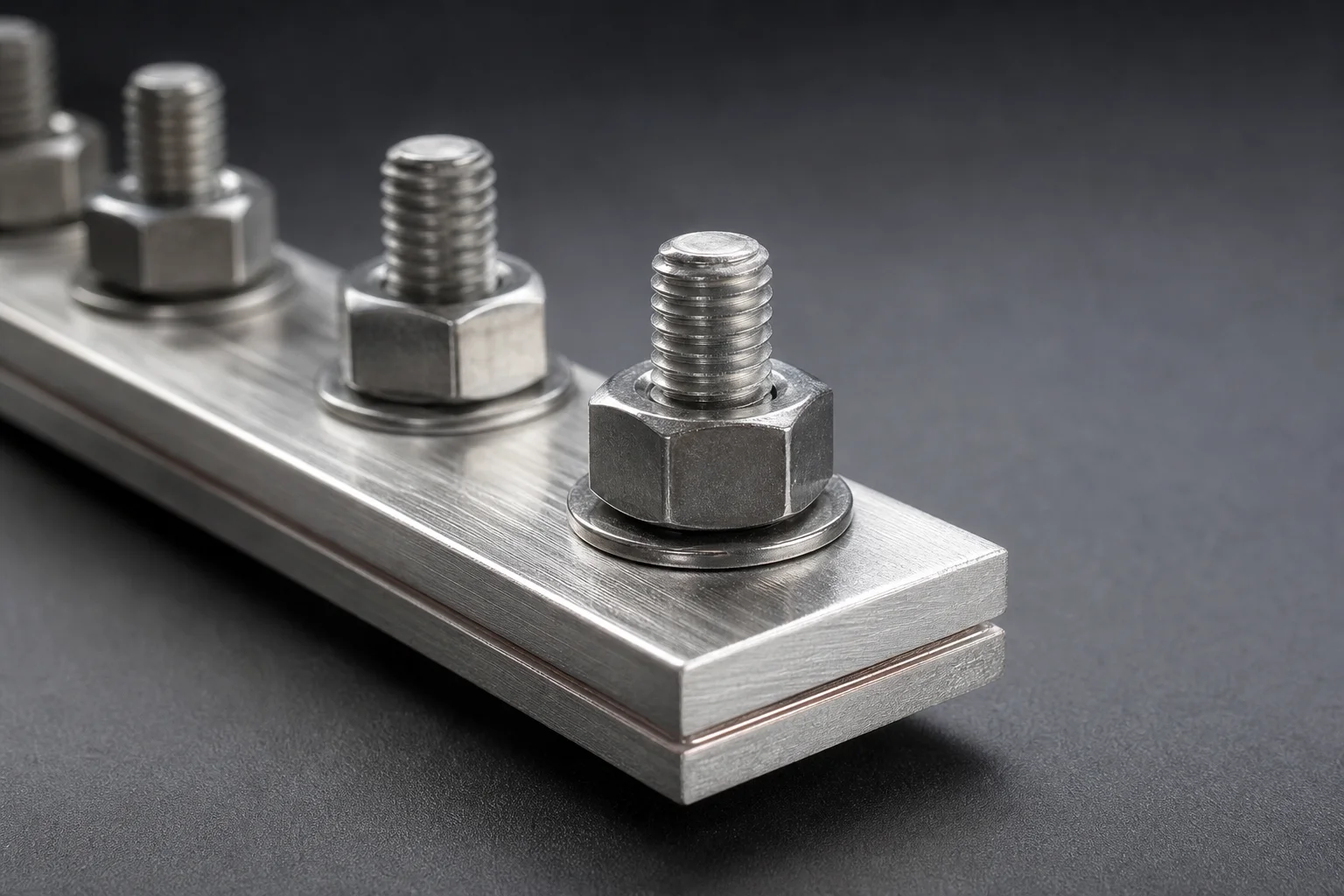
| Tinned copper | Best general choice | Copper conductivity with a surface that resists oxidation and corrosion. The standard for marine, vehicle and damp environments, and it keeps joint resistance stable over years. |
| Bare copper | Good, with a caveat | Electrically identical when new. It oxidises visibly, and in humid or salt air the oxide layer degrades joints. Fine in dry, controlled cabinets. |
| Aluminium | Situational | Lighter and cheaper, but needs larger cross-section for the same current and demands careful joint preparation. Only worth it where weight is critical. |
| Brass or stainless | Usually the wrong choice | Both conduct considerably less current than copper for the same size. Stainless is a structural and fastener material, not a conductor. Brass terminals are sometimes used for cost, and they are a common weak point at high current. |
The plating question matters more here than in mains switchgear, because DC distribution bars live in boats, campervans and outdoor cabinets where condensation and salt are routine. Tin plating is not cosmetic on a marine bar; it is the reason the joint resistance is still what you calculated five years later.
Stud spacing, hardware and what to specify
If you are specifying a DC distribution bar, these are the parameters that determine whether it fits your installation:
- Stud size and thread, matched to the ring terminals you will actually use — a stud that is too small limits the current per connection; too large may not fit the lug.
- Stud count and spacing, set by how many connections you need now plus room to add later. Spacing has to allow a wrench and a cable bend radius.
- Stud fixing method. Pressed or welded-in studs resist rotation far better than a bolt through a hole, which matters because a spinning stud while tightening is a common cause of damaged lugs.
- Bar thickness and width, from the voltage-drop calculation above.
- Mounting holes and their spacing, to match your insulating base or enclosure.
- Bar length and cut orientation, so the cable entries are not forced into sharp bends.
Hardware discipline matters as much as the bar. A plain flat washer spreads load; a spring washer or a properly torqued fastener keeps the joint tight as it settles; a cable lug must make full face contact rather than sitting on a burr. The bar's performance is only as good as its worst joint.
Mounting, insulation and protection
A DC distribution bar is a live, exposed conductor by design — that is how connections are made. Two consequences follow.
First, it needs to be mounted on an insulating base or on stand-off insulators rated for the voltage and the mechanical load, with enough clearance that a dropped tool cannot bridge the positive bar to the enclosure or to the negative bar. Where the environment is wet or the installation is accessible, a clip-on cover or a busbar insulant boot turns an exposed bar into a protected one without sacrificing access.
Second, the mounting has to handle the mechanical duty. A long bar with heavy cables bolted to it experiences real leverage, and vibration works fasteners loose over time. Supporting a bar at intervals rather than only at its ends, and keeping cable weight off the bar with cable ties to the structure, both matter more than they appear to.
Positive, negative and earthing bars
Three conventions are worth stating explicitly, because mixing them up creates problems that are hard to diagnose.
- Keep positive and negative bars separate and clearly identified. Physical separation plus clear marking is the cheapest safety measure available.
- Size the return bar like the positive bar. As above, the return path carries the same current and adds to the same voltage-drop budget.
- Treat earthing as its own system. On a vehicle or vessel, the chassis or hull earth bar is not the same thing as the DC negative bar, even where they are bonded at a single point. Bonding at one defined point avoids circulating currents through the structure.
Five mistakes that show up again and again
- Undersizing the return path. Covered above, and still the most common single error.
- Mixing metals at the joint. An aluminium lug on a copper bar, or a bare copper lug on an aluminium bar, invites corrosion. Use tinned interfaces or a bimetallic transition.
- Ignoring the fuse and breaker in the loss budget. These are real resistance in series, and on a 12 V circuit their contribution is not negligible.
- Using a bolt-through-hole connection where the load is high. A bolt that rotates as you torque it cannot be tightened reliably.
- Sizing for continuous current only. Inverter start-up and motor inrush draw several times the running current for a short period, and that is when the drop is worst.
Frequently asked questions
What size busbar do I need for a 3000 W inverter?
Start from the current: 3000 W at 12 V is about 250 A before efficiency, or about 125 A at 24 V. Then size for voltage drop over your actual path length, and check that the bar and its connections can carry the continuous current thermally. A 50 × 10 mm tinned copper bar loses only around 8.6 mV per metre at 250 A, so the bar itself is rarely the constraint — the cables, fuses, terminals and return path usually dominate the total drop.
Can I use a brass or stainless steel bar instead of copper?
They will conduct, but much less current for the same size, and they waste voltage that your 12 V budget cannot spare. Stainless in particular is a structural material rather than a conductor. Copper, tinned if the environment is damp, is the right choice for the current-carrying bar.
Should the positive and negative bars be the same size?
Yes, as a rule. The return path carries the same current as the supply path and adds its resistance to the same total. Making the negative bar smaller saves very little material and costs you voltage drop.
Do I need a tinned bar, or is bare copper fine?
In a dry, temperature-controlled cabinet, bare copper is acceptable. In a boat, a campervan, an outdoor cabinet or anywhere condensation forms, tin plating is worth paying for: it keeps the joint resistance stable instead of letting an oxide layer build up under every connection.
Can I drill extra holes or add studs myself?
Drilling is possible if you have the tooling and can deburr properly, but adding a load-bearing stud reliably requires pressing or welding, which is a manufacturing operation. A burr left in a hole, or a stud that is not properly fixed, will cause exactly the joint problems the bar was meant to avoid. If you need more connection points, specify a longer bar or more studs from the manufacturer.
Sizing DC distribution properly
The method is short: convert your loads to current, work out the resistance of the whole loop including the return path, check the voltage drop against a few per cent of system voltage, and confirm the bar can carry the current thermally. Do that and the 12 V problems — inverters tripping, chargers falling short, lights flickering — largely disappear before installation rather than after.
Zhejiang Zhongyan New Energy Co., Ltd. manufactures copper busbars in custom cross-sections, lengths, hole patterns and stud configurations, with tinned, dip-coated and insulated finishes, and can produce DC distribution bars to your drawing for off-grid, marine, vehicle and control applications.
Driven by the development of new energy and aiming for "zero carbon".
Copyright © Zhejiang Zhongyan New Energy Co., Ltd. All Rights Reserved.
