 English
 Español
Copper Busbar Buyer's Guide 2026: How to Choose a Custom Copper Busbar Manufacturer
A copper busbar is one of the least expensive components in an electrical assembly — and one of the most expensive to get wrong. When a busbar is undersized, poorly plated, or drilled outside tolerance, the failure does not show up on the bench. It shows up as a hot joint, a warranty claim, or a derated battery pack months later.
This guide walks through what actually determines copper busbar quality in 2026, which specifications a buyer should lock down before requesting a quote, and how to tell a real copper busbar manufacturer from a trading company.
Content
- What a copper busbar actually is
- Copper or aluminium? Run the numbers, not the habit
- The seven specifications to lock down before you request a quote
- Sizing a copper busbar for current-carrying capacity
- Plating and insulation: the specification that quietly decides service life
- Why the manufacturing process decides whether the bar is actually good
- Quality systems and certification
- Vetting a copper busbar manufacturer: a seven-point check
- Bringing it together
- FAQ
What a copper busbar actually is
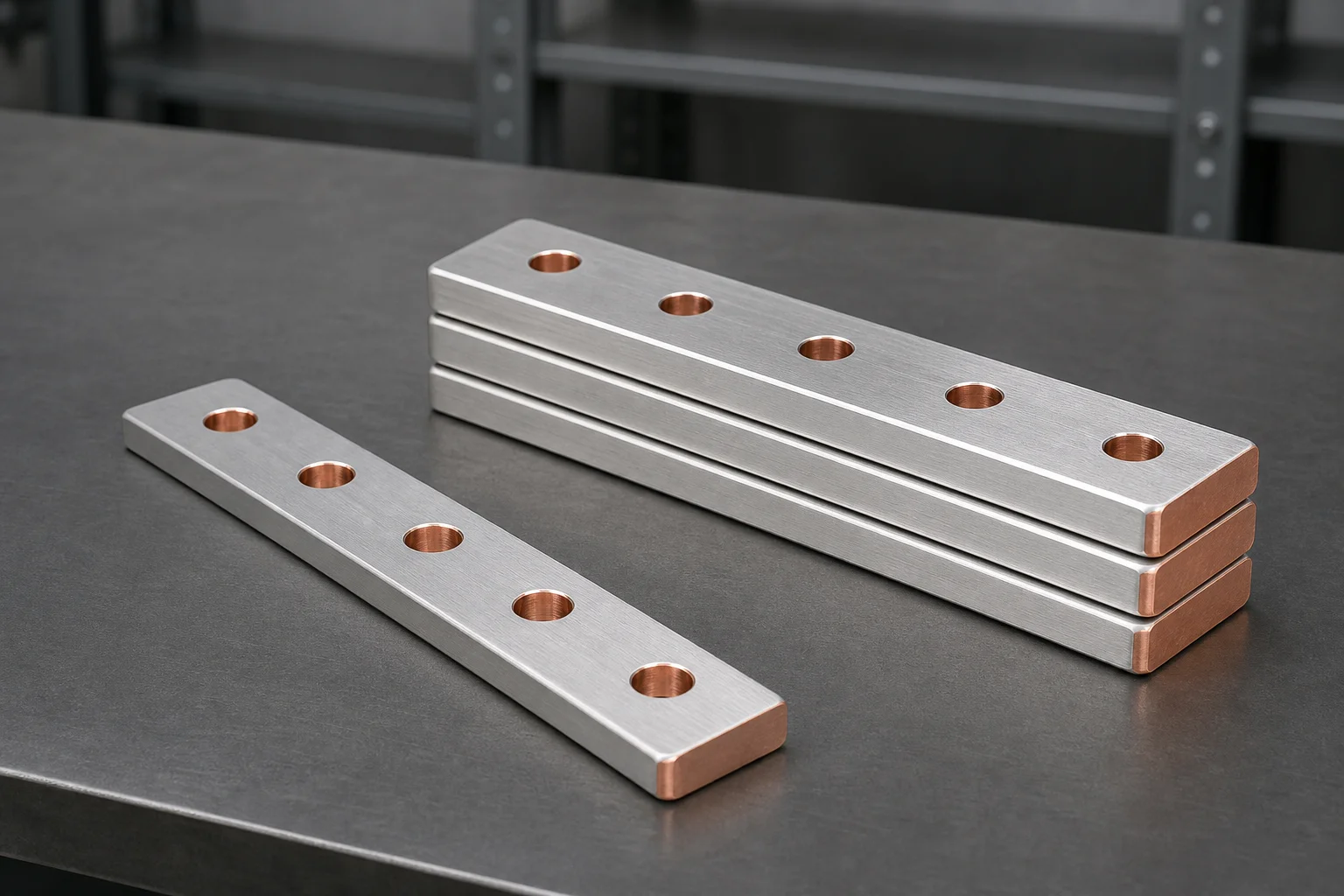
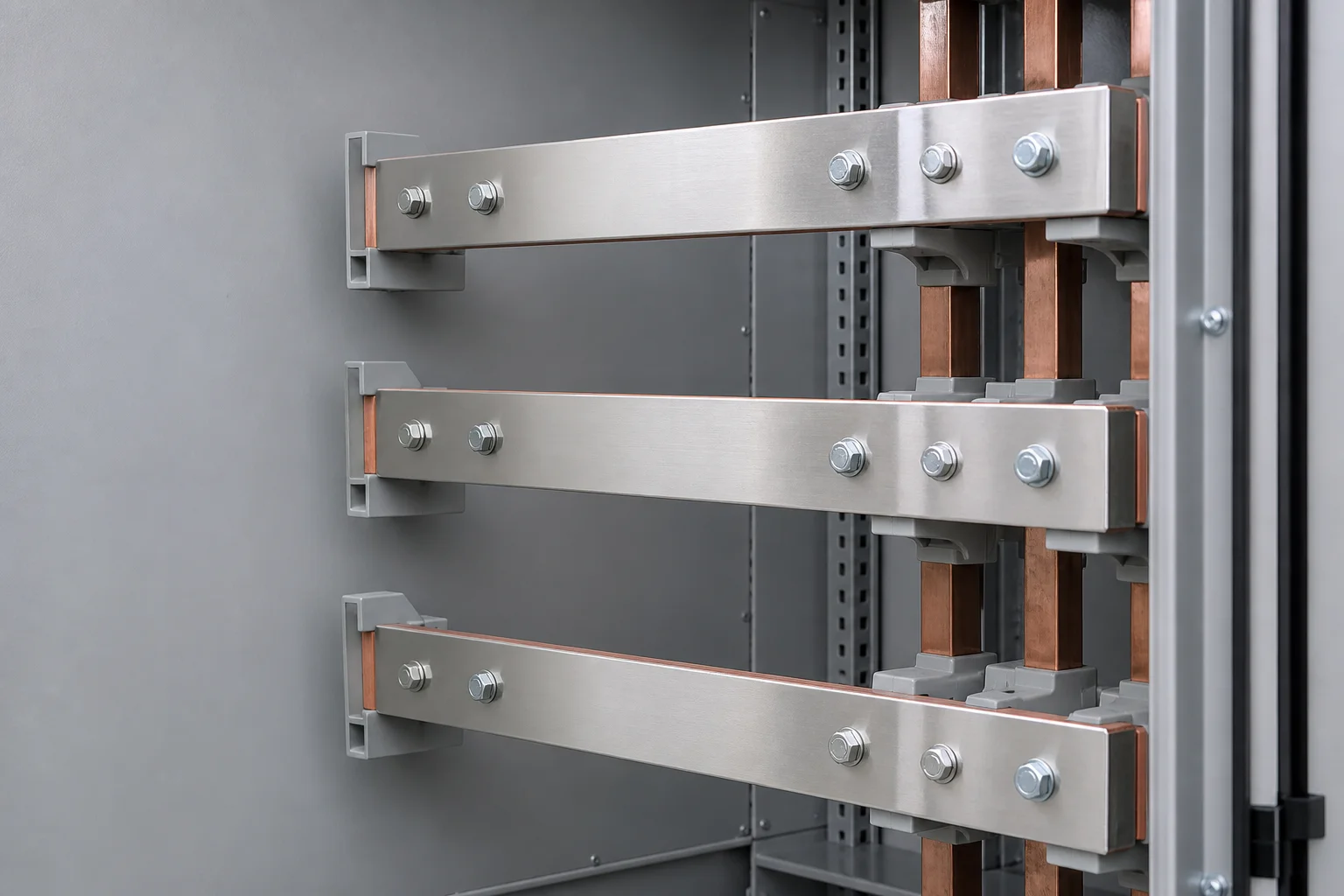
A busbar is a solid conductor used to carry current between two points in a system — a battery pack, a switchgear cabinet, an inverter, a rail traction box. Where a cable is flexible but bulky, a busbar is rigid, compact, and offers a large, stable surface for bolted connections.
The material matters more than most buyers expect. A credible copper busbar is produced from high-conductivity copper such as T2, with a copper content of 99.95% or higher. At Zhejiang Zhongyan New Energy Co., Ltd., we select high-purity oxygen-free copper at ≥ 99.95% and high-grade aluminium as standard input material — because oxygen content, trace impurities, and grain structure all show up later as resistance and heat.
Copper busbars are supplied in three broad forms:
- Rigid / solid busbars — flat or formed solid bars with drilled or punched holes, used for fixed connections in switchboards, cabinets, and power distribution.
- Flexible insulated busbars — laminated stacks of thin copper foil (or braided tape) with an insulating sleeve, used where vibration, thermal cycling, or a serviceable connection requires movement.
- Braided and stranded connectors — flat or round braided copper tape and stranded conductors, used where the joint must absorb mechanical stress rather than transmit it.
Getting this choice wrong at specification stage costs far more than the part itself. A rigid bar in a vibrating EV battery pack fatigues; a flexible connection in a fixed switchboard is simply money spent for no benefit.
Copper or aluminium? Run the numbers, not the habit
The reflex is "copper is better." That is only half true, because aluminium is roughly one-third the density and considerably cheaper per kilogram — and with a larger cross-section it can carry a comparable current.
| Copper | Aluminium | |
|---|---|---|
| Conductivity | Higher — smaller cross-section for the same current | Lower — needs a larger cross-section |
| Weight | Heavier | Roughly a third of the density |
| Corrosion | Stable, easy to plate | Forms an oxide layer; needs plating or antioxidant treatment |
| Cost | Higher material cost | Lower material cost |
| Best fit | High-current, space-constrained, thermally critical joints | Weight-sensitive and cost-driven assemblies, motor and enclosure work |
The practical rule: if the assembly is weight-sensitive, aluminium is worth engineering properly; if the joint is thermally critical or space is tight, copper usually wins on total system cost even at a higher part price. Custom nickel-plated aluminium busbars, for instance, are a common compromise — the conductivity and cost of aluminium with a plated surface that accepts a reliable bolted joint.
The seven specifications to lock down before you request a quote
Vague enquiries produce vague quotes, and vague quotes produce disputes. Pin these down first.
- Material grade — specify the copper grade (T2, C11000, or equivalent) and the minimum copper content, not just "copper."
- Cross-section and length — width × thickness × length, plus whether the bar is straight, bent, or stepped.
- Plating — tin, nickel, silver, or bare. Tin plating prevents oxidation and corrosion in humid, salt-spray, or polluted industrial environments. Zinc and nickel are common where a lower-resistance bolted joint is needed.
- Insulation — none, PVC dip, powder coating, heat-shrink sleeve, or a halogen-free compound. Insulation choice is driven by the enclosure's fire and smoke requirements as much as by electrical rating.
- Tolerances — hole diameter and position, bend angles, and overall length. Ask for the cutting tolerance explicitly; on precision work it should be stated numerically rather than described as "accurate."
- Hole and termination detail — hole count, diameter, pitch, countersink or chamfer, and whether lugs are crimped or welded.
- Certification and documentation — which standard the finished part must be documented against, and whether you need material certificates, dimensional reports, or third-party inspection.
A supplier who asks you for all seven is usually a supplier who can actually build the part. A supplier who quotes from a single dimension is guessing.
Sizing a copper busbar for current-carrying capacity
Current-carrying capacity is the specification buyers get wrong most often, usually by copying a number from a table that describes different conditions.
A busbar's real capacity depends on several variables at once:
- Cross-sectional area — width × thickness. Both matter; a flat bar of the same area as a square bar dissipates heat differently.
- Ambient temperature — a bar rated for a 35 °C installation is not rated for a 60 °C enclosure.
- Permitted temperature rise — the delta between ambient and the bar's surface temperature at full load.
- Installation method — free-air, in-enclosure, painted, sleeved, or bundled with other conductors. Each changes the heat-dissipation path.
- Duty cycle and harmonics — continuous load versus surge, and non-sinusoidal current, both affect heating.
- Joint quality — a bolted joint with correct torque and a clean, correctly plated interface is part of the current path. A good bar with a bad joint still runs hot.
Because these variables compound, sizing should be confirmed against your enclosure's design rules and the manufacturer's data — not assumed from a generic table. A manufacturer worth using will ask for your ambient temperature, your permitted temperature rise, and your installation method, then provide the calculation basis alongside the part.
Plating and insulation: the specification that quietly decides service life
Copper oxidises. In a dry, sealed enclosure that is a cosmetic problem. In a humid plant room, a coastal installation, or a road vehicle exposed to salt spray, it is a reliability problem — oxide layers raise contact resistance at the joint, and rising resistance means rising heat.
That is why tin plating is so common on copper busbars used outside clean rooms. On a tin-plated braided busbar, the tin layer prevents oxidation and corrosion, extending service life in humidity, salt spray, and industrial pollution while keeping electrical performance stable over time.
Insulation is the second half of the decision, and it is usually driven by the enclosure rather than the current:
- PVC dip coating — economical, good mechanical protection, widely used on rigid bars.
- Powder coating — thicker and more durable, better for abrasion resistance.
- Heat-shrink sleeving — fast to apply and reworkable, common on flexible connections.
- Halogen-free compounds — specified where fire, smoke, and toxicity performance matters, such as rail and enclosed public infrastructure.
Ask for the insulation's flammability rating explicitly. "Insulated" alone tells you nothing about what happens in a fault.
Why the manufacturing process decides whether the bar is actually good
Two busbars can have identical drawings and behave completely differently in service, because the difference is in the process.
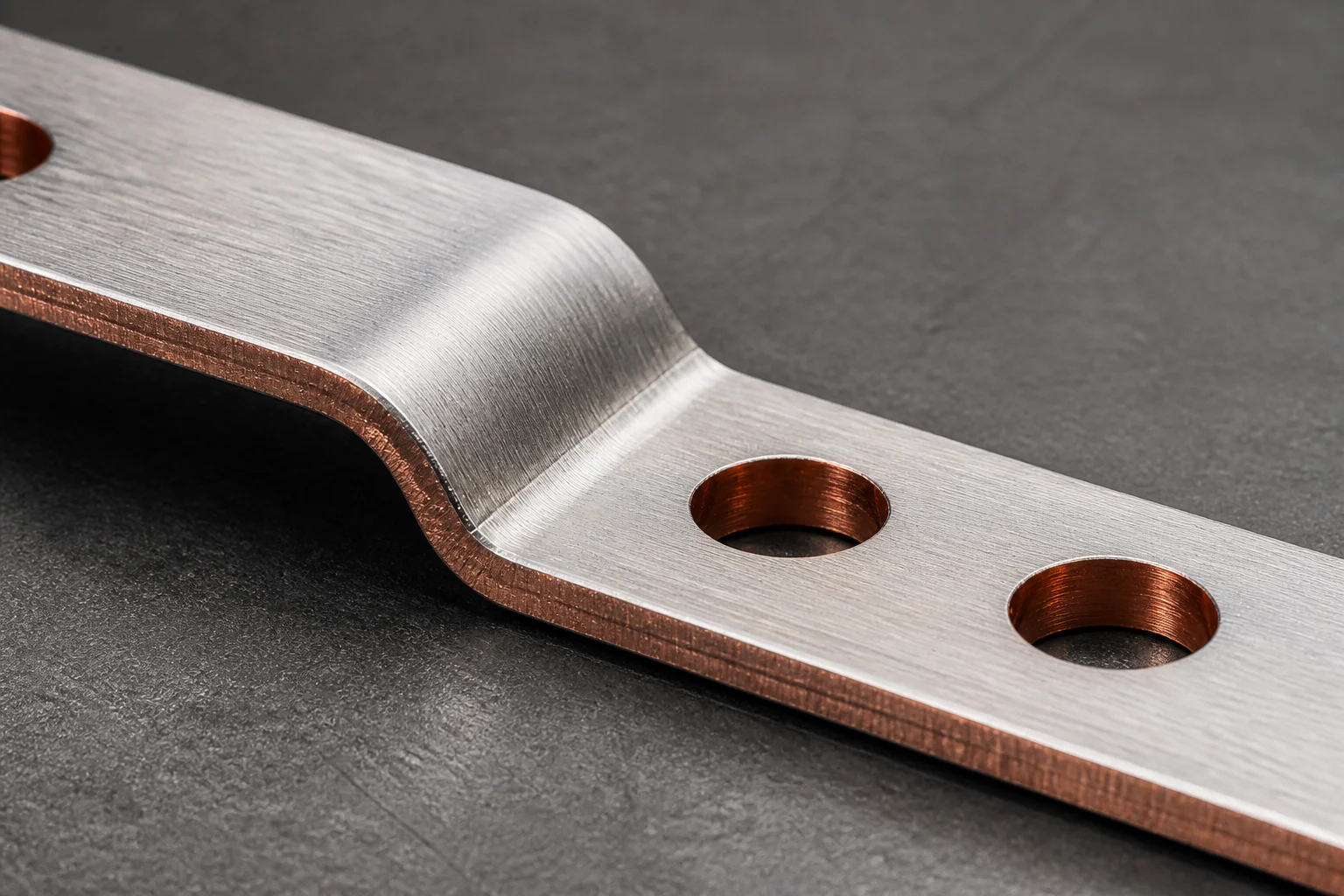
Blanking and cutting. High-precision laser cutting is the norm for custom work. On our own production, laser cutting holds a tolerance of ± 0.1 mm — which matters because hole position error is multiplied across a bolted joint, and a hole that is out of position forces the assembler to stress the joint or ream the hole.
Welding and joining. For flexible and laminated busbars, the joining process is the critical step. High-power diffusion welding and laser welding are used because they produce smooth welds with a small heat-affected zone. The practical benefit is straightforward: it removes the risk of virtual (cold) welds and false welds — the defects that pass a visual inspection and fail after thermal cycling. The result is a joint with low internal resistance, less heat generation, and a longer service life in the battery or cabinet it sits in.
Full process control. A manufacturer who performs blanking, welding, plating, and finishing in-house controls the tolerance chain and the delivery date. A manufacturer who outsources the plating or the welding controls neither, and cannot tell you who is accountable when a joint fails. In our own case, we complete battery assembly and soft-connection manufacturing internally, and control the process from raw material to finished product — which is also where cost control comes from, not from cheaper copper.
Custom engineering. Most high-value busbar work is not a catalogue order. It is a drawing, a sample, or a CAD model from the customer. A supplier needs real engineering capability to convert that into a manufacturable part — the ability to flag an impossible bend radius, propose a standard bar size that avoids a custom extrusion, or consolidate three parts into one. We hold more than ten invention patents covering appearance and process, and support development from drawings and samples; that is the capability to look for, whatever the supplier.
Quality systems and certification
Ask for the certification before the price. For busbar work that enters automotive, energy storage, or rail programmes, the quality system is not a formality — it is the evidence that the process is repeatable.
Zhejiang Zhongyan New Energy Co., Ltd. is an ISO- and IATF 16949-certified copper busbar manufacturer, and has been a core supplier to major battery and vehicle programmes. Certification does not guarantee a good part, but its absence limits who you can sell the finished assembly to.
Vetting a copper busbar manufacturer: a seven-point check
- Do they make it, or resell it? Ask which steps happen on their own floor. Plating and welding are the usual giveaways.
- Can they quote from a drawing? Send a real drawing with tolerances and see whether the response includes questions. Silence on tolerance is a warning sign.
- Will they state a numeric tolerance? "Good quality" is not a tolerance. ± 0.1 mm is.
- Can they show the weld process? Ask about diffusion welding, laser welding, and how they detect cold welds. A capable supplier answers technically.
- What documentation comes with the part? Material certificates, dimensional reports, plating thickness — agree these up front.
- Who is accountable for the finished surface? If plating is subcontracted, establish that before the order, not after.
- Can they scale? A pilot order and a production order should come off the same controlled process.
Bringing it together
The cheapest copper busbar is rarely the lowest-cost solution. Total cost is set by the joint that does not fail, the pack that does not derate, and the delivery that arrives without a rework loop.
If you are specifying custom copper busbars, flexible insulated busbars, laminated busbars, or CCS integrated busbars for EV and energy storage programmes, send us your drawing or sample. We will come back with a manufacturability review and a quotation against your tolerance, plating, and documentation requirements — not against a catalogue page.
FAQ
What grade of copper should a busbar be made from?
For most electrical work, high-conductivity copper such as T2 or C11000 with a copper content of 99.95% or higher. Specify the grade and the minimum copper content in the enquiry rather than writing "copper."
Is tin-plated copper busbar better than bare copper?
For indoor, sealed, dry enclosures, the difference is small. For humid, coastal, or industrial environments, tin plating is the safer choice because it suppresses the oxide layer that raises joint resistance over time.
How is copper busbar current-carrying capacity determined?
It depends on cross-sectional area, ambient temperature, permitted temperature rise, installation method, duty cycle, and joint quality — not on a single rating. Confirm sizing against your enclosure design rules and ask the manufacturer for the calculation basis.
How tight should the cutting tolerance be?
On precision busbar work, a stated tolerance in the region of ± 0.1 mm is achievable with laser cutting. Agree the number in writing, because hole position error accumulates across a multi-bolt joint.
Can busbars be customised from a drawing or sample?
Yes — that is the normal route for high-value busbar work. A capable manufacturer can also review the design and propose changes that reduce cost without reducing performance.
What is the difference between a rigid busbar and a flexible busbar?
A rigid busbar is a solid bar for fixed connections. A flexible busbar is built from laminated foil or braided copper, usually insulated, and is used where vibration, thermal cycling, or a serviceable joint requires movement.
Zhejiang Zhongyan New Energy Co., Ltd. manufactures copper and aluminium busbars, insulated flexible busbars, laminated and CCS integrated busbars, braided copper connectors, and battery storage connectors for power distribution, EV, rail transit, telecom, and energy storage customers.
Driven by the development of new energy and aiming for "zero carbon".
Copyright © Zhejiang Zhongyan New Energy Co., Ltd. All Rights Reserved.
