 English
 Español
Battery Busbar Guide 2026: CCS Integrated Busbars and Laminated Busbars for EV and Energy Storage Packs
Inside every electric vehicle battery pack and every grid-scale energy storage container there is a component that never appears in the marketing specification: the busbar. It is the part that decides whether the pack holds together electrically, thermally, and mechanically for its full service life.
This guide covers the three busbar architectures used inside battery packs in 2026, why laminated and CCS integrated busbars have displaced simple copper bars in high-voltage packs, and what a buyer should specify before requesting a quotation.
Content
- Why the busbar decides whether the pack holds together
- The three busbar architectures inside a battery pack
- What "laminated" actually means, and why it matters at high voltage
- CCS integrated busbars: the cell contact system explained
- What to specify before you request a quotation
- The process questions that predict whether the part will survive
- Quality evidence to request before the first production order
- FAQ
- Send us your pack drawing
Why the busbar decides whether the pack holds together
Cells are the expensive part of a battery pack. The busbar is the part that is cheap to buy and expensive to get wrong.
A busbar in a traction pack has to do four jobs at once. It carries the full pack current with minimal resistive loss. It survives continuous thermal cycling as cells expand and contract. It absorbs mechanical vibration and shock over years of vehicle service. And it holds the insulation integrity that separates high-voltage conductors from everything around them.
Fail at any one of those and the symptom is rarely a clean failure. It is a joint that slowly rises in temperature, a pack that derates on fast charge, or a field return that costs many times the value of the part.
The three busbar architectures inside a battery pack
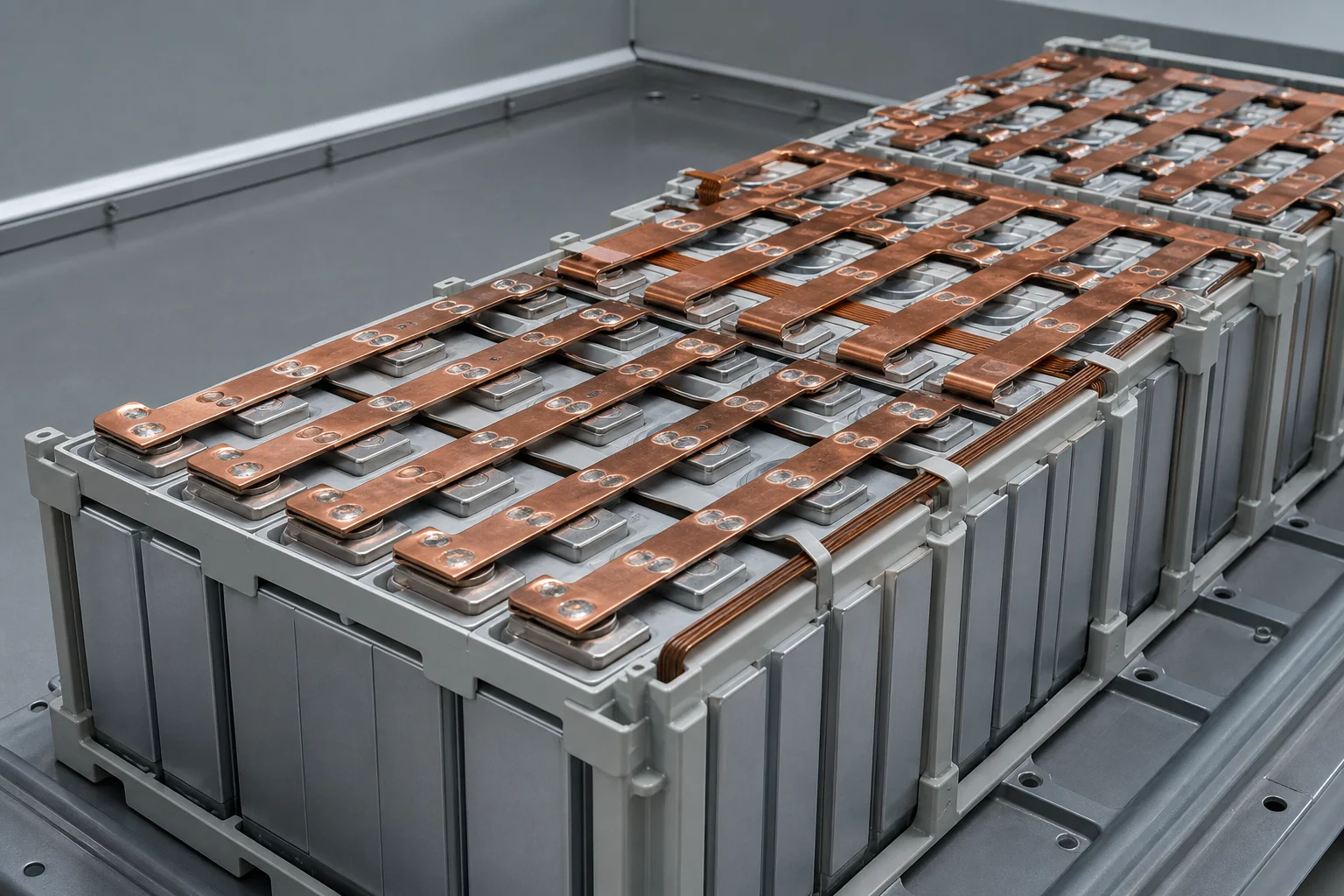
Rigid solid busbars. Flat copper bars, drilled or punched, bolted or welded across cell terminals. Straightforward, low cost, and still the right answer for fixed, low-vibration, or low-voltage connections.
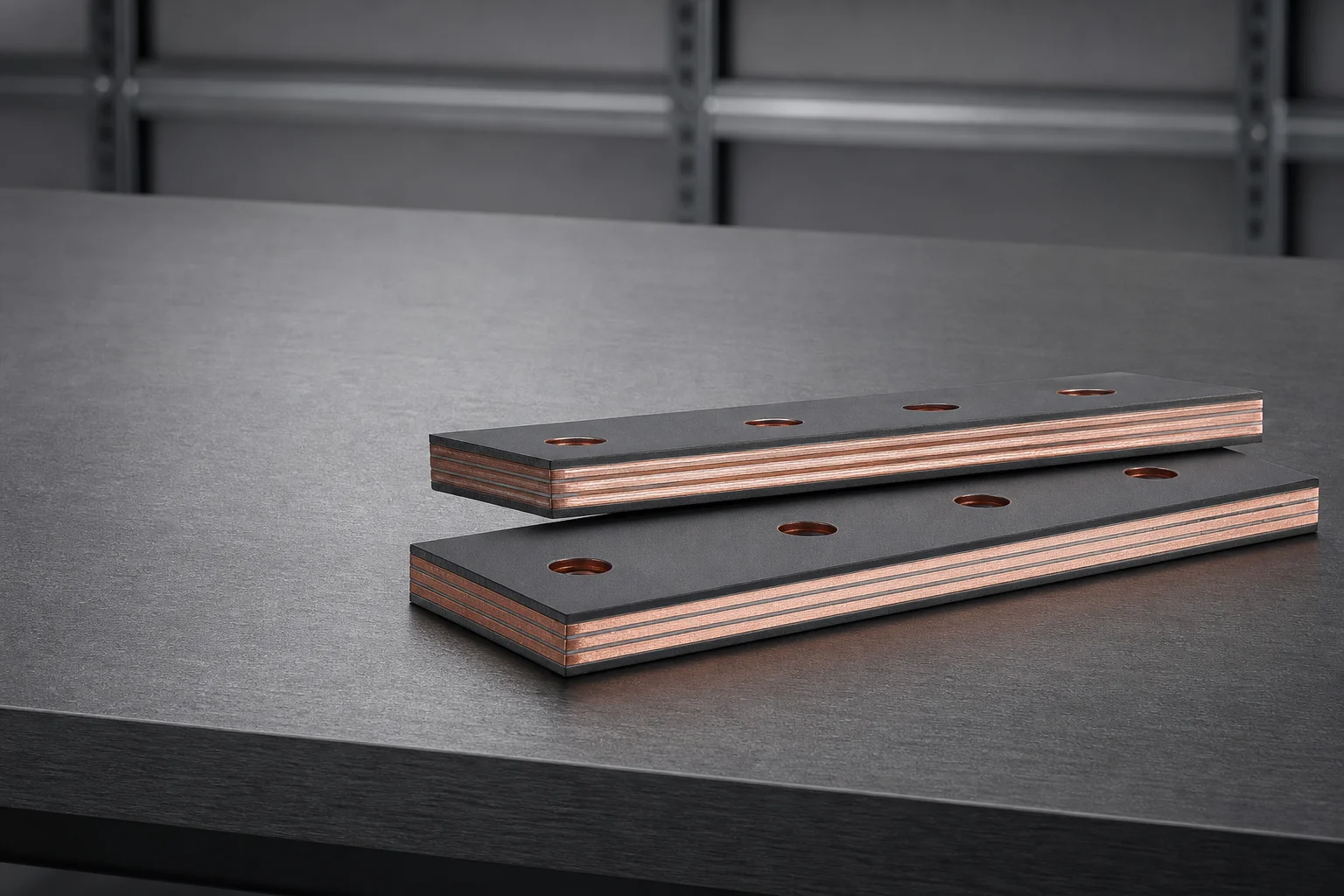
Flexible laminated busbars. A stack of thin copper plates bonded together into a single flat sandwich, usually with an insulating coating on the outer faces and thin insulating layers between the conductors. The laminated construction gives the part controlled flexibility in the direction that matters while remaining rigid where it must be.
CCS integrated busbars. A cell contact system that combines the current-carrying conductors with the voltage-sensing path, mounted on a carrier and often delivered as one integrated module that drops into the pack.
The choice is driven by voltage class, current, pack topology, and how much assembly work the customer wants to do at the pack line.
What "laminated" actually means, and why it matters at high voltage
A laminated busbar is not simply several bars bolted together. The conductors are bonded into one structure with insulating layers between them, and that structure is what produces the electrical benefit.
Low stray inductance. When a positive and a return conductor are laminated close together with a thin insulator between them, their magnetic fields largely cancel. The result is a much lower stray inductance than two separate bars routed apart. In a fast-switching inverter or a high-voltage pack, lower inductance means lower voltage spikes when current changes quickly — and lower spikes mean less stress on semiconductors, insulation, and everything downstream.
Better heat dissipation. A laminated part presents a large, flat, continuous surface to the surrounding air or to a cooling plate, rather than several separated conductors each heating its own local pocket of air.
Insulation performance. The insulating layers are bonded and controlled in the factory rather than relying on clearance and creepage as assembled in the field. That makes the insulation predictable and repeatable, which matters most in exactly the high-voltage applications where it is hardest to inspect.
Compactness. Lamination removes the free air space between conductors. The result is a lower-profile part that frees volume for cells, which in a traction pack is the same as freeing range.
CCS integrated busbars: the cell contact system explained
A CCS (Cell Contact System) integrated busbar is the interface between the battery cells and the rest of the pack electronics. It carries three things at once:
- Power. The current-carrying conductors that link cell terminals into the pack's series and parallel topology.
- Voltage sensing. The sensing path that reports individual cell or group voltages to the battery management system, so the BMS can balance and protect the pack.
- Mechanical location. The carrier that holds the conductors and sensing path in the correct position relative to the cell terminals during welding and throughout the pack's life.
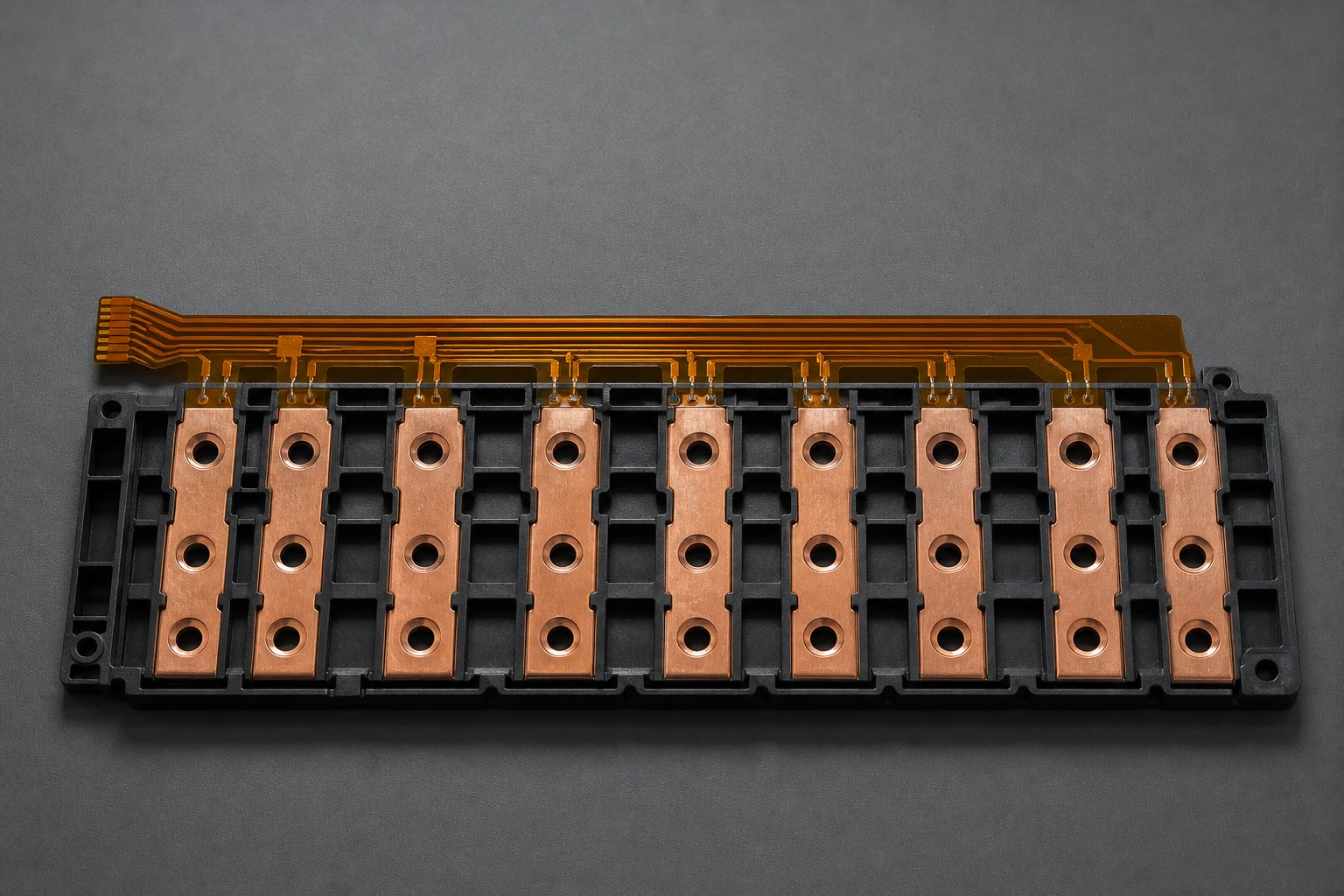
Integrating these into one part is what makes CCS busbars worth the engineering. A separate busbar and a separate wiring harness have to be aligned, positioned, and welded independently, and each introduces its own tolerance and its own failure mode. An integrated CCS busbar removes an assembly step, removes a set of interfaces, and makes the geometry of both the power and sensing paths a factory-controlled dimension.
Zhejiang Zhongyan New Energy Co., Ltd. manufactures CCS integrated busbars for electric vehicle battery packs and energy storage systems, designed with precision composite lamination so that the part delivers low stray inductance, strong heat dissipation, and insulation performance suited to high-voltage applications. Because the busbar is fully customisable to the pack's topology, current and voltage requirements, and installation dimensions, these parts are built against the customer's pack drawing rather than selected from a catalogue.
What to specify before you request a quotation
- Pack topology. How many cells in series and parallel, and how the conductors must route between them. This determines the part more than any other input.
- Continuous and peak current, and the duty cycle the pack will see. Continuous rating alone understates the requirement in a fast-charge application.
- Voltage class and insulation requirement, including the flammability rating the enclosure demands.
- Connection method at the cell: laser welding or bolted. This changes the terminal geometry and the surface finish you need.
- Sensing requirements: how many voltage taps, and what sensing element the BMS expects.
- Installation dimensions and the mounting datum the part must locate against.
- Thermal interface: free air, or coupled to a cooling plate.
- Documentation: which standard the part is documented against, and what dimensional, material, and plating reports you require.
A supplier who asks for these eight things is a supplier who understands pack integration. A supplier who quotes from a photo is not.
The process questions that predict whether the part will survive
The busbar's electrical design can be perfect and the part can still fail, because the failure mode is usually in the joint.
How are the conductors bonded? For laminated and CCS parts, the joining process is the critical step. Diffusion welding and laser welding are used because they create smooth joints with a small heat-affected zone, which removes the risk of virtual or false welds — the defects that pass a visual inspection and then fail after thermal cycling. A well-made joint keeps internal resistance and heat generation low, which is what actually extends pack life.
What is the cutting tolerance? On precision busbar work, high-precision laser cutting should hold a tolerance around ± 0.1 mm, stated numerically. Across a multi-terminal CCS part, small positional errors accumulate and force the assembly line to stress or ream joints.
Who performs each step? A manufacturer who controls blanking, welding, plating, and finishing in-house controls the tolerance chain and the delivery date. When the plating or the welding is subcontracted, no single party owns the finished dimension.
Quality evidence to request before the first production order
- The quality system certificate. For busbar work entering automotive or stationary storage programmes, look for IATF 16949 alongside ISO. Zhejiang Zhongyan New Energy Co., Ltd. is certified to both, and has supplied major battery and vehicle programmes.
- A first article inspection report and dimensional report against your drawing.
- Material certificates confirming the conductor grade and copper content — oxygen-free copper at 99.95% or higher is the normal expectation.
- The welding process specification and how cold or false welds are detected.
- Plating thickness and adhesion results, or the insulation's electrical and flammability test data.
FAQ
What is the difference between a laminated busbar and a CCS integrated busbar?
Laminated describes how the conductors are built — thin copper plates bonded into a sandwich with insulating layers, which lowers stray inductance. CCS integrated describes what the part does — it combines the current-carrying conductors with the cell voltage-sensing path and carrier into one module for a battery pack. A CCS busbar is frequently, but not always, laminated.
Why does stray inductance matter in a battery pack?
Because fast current changes across inductance produce voltage spikes. Laminating the supply and return conductors close together lets their fields cancel, lowering the spike and reducing stress on semiconductors, insulation, and connected electronics.
Should battery busbars be welded or bolted to the cells?
Laser welding is typical for high-volume traction packs because it removes a fastener and a maintenance point. Bolted joints remain common where the pack must be serviceable. The choice changes the terminal geometry and surface finish, so it belongs in the specification.
Can a battery busbar be made from aluminium instead of copper?
Yes, and aluminium is attractive where pack weight is critical. It requires a larger cross-section for the same current and needs plating or an anti-oxidation treatment at the joint, so the decision should be made on total system cost rather than metal price alone.
How tight should the conductor tolerance be?
Around ± 0.1 mm is achievable with high-precision laser cutting, and it should be stated numerically in the drawing. In a CCS part with dozens of terminals, positional tolerance is what determines whether the pack line can assemble without rework.
How long does a custom battery busbar take to develop?
It depends on whether the design is a variant of an existing part or a new lamination and carrier. Send the pack drawing or a sample and request a manufacturability review — that review, not a catalogue lookup, is what determines the schedule.
Send us your pack drawing
Zhejiang Zhongyan New Energy Co., Ltd. manufactures copper and aluminium busbars, insulated flexible busbars, composite laminated busbars, CCS integrated busbars, copper braided connectors, and battery storage connectors for power transmission and distribution, electric vehicles, rail transit, telecommunications, and energy storage.
If you are specifying battery busbars for an EV or energy storage programme, send the pack drawing, the topology, and your current and voltage requirements. We will return a manufacturability review and a quotation against your tolerances, welding method, and documentation requirements.
Driven by the development of new energy and aiming for "zero carbon".
Copyright © Zhejiang Zhongyan New Energy Co., Ltd. All Rights Reserved.
