 English
 Español
Insulated Flexible Busbar Guide 2026: When to Choose Flexible Copper Busbars Over Rigid Bars
A rigid copper bar carries current perfectly well — until the assembly around it moves. Then the joint becomes the weakest point in the circuit, and the failure appears as a hot connection, a cracked terminal, or a warranty claim that is very hard to explain.
This guide explains what an insulated flexible busbar is, the four specific problems it solves that a rigid bar cannot, how to choose between foil-stack, braided, and stranded constructions, and what to specify before you request a quotation.
Content
- What an insulated flexible busbar actually is
- The four problems flexibility solves
- Foil-stack, braided, or stranded: choosing the construction
- Tin plating on flexible busbars — why it is almost always specified
- Insulation options and what to specify
- Where insulated flexible busbars are used
- When a flexible busbar is the wrong answer
- Specification checklist
- Why the joining process decides whether the part is good
- FAQ
- Send us your drawing
What an insulated flexible busbar actually is
A flexible busbar is a flat conductor built from many thin elements rather than one solid bar. In the laminated type, thin copper foils are stacked, bonded, and compressed at the ends into solid terminals that are drilled for bolts; the middle section stays flexible. In the braided type, fine copper strands are woven into a flat tape and terminated with pressed lugs.
An insulated flexible busbar adds a sleeve or coating over the flexible section — typically PVC or TPE on a dipped or extruded part, or a heat-shrink sleeve — leaving the terminal ends bare for the electrical connection.
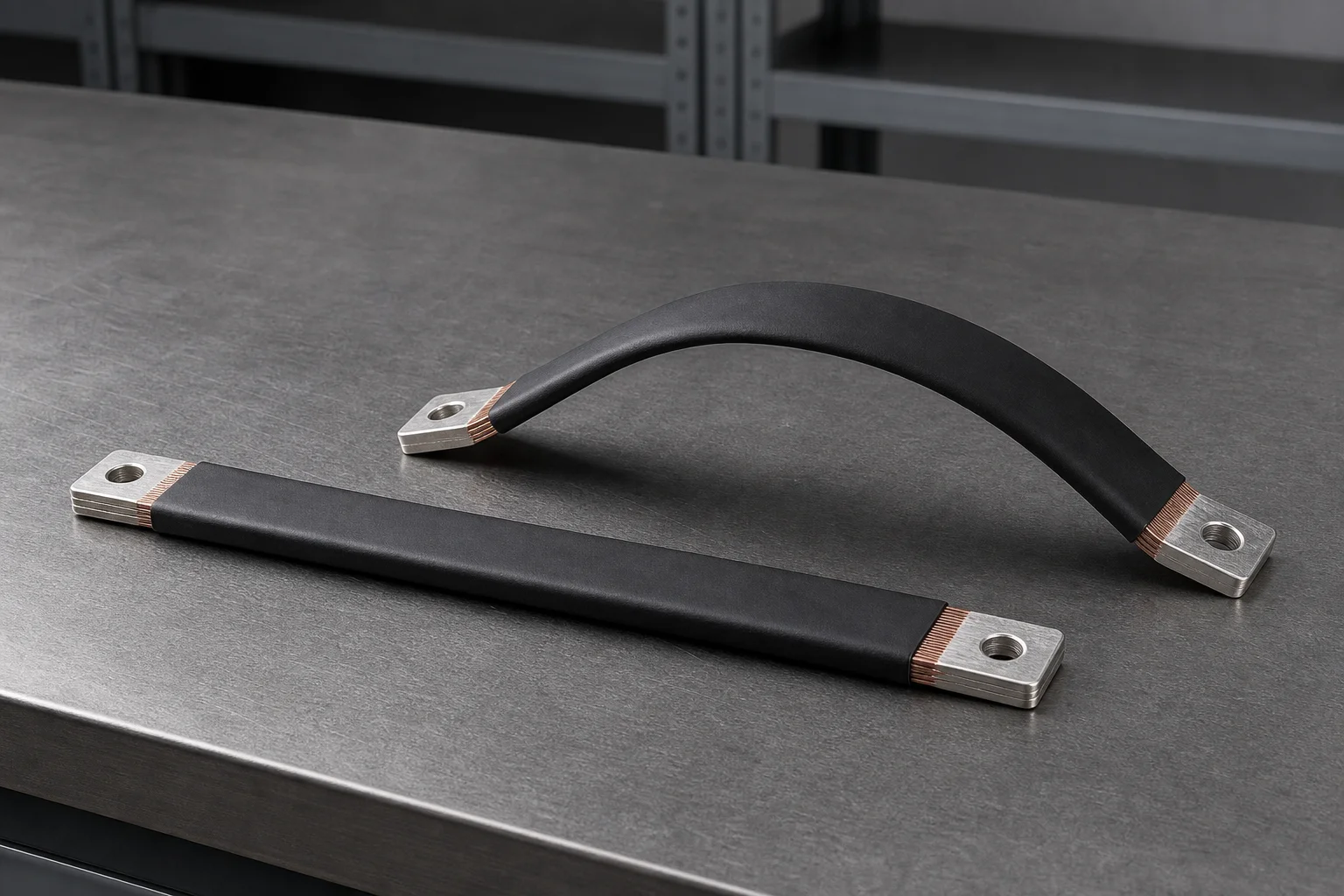
The result is a conductor that behaves like a busbar electrically and like a short cable mechanically. That combination is the entire point of the product.
The four problems flexibility solves
1. Vibration and mechanical stress. A rigid bar transmits every vibration and shock load directly into its bolted joints and into the components on either side. A flexible busbar absorbs that movement internally, which is why flexible connections are standard in vehicles, rail equipment, and rotating machinery.
2. Thermal cycling and expansion. Conductors heat up under load and cool down again, and different materials expand by different amounts. Over thousands of cycles, a rigid bar that has been bolted across two rigid points develops fatigue at the joint. A flexible section absorbs the differential movement instead of resisting it.
3. Tolerance stack-up during assembly. Real assemblies do not match their drawings exactly. A flexible busbar can be installed between two connection points that are slightly misaligned without forcing the joint or the terminal. A rigid bar must fit, or something has to be re-machined.
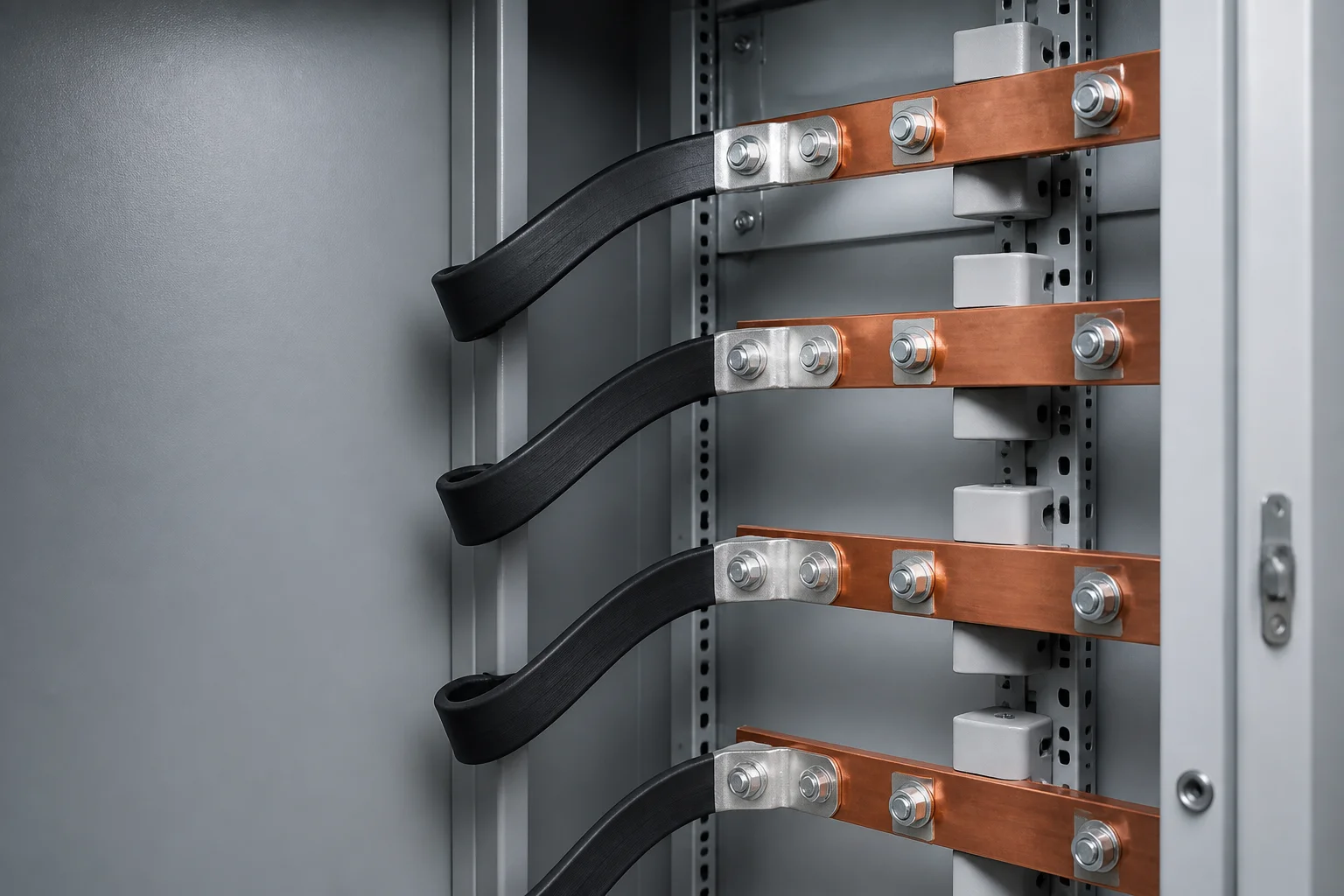
4. Serviceability. Where a connection has to be opened for maintenance — a switchgear link, a module in a battery pack, a removable inverter — a flexible busbar with a service loop lets the part be unbolted and moved aside. A rigid bar is captive to its own geometry.
Foil-stack, braided, or stranded: choosing the construction
| Foil-stack (laminated flexible) | Braided tape | Stranded conductor | |
|---|---|---|---|
| Construction | Many thin copper foils bonded and compressed into solid ends | Fine strands woven into a flat tape with pressed lugs | Stranded copper conductor with terminated ends |
| Flex direction | Controlled — bends in the plane of the foils | Very free in all directions | Very free in all directions |
| Current for a given size | High — maximum copper cross-section in a flat profile | High, with a slightly lower fill factor than a solid stack | Moderate |
| Damping and vibration | Good | Excellent — the weave absorbs movement | Good |
| Best fit | High-current links where a low, flat profile matters | Grounding, earthing, harsh vibration, tight bends | General flexible connections and harness-style links |
The practical guide: if the link must carry high current in a low, flat space, use a foil-stack busbar. If the connection must tolerate heavy vibration, repeated movement, or a bend radius that a flat stack cannot follow, use a braided tape. For earthing and grounding connections where current is lower, braided and stranded constructions are usually the economical answer.
Tin plating on flexible busbars — why it is almost always specified
Copper oxidises. In a dry, sealed enclosure that is cosmetic. In a humid plant room, a coastal installation, a vehicle underbody, or an outdoor cabinet, it is a reliability problem: the oxide layer raises resistance at the joint, and rising resistance means rising temperature at exactly the point where you can least afford it.
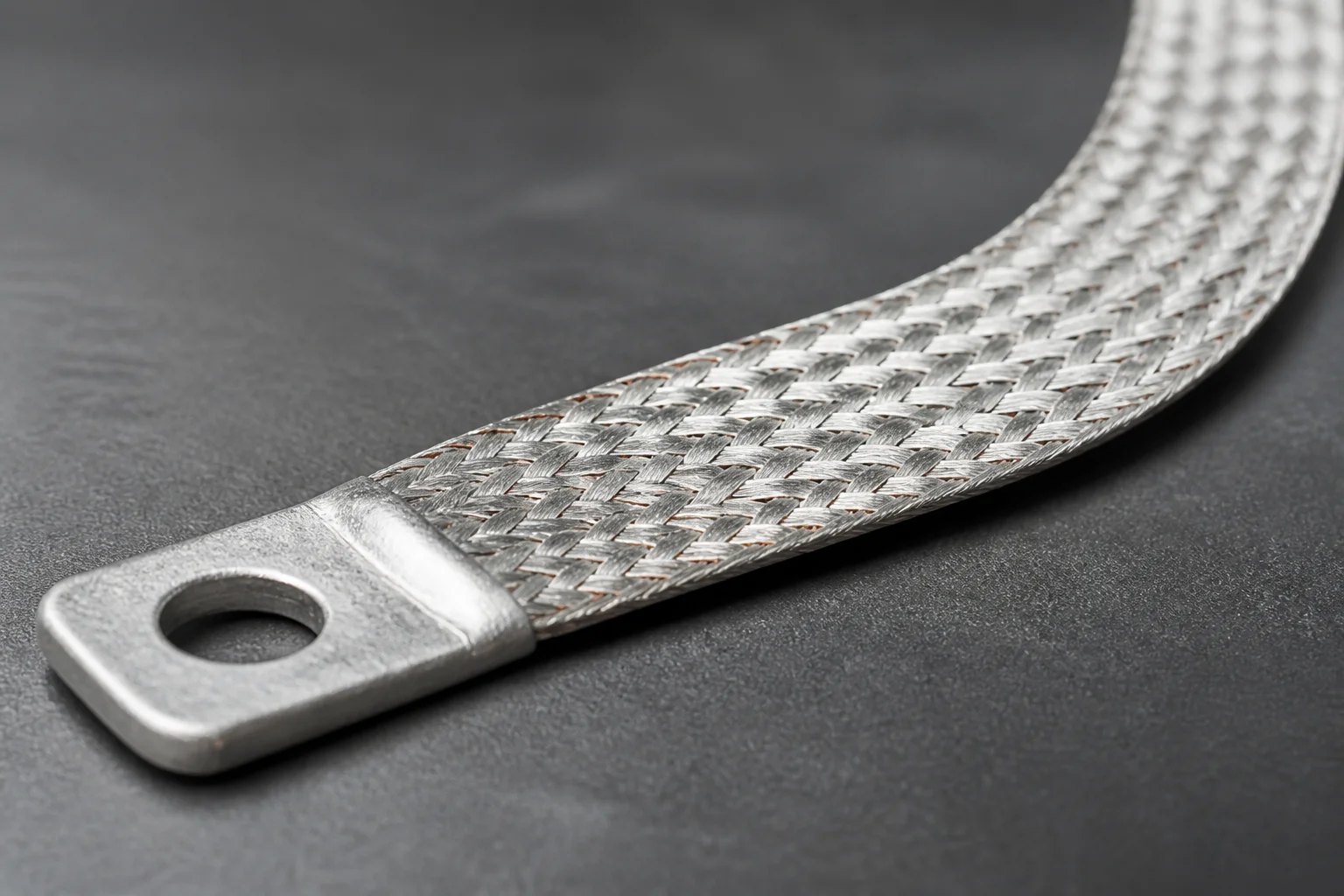
Tin plating prevents that oxidation and corrosion and keeps electrical performance stable in humidity, salt spray, and polluted industrial atmospheres. On a tin-plated braided busbar the plating covers the individual strands, so the protection extends through the weave rather than sitting only on the outside.
Insulation options and what to specify
- PVC dip or extrusion. Economical, good mechanical protection, well established on rigid and semi-flexible parts.
- TPE and other elastomers. More flexible and more temperature-tolerant than PVC, which matters on a part that is designed to move.
- Heat-shrink sleeving. Fast to apply and reworkable, and common on braided connections.
- Halogen-free compounds. Specified where fire, smoke, and toxicity performance matters, such as rail interiors and enclosed public infrastructure.
Two things belong in the specification and are often left out. First, the flammability rating — "insulated" says nothing about what the material does in a fault. Second, the temperature rating of the insulation relative to the conductor's own operating temperature, because the insulation is usually the limiting component, not the copper.
Where insulated flexible busbars are used
- Electric vehicle battery packs — module interconnects and pack-level links that must survive continuous vibration.
- Energy storage systems — container and rack connections where thermal cycling is constant.
- Switchgear and distribution cabinets — serviceable links between rigid busbars and between compartments.
- Rail transit — traction and auxiliary power connections under continuous shock and vibration.
- Inverters and power electronics — high-current DC links where a low profile and a controlled bend are both required.
- Telecommunications and data centre power — battery and rectifier interconnects.
When a flexible busbar is the wrong answer
Flexible busbars are not a universal upgrade, and specifying one where a rigid bar would do simply adds cost.
If both connection points are fixed and rigidly mounted, the assembly does not vibrate, and the parts are dimensionally repeatable, a solid busbar is cheaper, stiffer, and easier to support. If the run is long and needs structural support or a defined shape, rigidity is a feature. And where the current path must also act as a structural member of the enclosure, a flexible link cannot take that role.
The correct question is not "which is better" but "is there relative movement between the two points, and does it need to be absorbed?" If yes, be flexible. If no, be rigid and save the cost.
Specification checklist
- Current rating and duty cycle — continuous, plus the surge the link must survive.
- Cross-section — for a foil stack, the number and thickness of foils; for a braid, the strand construction and the flat width.
- Overall length, and the terminal-to-terminal distance in the installed position.
- Terminal detail — hole diameter, hole pitch, whether the ends are compressed and drilled, tinned, or fitted with pressed lugs.
- Bend requirement — the radius the part must follow, and in which plane. This often decides foil-stack versus braid.
- Insulation — material, wall thickness, temperature rating, and flammability rating.
- Plating — tin, nickel, or bare, and the plating thickness if the joint is thermally critical.
- Documentation — material certificates, dimensional reports, and the standard the part is documented against.
Why the joining process decides whether the part is good
Two flexible busbars can share a drawing and behave completely differently, because in a flexible part the joint is the product.
For foil-stack and laminated parts, the ends and the internal bonds are made by diffusion welding or laser welding. These processes are used because they produce a smooth joint with a small heat-affected zone, which removes the risk of virtual or false welds — the defects that pass a visual inspection and then fail after thermal cycling. The practical benefit is a joint with low internal resistance and low heat generation, and that is what determines service life.
Cutting tolerance matters too. High-precision laser cutting should hold a stated tolerance around ± 0.1 mm. On a flexible link with a drilled terminal at each end, hole position error directly translates into a joint that has to be forced during assembly.
Zhejiang Zhongyan New Energy Co., Ltd. manufactures insulated flexible busbars and copper braided busbars from high-purity oxygen-free copper at 99.95% or higher, using high-precision laser cutting, high-power diffusion welding, and laser welding, with a stated cutting tolerance of ± 0.1 mm. The company is certified to ISO and IATF 16949 and supports development from customer drawings and samples.
FAQ
What is the difference between a flexible busbar and a rigid busbar?
A rigid busbar is a solid bar used where both connection points are fixed. A flexible busbar is built from a stack of thin copper foils or a woven braid, so it can absorb vibration, thermal expansion, and assembly misalignment between two points that move relative to each other.
What is an insulated flexible busbar made of?
A flexible copper conductor — laminated foil or woven braid — with the flexible middle section covered by a PVC, TPE, or heat-shrink sleeve, plated with tin where corrosion resistance is required, and left bare at the drilled terminal ends for the electrical connection.
Can a flexible busbar carry as much current as a solid bar of the same size?
A laminated foil-stack busbar is a flat, high-fill conductor and comes close to a solid bar of the same cross-section. A braided tape has a slightly lower fill factor because of the weave, so it needs a slightly larger section for the same current. Specify the current requirement and let the manufacturer size it.
Why is tin plating used on flexible copper busbars?
To prevent the copper from oxidising. Oxide raises resistance at the joint and therefore temperature, so on the tin-plated surface the plating keeps the connection stable in humid, coastal, and polluted environments.
Does a flexible busbar need a support?
In most installations the flexible section is left free so it can move, while the ends are bolted hard to their terminals. Where the run is long, a support or guide is used to control the loop without locking the part rigid.
Can flexible busbars be made to a custom length and hole pattern?
Yes, and that is the normal way they are bought. Send the drawing with the terminal-to-terminal distance, hole diameter and pitch, current requirement, and insulation specification, and the part is built to that drawing.
Send us your drawing
Zhejiang Zhongyan New Energy Co., Ltd. manufactures insulated flexible busbars, composite laminated busbars, CCS integrated busbars for EV battery packs, copper braided busbars, stranded copper connectors, and battery storage connectors for power transmission and distribution, electric vehicles, rail transit, telecommunications, and energy storage.
Send us your drawing or a sample and we will return a manufacturability review and a quotation against your tolerance, plating, insulation, and documentation requirements.
Driven by the development of new energy and aiming for "zero carbon".
Copyright © Zhejiang Zhongyan New Energy Co., Ltd. All Rights Reserved.
