 English
 Español
Grounding Busbar Guide 2026: Earthing Bars and Braided Copper Ground Straps Explained
Earthing is the one part of an electrical installation that is specified last, installed quickly, and inspected least. It is also the part that has to work perfectly the first time it is needed — during a fault.
This guide covers what a grounding busbar (earth bar) does, why the connection to it is almost always made with a flexible braided copper strap rather than a solid bar, how to specify both, and the installation details that decide whether the earth path is actually reliable.
Content
- What a grounding busbar is for
- Why the earth connection is usually made with a braided strap
- Earth bar, braided strap, or solid conductor — choosing the right component
- Why tin plating matters more here than anywhere else
- What to specify before you request a quotation
- Installation details that quietly decide whether the earth path works
- Documentation worth asking for
- FAQ
- Send us your drawing
What a grounding busbar is for
A grounding busbar — also called an earth bar, ground bar, or earthing bar — is a metal bar, usually copper, mounted inside an enclosure or on a structure, whose single job is to give every metal part that must be earthed a common, low-impedance connection point.
It does two distinct things:
- Fault current return. When insulation fails, the fault current has to return to the source through a defined path so the protective device operates. If that path is not low-impedance, the device may not trip, and the fault becomes a fire risk instead of a brief event.
- Equipotential bonding. Every exposed conductive part — the enclosure, the door, a mounting plate, a cable gland plate, a frame — is bonded to the same bar, so that no dangerous potential difference can exist between them and touch nothing becomes live.
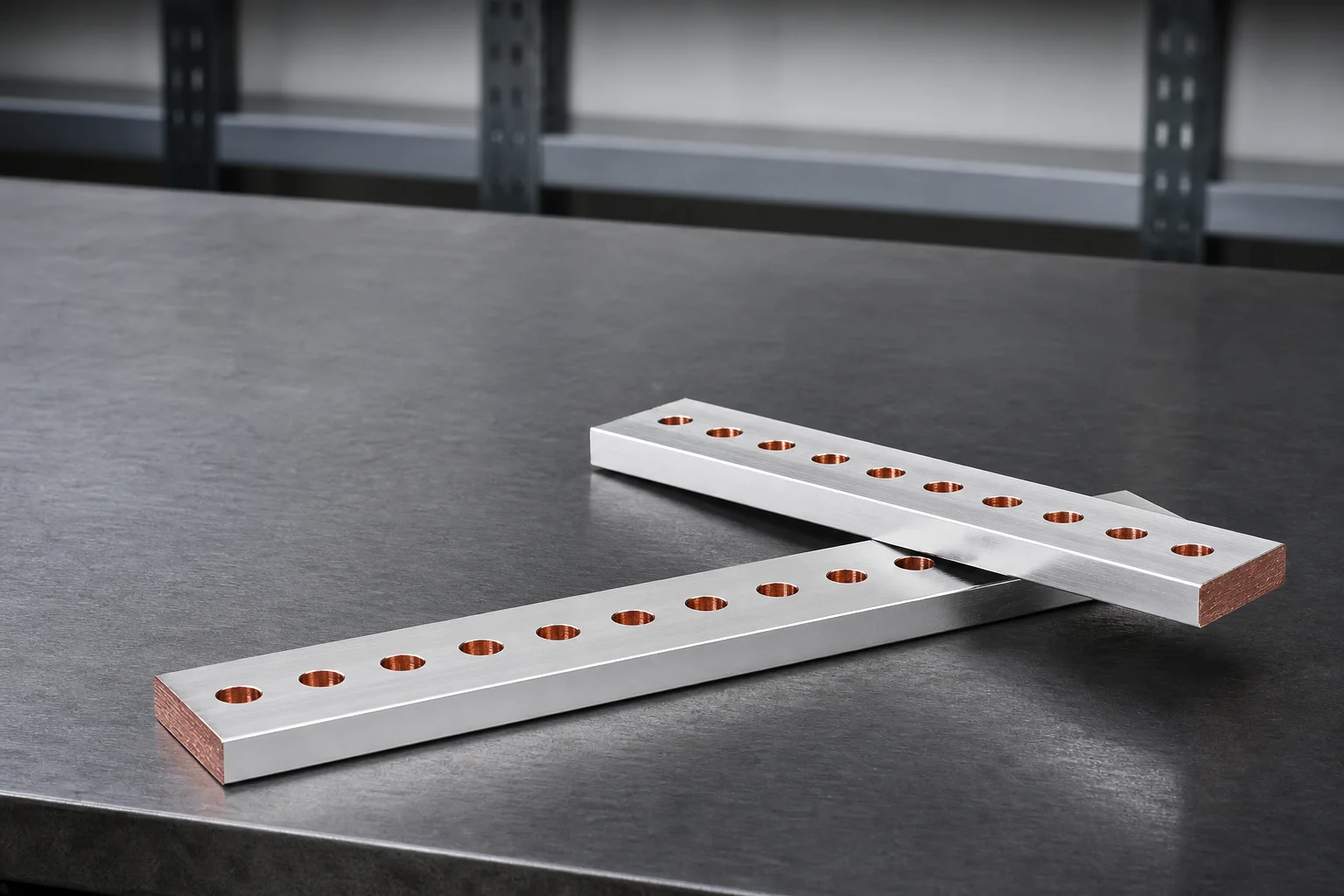
That second role is where most real-world failures hide. A fault return path is usually sized and checked. The bonding of a door, or of a removable panel, is frequently an afterthought — and it is exactly the connection that has to survive being opened and closed for the life of the installation.
Why the earth connection is usually made with a braided strap
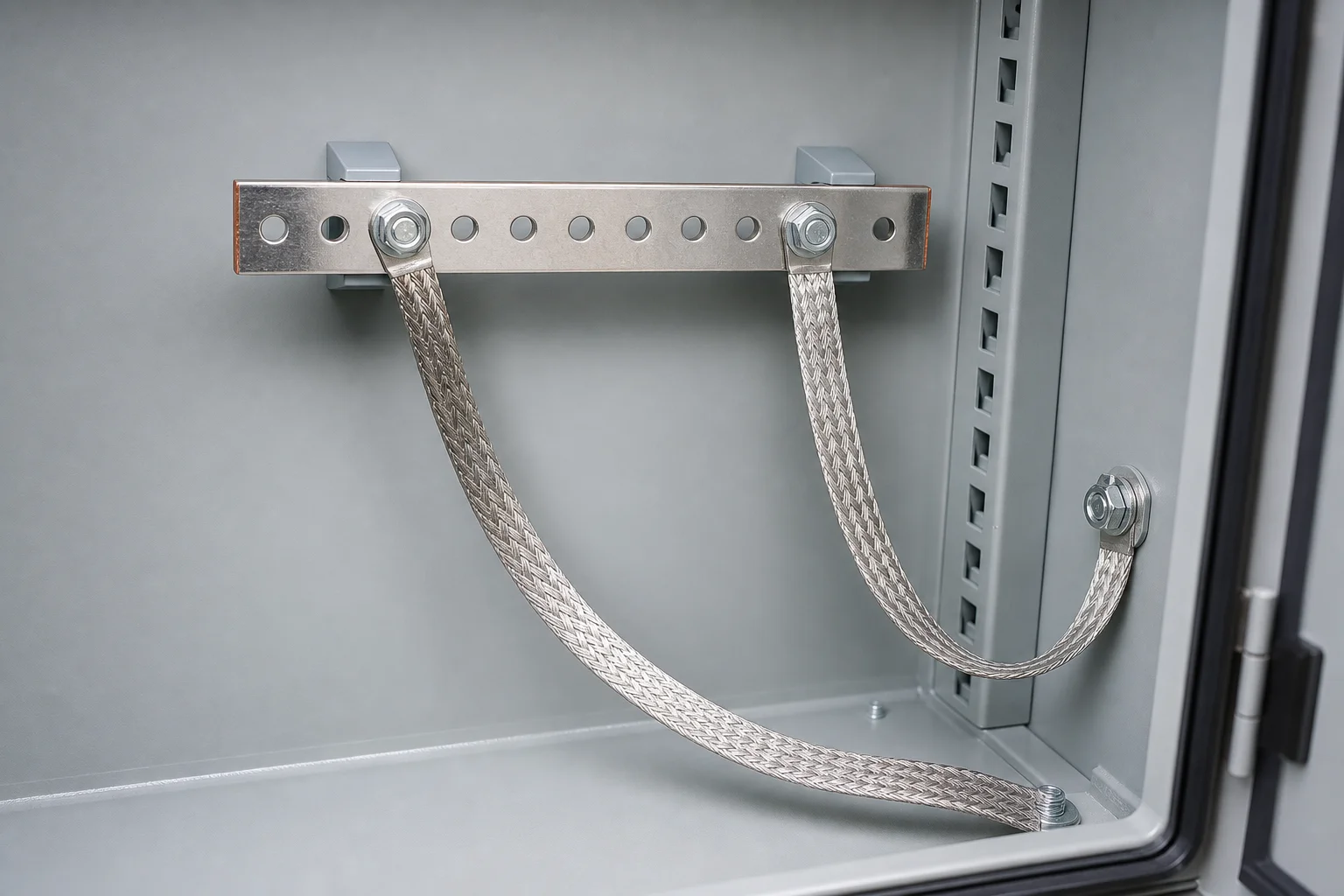
Look inside almost any industrial enclosure and you will find the earthing connections made not with solid copper bar but with flat braided copper tape — often tinned, with a pressed lug at each end.
That is not a cost shortcut. It is because the earth connection has to tolerate movement that a solid bar cannot:
Doors and hinged panels. A door swings hundreds or thousands of times. A solid conductor spanning a hinge line work-hardens and fractures. A braided strap flexes without fatigue because the movement is distributed across thousands of individual strands rather than concentrated in one solid section.
Vibration. In vehicles, rail equipment, generator sets and rotating machinery, a rigid link transmits vibration into its bolted joints. A braided strap absorbs it, so the joint does not loosen and the conductor does not crack at the lug.
Thermal cycling. Enclosures heat and cool with load, and dissimilar materials expand differently. A flexible strap accommodates that movement instead of resisting it.
Assembly tolerance. Bonding a removable plate to an earth bar means bridging two points whose relative position varies from unit to unit. A braid takes up that variation; a rigid bar has to be remade.
Earth bar, braided strap, or solid conductor — choosing the right component
| Earth bar (grounding busbar) | Braided copper strap | Solid copper conductor | |
|---|---|---|---|
| Role | The common bonding point inside an enclosure or on a structure | A flexible link between two bonding points | A fixed, rigid connection or run |
| Movement | Fixed — bolted to the enclosure | Absorbs movement in all directions | None; must be supported |
| Typical use | Distribution boards, panels, cabinets, equipment frames, substation earth bars | Door and panel bonding, vibration-exposed equipment, removable assemblies | Fixed internal runs, risers, fixed links |
| Best material | Copper, usually tin-plated in humid or outdoor locations | Tin-plated copper braid with pressed lugs | Copper, sometimes tin-plated |
In practice the three are used together: a tin-plated copper earth bar as the hub, braided straps to everything that moves, and solid conductors for fixed internal runs.
Why tin plating matters more here than anywhere else
An earth connection can sit unused for years and then be called on once. That is the worst possible duty for a bare copper joint.
Copper oxidises. The oxide layer is not a good conductor, and at a joint that has been sitting idle it raises resistance precisely when the fault current arrives. In a damp plant room, a coastal installation, an outdoor cabinet, or a vehicle underbody, that process is faster and more aggressive.
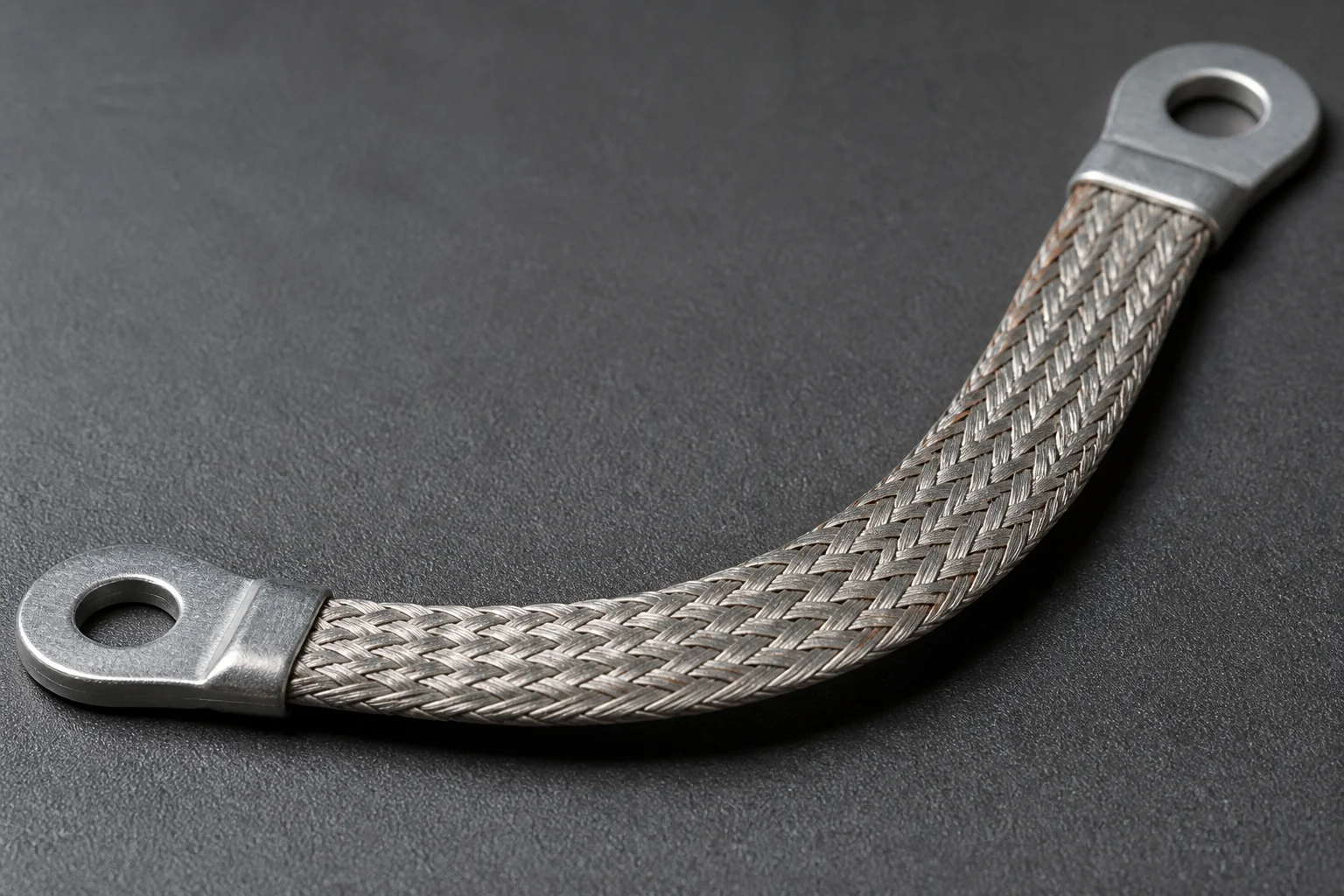
Tin plating solves it. On a tin-plated braided earth strap the plating covers every individual strand, so protection reaches through the weave rather than only sitting on the outside. The result is an earth path whose resistance stays stable in humidity, salt spray and polluted industrial atmospheres — which is exactly the environment where earthing is most likely to be relied on.
Tin plating also helps at dissimilar-metal joints, where the contact between copper and a plated steel enclosure or a galvanised structure would otherwise encourage galvanic corrosion.
What to specify before you request a quotation
- Fault current and its duration. The earth path must survive the fault long enough for the protective device to operate, without melting or annealing at the joints. Specify the prospective fault current and the clearing time, not just "earthing."
- Required cross-section. Usually derived from the phase conductor size and the fault duty by the applicable wiring regulation — state the requirement rather than leaving it to the supplier.
- The number and spacing of connection points. For an earth bar, hole count, hole diameter and pitch. For a strap, the lug bore and the distance between lug centres.
- Termination type. Pressed lugs, welded ends, bare drilled ends, or a bolted palm. This changes both the tooling and the inspection method.
- Plating. Tin, nickel, or bare — and the plating thickness where the joint is thermally or galvanically critical.
- Insulation. Clear, or sleeved where the earth link must be protected from accidental contact or mechanical damage. If insulated, state the temperature and flammability rating.
- Mounting and orientation. How the bar or strap is fixed, and which direction the strap must bend.
- Documentation. Material certificates, dimensional reports, plating thickness, and the standard the finished part is documented against.
Installation details that quietly decide whether the earth path works
A correctly specified earth bar and strap can still fail at the joint. These are the points that matter:
- Clean, prepared contact surfaces. Paint, oxide, oil and plating damage all raise joint resistance. Bonding to a painted enclosure panel requires a properly prepared, bare contact area — not a bolt through the paint.
- Correct torque. A loose bolt is high resistance; an over-torqued bolt deforms the lug. The manufacturer's torque figure exists for a reason.
- Dissimilar metals. Copper against galvanised steel or aluminium in a damp location needs plating, a bimetallic interface, or an antioxidant compound to prevent galvanic corrosion.
- Star washers and locking. Earth connections vibrate loose more often than they corrode. Mechanical locking belongs in the design.
- Minimum bend radius. A braided strap should be routed with a gentle loop, not pulled tight around a corner, so movement is absorbed by the weave rather than concentrated at the lug.
- Bonding the moving parts. Doors, hinged covers and removable panels each need their own bonding strap. With a single strap per panel, the failure of that one connection removes the protection for everything on that panel.
Documentation worth asking for
- Material certificates confirming the conductor grade — high-purity oxygen-free copper at 99.95% or above is the normal expectation.
- Plating thickness and adhesion results, which is what actually determines the corrosion performance.
- A dimensional report against your drawing, including hole position and lug bore.
- The manufacturer's declared cutting tolerance. Zhejiang Zhongyan New Energy Co., Ltd. holds a stated laser cutting tolerance of ± 0.1 mm, which matters on an earth bar where a row of holes must line up with a row of terminals.
FAQ
What is the difference between a grounding busbar and an earth bar?
They are the same thing under different names — also called a ground bar. It is the common bonding point inside an enclosure or on a structure to which all parts that must be earthed are connected.
Why use a braided copper strap instead of a solid copper bar for earthing?
Because the connection usually has to tolerate movement. Doors hinge, equipment vibrates, assemblies thermally cycle and removable panels do not locate exactly. A braided strap flexes without fatigue; a solid bar concentrates the stress and eventually cracks or loosens its joint.
Should an earth bar be tin-plated?
In damp, coastal, outdoor or polluted environments, yes. Tin plating stops the copper from oxidising, and an idle earth connection that has oxidised will have raised resistance exactly when fault current arrives. Bare copper is acceptable only in dry, controlled locations.
How is the cross-section of an earthing conductor determined?
It is derived from the prospective fault current, the duration the fault must be carried, and the size of the associated phase conductors, following the wiring regulation that applies to your installation. State those inputs to the supplier rather than selecting a size by eye.
Does an earthing bar need to be a specific length or hole pattern?
No — the bar is built to the enclosure. Give the hole count, diameter, pitch and bar length, and the bar is machined to that drawing. Custom patterns are the normal way these parts are bought, not a special order.
What is the difference between earthing and bonding?
Earthing connects the system to the general mass of earth. Bonding connects conductive parts to each other so they sit at the same potential. A grounding busbar normally serves both purposes within one enclosure.
Send us your drawing
Zhejiang Zhongyan New Energy Co., Ltd. manufactures copper and aluminium busbars, tin-plated copper braided busbars and braided tape, insulated flexible busbars, laminated busbars, CCS integrated busbars, and battery storage connectors for power transmission and distribution, electric vehicles, rail transit, telecommunications, and energy storage.
Send us your earth bar drawing or your bonding strap dimensions — lug bore, lug centre distance, cross-section and plating — and we will return a manufacturability review and a quotation against your documentation requirements.
Driven by the development of new energy and aiming for "zero carbon".
Copyright © Zhejiang Zhongyan New Energy Co., Ltd. All Rights Reserved.
