 English
 Español
Busbar for Electrical Panels and Switchboards Guide 2026: Sizing, Specification and Installation
In an electrical panel, the busbar system is the part that everything else depends on. Breakers, meters, surge protection, outgoing ways — all of them connect to the same copper bars, and the whole assembly's current rating is set by those bars and the joints bolted to them.
This guide covers the busbar system inside a distribution panel or switchboard, what actually determines the bar's size, how it should be mounted and connected, and what to specify when you buy bars for panel building.
Content
The busbar system inside a panel
A panel busbar system is not a single bar. It is a set of distinct conductors, each with a different job:
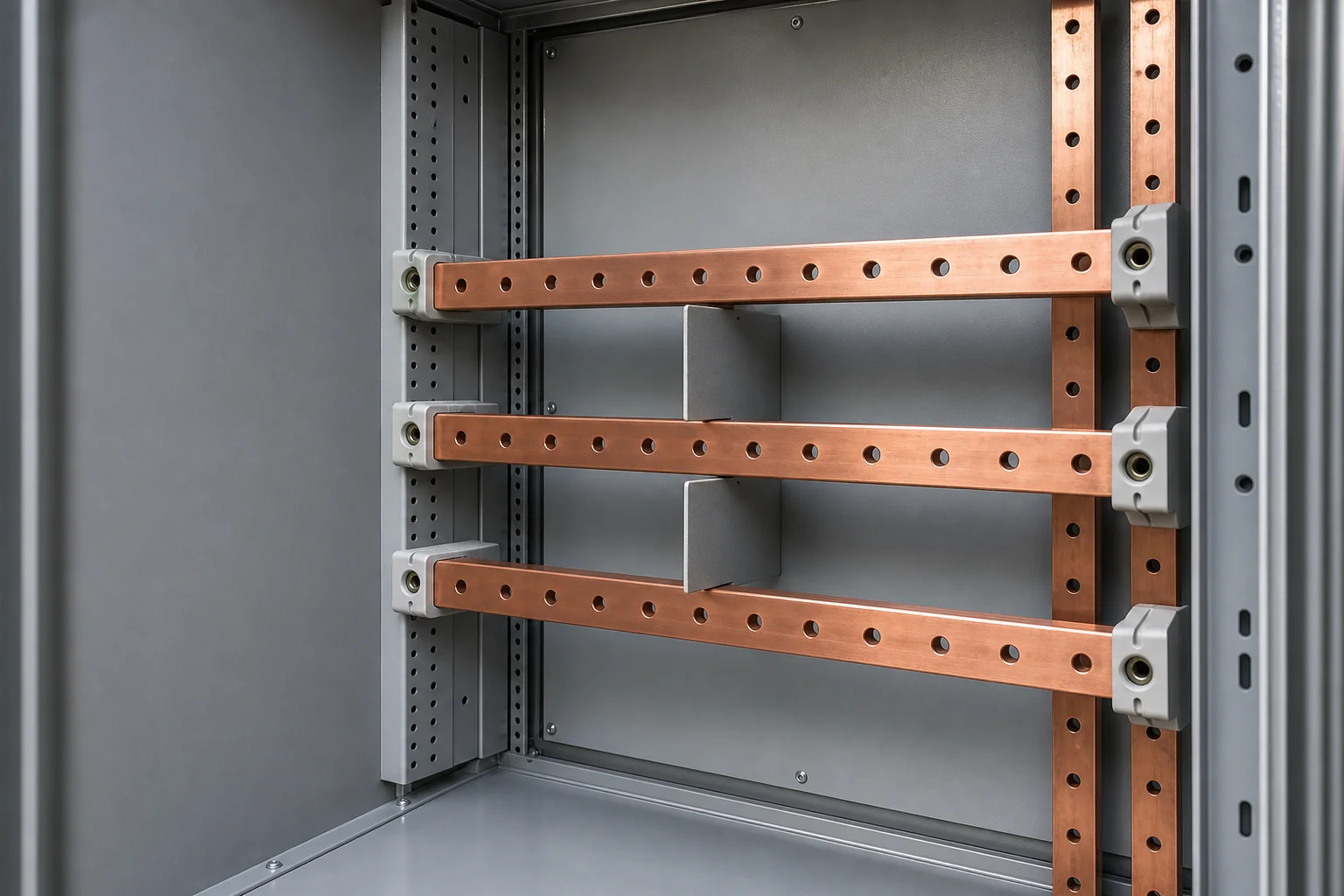
- Phase bars. One bar per phase, running horizontally through the panel to feed the incoming device and every outgoing way. These carry the load current and must also withstand the short-circuit current until the protective device clears it.
- The neutral bar. Carries the return current in single-phase and unbalanced three-phase installations. Where harmonics are significant, it may need to be the same size as the phase bars rather than smaller.
- The earth bar. The common bonding point for the enclosure and every circuit's protective conductor. It normally carries no current at all — until there is a fault.
- Risers and tap-offs. The vertical bars and short links that take current from the main horizontal run to individual devices or to a second section of the panel.
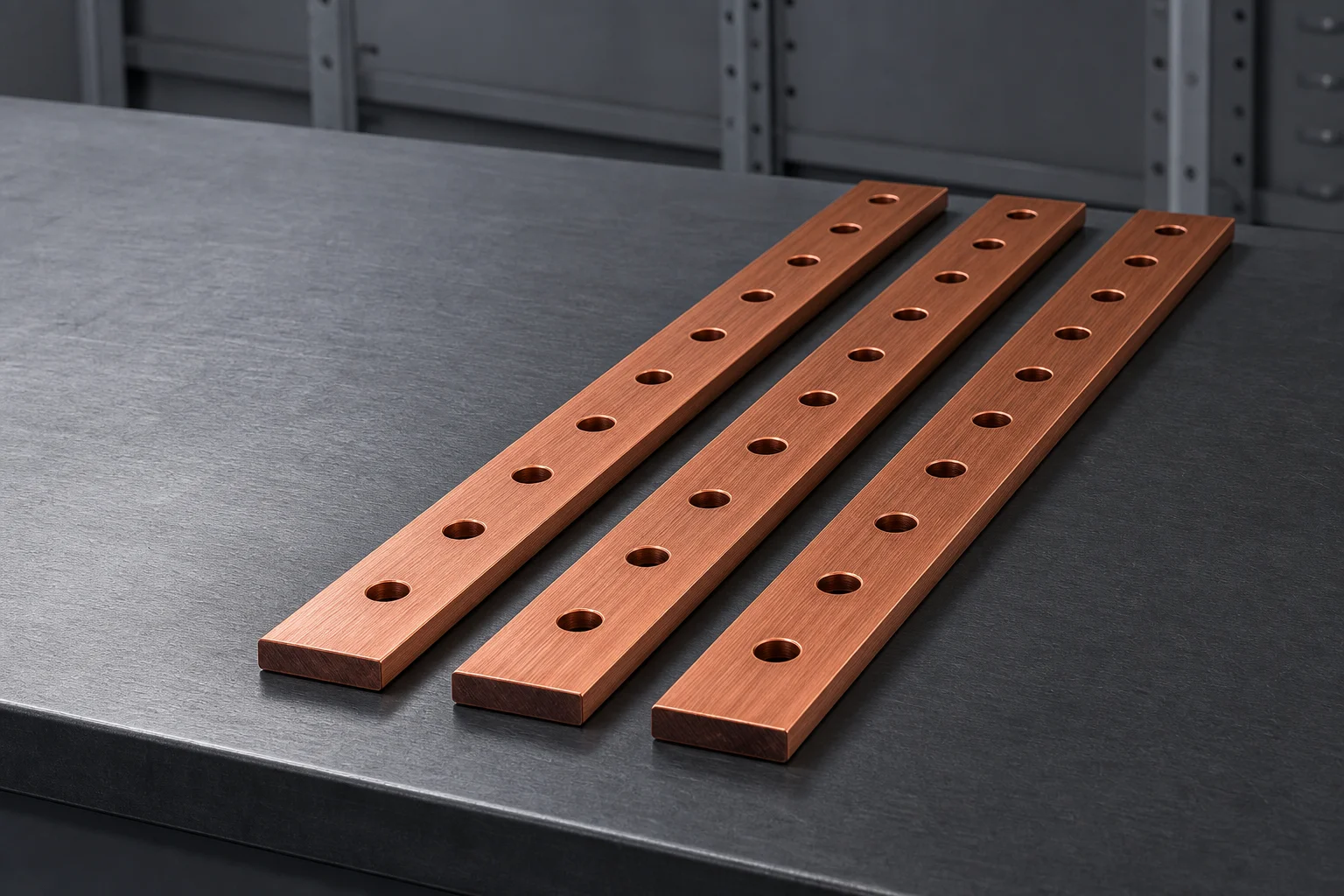
Specifying them as a set rather than as separate purchases is what makes the assembly fit together: the hole pitch on the phase bars has to match the tap-off positions, and the earth bar has to reach every section of the enclosure.
Copper or aluminium for panel busbars
Copper is the default for panel work, and for good reasons: it needs a smaller cross-section for the same current, it takes a reliable bolted joint without special treatment, and it is dimensionally stable in a bar of practical thickness.
Aluminium is lighter and cheaper per kilogram and is widely used in larger, weight-sensitive assemblies. It has two practical consequences in a panel: it needs a larger cross-section for the same current, and its oxide layer forms immediately on an exposed surface, so joints need plating or an antioxidant treatment and proper surface preparation. Where weight is not the driver, copper usually wins on total installed cost.
What actually determines the size of a panel busbar
Busbar sizing is where panel builders most often reach for a table and stop thinking. A table describes one set of conditions. Your panel has its own:
- Load current, continuous and peak. The continuous rating is not the whole requirement — a panel serving a load with high starting current or a high duty cycle needs more margin.
- Ambient temperature inside the enclosure. The temperature inside a closed panel with other heat-producing devices is not the temperature of the room. A bar chosen from a table rated at 35 °C may be undersized in a 60 °C enclosure.
- Permitted temperature rise. The limit your specification or the customer's acceptance criteria impose on the bar's surface temperature above ambient. A tighter limit means a bigger bar.
- Installation conditions. Bars in free air dissipate heat much better than bars crowded inside a closed enclosure, painted, sleeved, or grouped closely with other bars.
- Short-circuit withstand. The bar and its supports must survive the prospective fault current for the clearing time — both thermally and mechanically, because the magnetic forces between parallel bars during a fault are substantial.
- Harmonics. Non-sinusoidal current increases heating for the same RMS value, and can load a neutral far beyond a simple balanced-load calculation.
Because these factors interact, sizing should be confirmed against the assembly standard and the enclosure's design conditions, not assumed from a generic table. If you are buying bars rather than designing the panel, state the continuous current, the ambient inside the enclosure, the permitted temperature rise and the short-circuit duty, and let the supplier confirm the cross-section.
Mounting: supports, barriers and spacing
How the bar is mounted changes both its electrical performance and its safety.
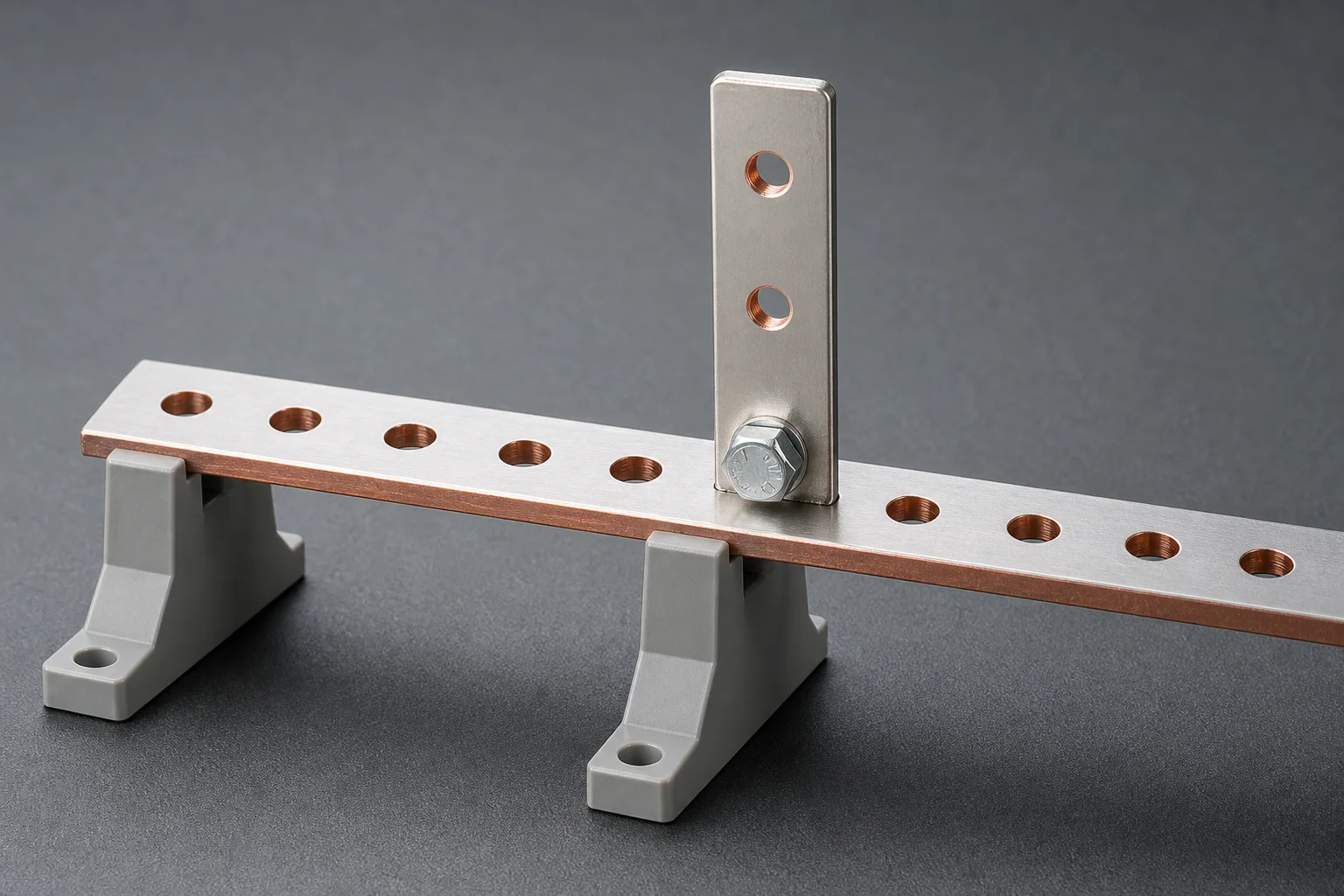
Insulating supports. The bar sits on moulded insulating supports that hold it clear of the enclosure and at the correct height. Support spacing has to be close enough to resist the mechanical forces of a short circuit, not just to carry the bar's weight.
Phase barriers. Insulating barriers between phases prevent accidental contact between bars, between bars and tools, and between bars and the arc of a fault. They also allow the phase spacing to be tighter, which reduces the enclosure size.
Clearance and creepage. The air gap and the surface distance between phases, and between a live bar and earthed metal, are determined by the system voltage and the pollution degree of the environment. These are design inputs, not choices to be made on the assembly bench.
Support material. The support is part of the insulation system. Its temperature rating, tracking resistance and flammability rating matter as much as the bar's electrical capacity.
Connections: where panel busbars actually fail
A correctly sized bar with a poor joint runs hot, and heat at a joint accelerates the oxidation that raises resistance further. It is a self-reinforcing failure.
The points that matter:
- Plating. Tin plating keeps the joint surface stable over years of thermal cycling and protects it in humid or polluted plant rooms. Bare copper is acceptable in dry, controlled conditions; in most real installations, tinned bars are the safer specification.
- Surface preparation. Contact faces must be clean, flat and free of oxide, paint and grease at the moment they are bolted. Cleaning immediately before assembly matters — a cleaned surface left overnight is not a cleaned surface.
- Torque. Every bolted joint has a specified torque. Under-torque leaves contact resistance high; over-torque deforms the bar and the washer and reduces the contact area.
- Dissimilar metals. Copper bolted directly to aluminium in a damp location needs a bimetallic interface or an antioxidant compound. Copper to tinned copper, or copper to plated steel, is far less problematic.
- Hole position within tolerance. In a bar with a long row of drilled holes, small position errors accumulate. If the holes do not line up with the devices, the assembler either forces the joint or reams the holes — and both destroy the joint. This is why the cutting tolerance is a real specification item, not a detail. Zhejiang Zhongyan New Energy Co., Ltd. holds a stated laser cutting tolerance of ± 0.1 mm.
- Bolt and washer quality. Plated hardware of the correct grade, with locking washers where vibration is present.
What to specify when you buy busbars for panel building
- Material and grade — copper to a stated grade and minimum copper content, or aluminium with the joint treatment named.
- Cross-section and length, for each bar in the set, including the neutral and earth bars.
- Hole pattern — count, diameter and pitch, plus whether holes are drilled, punched or tapped.
- Plating — tin or nickel, with thickness where the joint duty requires it.
- Insulation, where bars are sleeved or coated, with its temperature and flammability rating.
- Cutting tolerance, stated numerically.
- Forming — bends, offsets and end profiles, with the drawing.
- Documentation — material certificates, dimensional reports and plating results.
FAQ
What size busbar does an electrical panel need?
It depends on the continuous current, the ambient temperature inside the enclosure, the permitted temperature rise, how the bars are installed and grouped, and the short-circuit duty. There is no single size that is correct without those inputs — confirm the cross-section against your panel's design conditions and the applicable assembly standard.
Is tinned copper busbar better than bare copper in a panel?
For most real installations, yes. Tin plating keeps the joint surface stable through thermal cycling and protects it in humid or polluted environments. Bare copper is acceptable in dry, controlled rooms.
Can aluminium busbars be used in switchboards?
Yes, and they are common in larger assemblies where weight matters. They need a larger cross-section for the same current and require plating or an antioxidant treatment at every joint, because aluminium oxide forms immediately on an exposed surface.
Why does the earth bar have to reach every section of the panel?
Because every circuit's protective conductor, and every removable panel or door, has to bond to a common point with a low-impedance connection. If the bar does not reach a section, that section gets bonded through an improvised link, which is where earthing failures usually start.
Should the neutral bar be the same size as the phase bars?
Not always, but the assumption that it can be smaller needs checking. In installations with significant harmonic content or unbalanced single-phase loading, neutral current can approach or exceed the phase current. Where that is possible, specify the neutral to match.
Can busbars be supplied pre-drilled and formed to a panel drawing?
Yes — that is the normal way they are bought. Send the drawing with hole positions, pitch, bends and bar profile for each phase, neutral and earth bar, and the set is manufactured to that drawing.
Send us your panel drawing
Zhejiang Zhongyan New Energy Co., Ltd. manufactures copper and aluminium busbars, tin-plated and nickel-plated busbars, insulated flexible busbars, laminated busbars, CCS integrated busbars, braided copper earthing tape, and battery storage connectors for power transmission and distribution, electric vehicles, rail transit, telecommunications, and energy storage. The company is certified to ISO and IATF 16949 and manufactures from customer drawings and samples.
Send us the panel drawing with your current, ambient and short-circuit requirements and we will return a manufacturability review and a quotation against your tolerances, plating and documentation requirements.
Driven by the development of new energy and aiming for "zero carbon".
Copyright © Zhejiang Zhongyan New Energy Co., Ltd. All Rights Reserved.
