 English
 Español
Aluminium Busbar vs Copper Busbar 2026: Conductivity, Ampacity, Weight and When Aluminium Wins
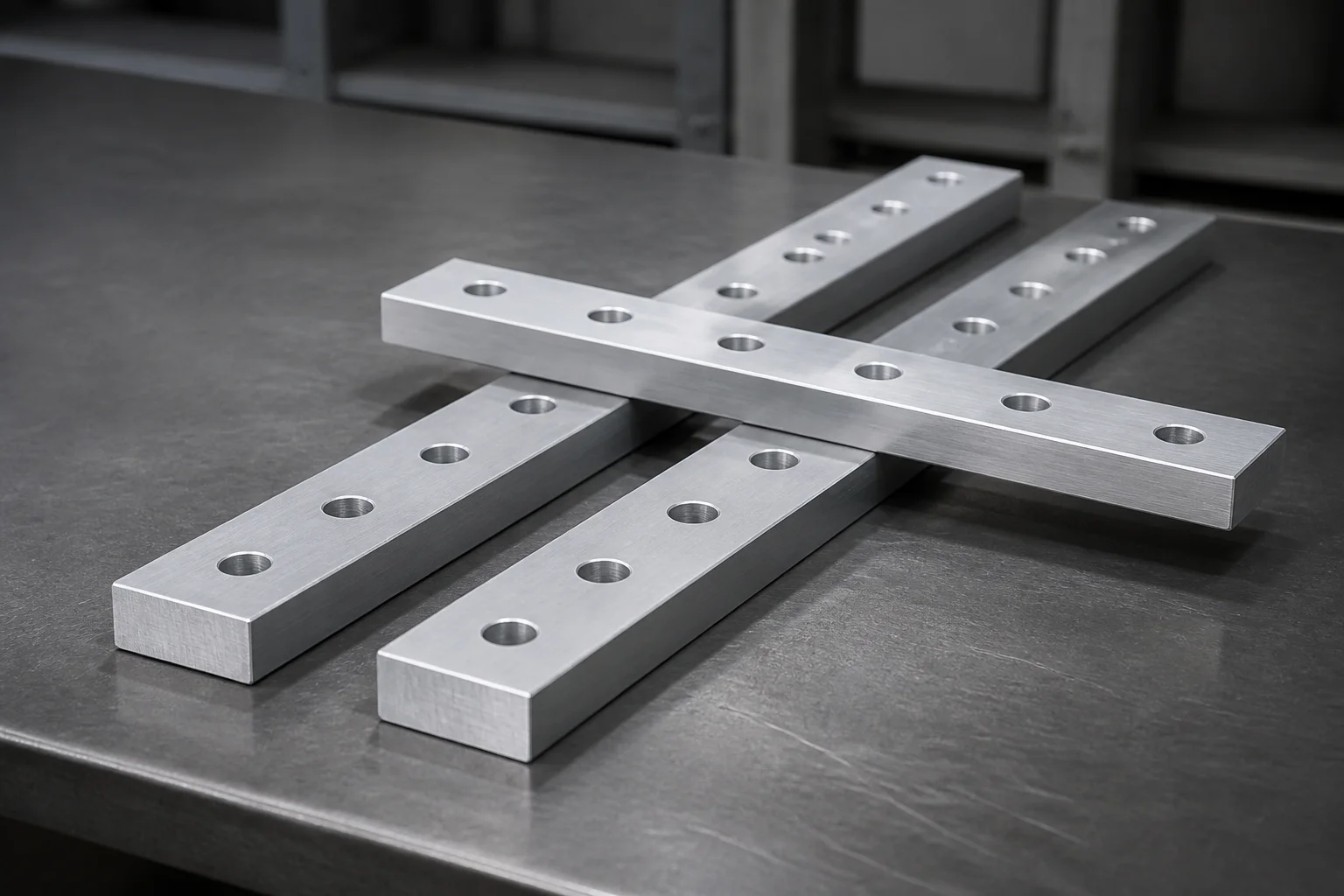
Aluminium busbars have a reputation problem in some engineering teams, inherited from the era when aluminium wiring was used carelessly in small branch circuits and failed at the terminations. Used properly, in the right application, aluminium busbar is a sound engineering choice and has been for decades — most high-voltage transmission and much switchgear buswork is aluminium.
The decision is not "which metal is better". It is a set of trade-offs between conductivity, mass, cost, joint design and the environment the bar will live in. This guide works through them in the order that actually decides the answer.
Content
The conductivity difference, in practical terms
Copper is the better conductor by a wide margin. Commercial-purity aluminium carries roughly 60 per cent of the conductivity of copper for the same cross-sectional area. That single number drives most of what follows.
The practical consequence is that an aluminium bar must be physically larger than a copper bar carrying the same current. Depending on the bar profile and the cooling conditions, that typically means a cross-section of roughly one and a half to two times the copper area — so the aluminium bar is both wider and thicker than the copper part it replaces.
That matters because the current rating of a busbar is only half the story. What actually limits a busbar in service is the temperature rise it reaches at its rated current, and temperature rise depends on the balance between the heat generated inside the bar and the surface area available to reject it. A larger aluminium bar has more surface, which partly offsets its higher resistivity, but it also takes up more space in an enclosure that may not have any to give.
Where aluminium wins
Weight
Aluminium weighs roughly a third as much as copper for the same volume. Even after the cross-section is increased to match conductivity, an aluminium bar is still substantially lighter than the copper bar it replaces — commonly on the order of half the weight for the same current-carrying duty.
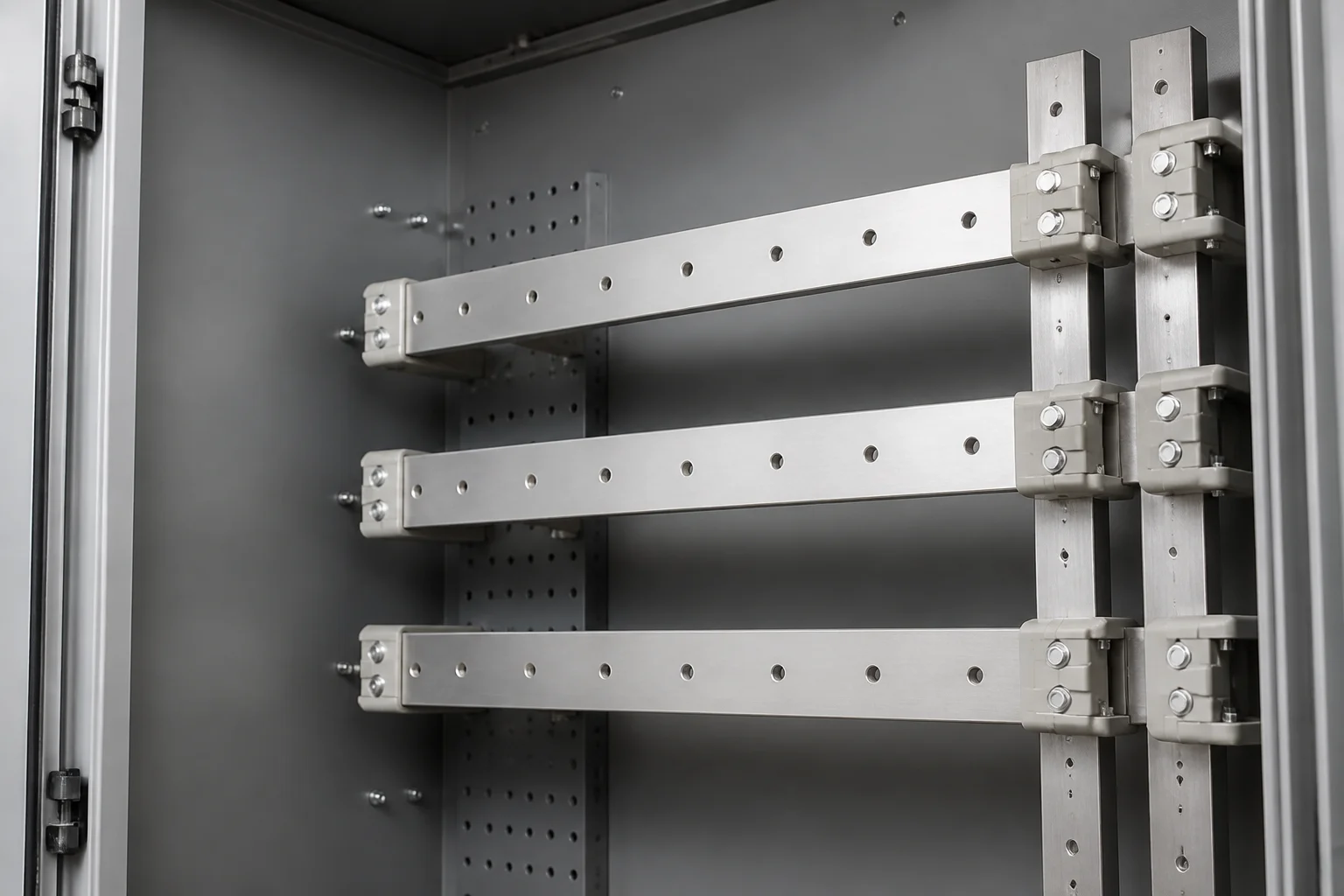
On a long horizontal bus run, that difference changes the mechanical design. Lighter bars need fewer or more widely spaced supports, impose less load on insulators and enclosure structures, and are easier to lift and position during installation. On anything that moves — rail, vehicle, transportable equipment — weight is a design constraint in its own right, not just a cost line.
Cost
Aluminium is cheaper per kilogram than copper, and it is also cheaper per unit of current-carrying capacity once the larger cross-section is accounted for, though the gap narrows considerably when you do the like-for-like comparison properly. Where the price advantage is decisive is on high-current, long-run buswork where the extra volume of metal is not a constraint: substation busbars, high-current distribution runs, and large panel busbar systems.
Availability and machining
Aluminium bar stock is widely available in a range of standard profiles and is light enough that fabricating it is physically easier. It machines quickly, although it is softer and more prone to galling and to leaving built-up edge on tooling, which means the fabricator's process discipline matters.
The real engineering problem: joints
Here is where aluminium busbar projects actually fail, and it has almost nothing to do with conductivity.
The oxide layer
Aluminium forms an oxide layer within seconds of being exposed to air. That layer is an electrical insulator with a very high melting point. Untreated, it sits between the two faces of a bolted joint and the joint's contact resistance is set by the oxide, not by the metal.
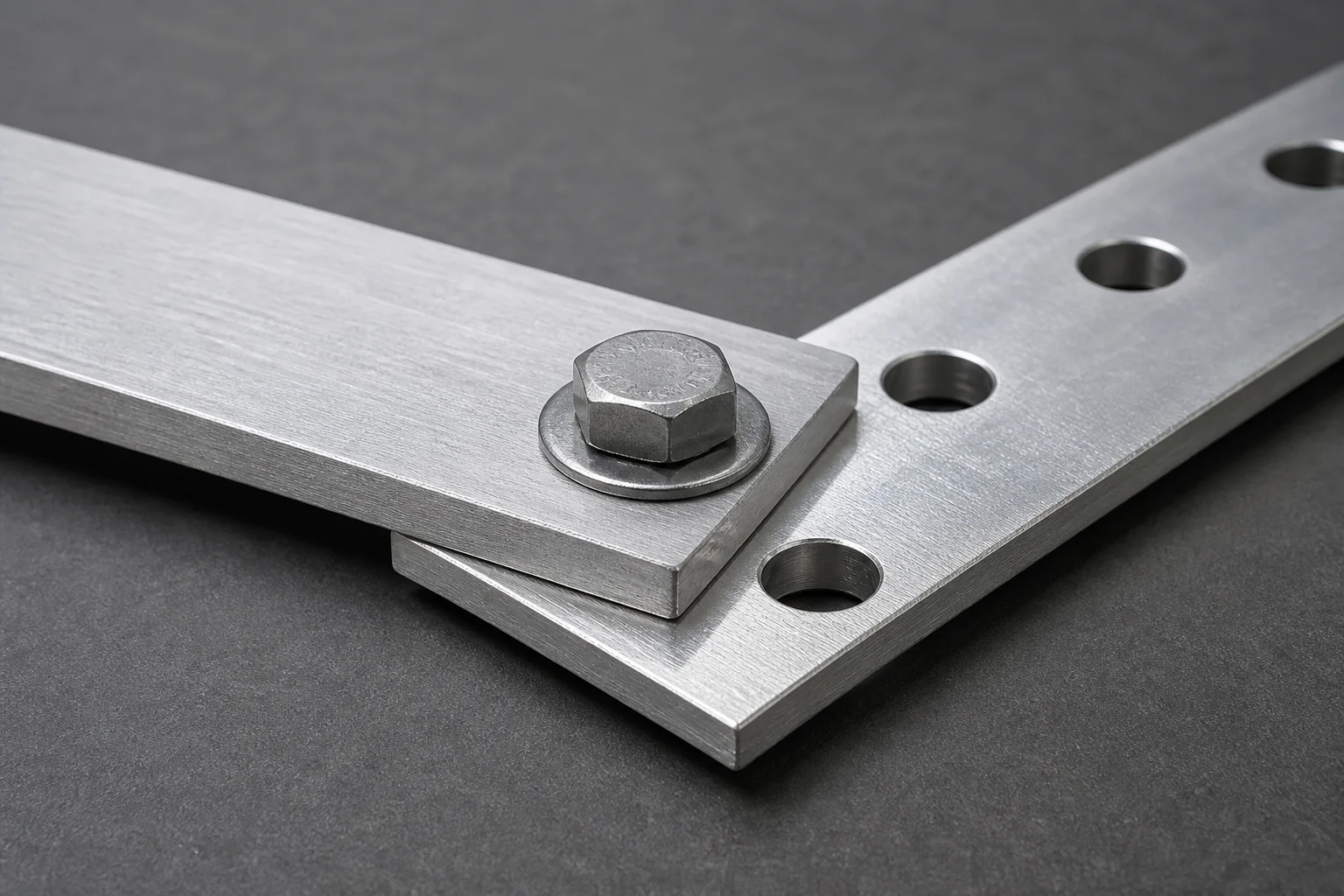
The consequence is that an aluminium joint cannot be assembled the way a copper joint is. Surface preparation is not optional, and the preparation has to happen immediately before assembly — wire brushing or abrading the contact faces, applying a jointing compound that excludes air from the freshly exposed surface, and closing the joint before the oxide can re-form.
Thermal expansion and creep
Aluminium expands and contracts more than copper for the same temperature change. In a joint that cycles with load, that movement works at the fastener. Aluminium is also more prone to creep — slow plastic deformation under sustained compressive load — which means the contact pressure delivered at installation relaxes over time and with thermal cycling.
The standard mitigations are well established: use a larger, thicker washer or a Belleville-type spring washer to maintain contact pressure as the joint settles; use more fasteners over a longer joint to reduce the load each one carries; and specify a re-torque interval as part of the maintenance schedule. Conical or disc spring washers are the usual choice precisely because they store elastic energy and keep pushing as the joint compresses.
Bimetallic joints
Connecting aluminium directly to copper creates a galvanic couple, and in the presence of moisture the aluminium is the one that corrodes. The accepted solutions are to keep the metals apart with a bimetallic transition plate, to plate one or both surfaces so the couple is broken, or to use a tinned copper interface — which is why tin-plated aluminium and copper-clad aluminium products exist as a category, rather than being a gimmick.
Copper-clad and plated aluminium
Two hybrid approaches are worth knowing about.
Tin-plated aluminium. The aluminium bar is given a tin coating. The joint faces then behave much more like a plated copper joint: the oxide problem is solved by the plating, the contact resistance is stable, and the bar can be bolted directly to a tin-plated copper bar without a transition plate. You keep most of the weight advantage and pay for a plating operation.
Copper-clad aluminium. A copper skin is metallurgically bonded over an aluminium core. Current at high frequency crowds toward the surface, so for some applications the cladding carries the useful current while the aluminium core carries the weight saving and the structural duty. For direct-current busbars in a panel, the benefit is mainly in the joint behaviour rather than in the conduction path.
Ampacity: what a chart actually depends on
Searching for an aluminium busbar ampacity chart is a reasonable instinct, and the honest answer is that no single chart is valid for every case. An ampacity figure is not a property of aluminium. It is the result of a calculation that depends on at least these variables:
- The alloy and temper. Electrical-conductor grades behave differently from structural alloys, and temper affects both resistivity and how the bar behaves when formed.
- Ambient temperature inside the enclosure. A panel in a climate-controlled room and a panel in an unconditioned outdoor cabinet are not the same thermal environment.
- Enclosure and ventilation. A bar in free air rejects heat very differently from the same bar in a sealed, densely packed enclosure.
- Grouping. Parallel bars, or bars close to other heat sources, heat each other and must be derated.
- Orientation and surface finish. Vertical bars with unobstructed faces reject heat better than horizontal bars mounted flat against a panel back sheet.
- Load duty. Continuous versus cyclic, and the duration and frequency of any overload.
- Plating or insulation. Paint, powder coating and sleeving change the emissivity and the effective radiating surface.
The consequence is that the chart you find online may be entirely correct for the conditions it was calculated against, and wrong for yours. The safe approach is to size from the applicable assembly or installation standard for your market, or to have the manufacturer confirm the rating against your actual ambient and enclosure conditions. A manufacturer who will run that calculation for your case is worth more than any downloadable table.
Where aluminium busbars are the right answer
Aluminium is usually the better choice when most of the following are true:
- The current is high and the bus run is long, so the volume of metal is significant.
- Weight matters — rail, vehicle-mounted equipment, transportable plant.
- The environment is dry and controlled, or the joint design can be properly protected from moisture.
- There is enough space in the enclosure for the larger cross-section.
- The joint can be properly prepared, torqued to specification, and maintained on a re-torque schedule.
Copper is usually the better choice when:
- Space is the binding constraint and the enclosure cannot grow.
- The joints are numerous, small, and hard to prepare consistently on site.
- The environment is humid, coastal, or otherwise aggressive, and a bimetallic joint cannot be avoided.
- The duty involves frequent thermal cycling and access for re-torquing is difficult.
- The application is a compact, high-performance connection — battery packs, power electronics, dense switchgear — where every cubic centimetre counts.
Note that "space" and "joint count" explain most real-world decisions. A substation busbar with a handful of large, accessible, properly prepared joints is an excellent aluminium application. A battery pack with dozens of small joints buried inside a sealed module is not, which is why copper dominates that application regardless of the weight saving on offer.
Specifying an aluminium busbar
If you are specifying aluminium rather than copper, these are the points to put in the specification explicitly, because the default assumptions behind a generic busbar quote will be the copper ones.
- Alloy and temper, not simply "aluminium".
- Surface treatment — bare, tin-plated, or another coating — and whether the joint faces and hole bores are included.
- Joint preparation and assembly instructions, including the jointing compound, the washer type and the torque value.
- Flatness and straightness over the full length, since the larger cross-section makes twist harder to detect visually.
- Re-torque interval as part of the delivered documentation.
- The bimetallic interfaces, stated explicitly, with the transition method agreed rather than left to site improvisation.
Frequently asked questions
Is aluminium busbar safe to use?
Yes, when it is specified and installed correctly. The historical problems came from small branch-circuit terminations made without surface preparation, torque control or re-torquing. Large aluminium busbar with properly prepared, spring-loaded joints is standard practice in transmission and distribution equipment.
Can aluminium and copper busbars be bolted directly together?
Not reliably in a damp environment without protection. The joint forms a galvanic couple and the aluminium side corrodes. The usual solutions are a bimetallic transition plate, plating one or both surfaces, or using a tin-plated interface so the contact is effectively tin-to-tin.
Does aluminium busbar need to be re-torqued?
It should be, and the interval should be part of the maintenance schedule. Aluminium creeps under sustained compression and expands more than copper under thermal cycling, so contact pressure relaxes more than it would in an equivalent copper joint. Spring washers reduce the rate of relaxation but do not remove the need for a schedule.
Why is aluminium busbar bigger than copper busbar?
Because it conducts roughly 60 per cent as well as copper for the same area. To carry the same current within the same temperature rise limit, the aluminium bar needs a larger cross-section — typically one and a half to two times the copper area, depending on conditions.
Is tinned aluminium busbar worth the extra cost?
Where joints matter, usually yes. The tin coating solves the insulating oxide layer and makes the joint behave like a plated copper joint, which removes most of the assembly risk and the bimetallic corrosion problem. You keep most of the weight saving and pay for one additional process step.
Choosing between them
The decision comes down to which constraint binds hardest. If it is cost and weight on a long, high-current run with accessible joints, aluminium is the engineering answer and always has been. If it is space, joint count or a hostile environment, copper earns its price. And if it is weight with good joint behaviour, a plated aluminium bar gives you most of both.
Zhejiang Zhongyan New Energy Co., Ltd. manufactures copper and aluminium busbars, plated and insulated variants, insulated flexible busbars, laminated and CCS busbars, and braided copper connections. Tell us your current, your enclosure conditions and your joint design, and we will help you size the right conductor rather than the default one.
Driven by the development of new energy and aiming for "zero carbon".
Copyright © Zhejiang Zhongyan New Energy Co., Ltd. All Rights Reserved.
